
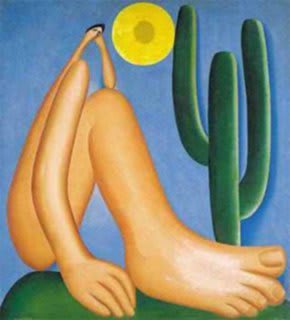
Abaporu - Tarsila do Amaral
Discover the iconic Abaporu by Tarsila do Amaral, a pioneering figure in Brazilian modern art.
Article Index
We invite you to explore the enigmatic Abaporu by Tarsila do Amaral, a seminal work of Brazilian modern art.
Created in 1928, this painting depicts a figure in a surrealistic and symbolic landscape.
Commissioned by writer Oswald de Andrade, Abaporu's inspiration sparked the antropofágico movement, which advocated for the 'devouring' of European culture to create a truly Brazilian art.
With its vibrant colors and simplified forms, Abaporu celebrates Brazilian culture and identity, remaining a source of inspiration and admiration to this day.
As we contemplate Abaporu, we are encouraged to reflect on the diversity and richness of Brazilian culture, as well as the role of art in shaping national identity.
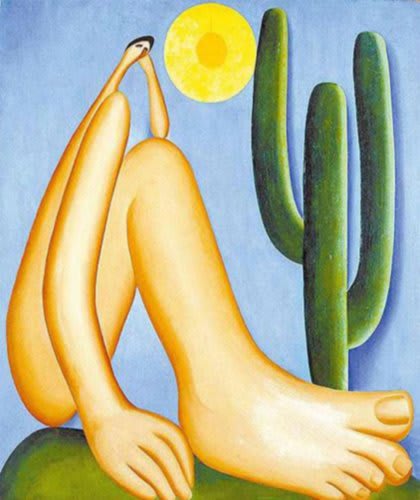
Abaporu. Tarsila do Amaral. 1928. Oil on Canvas (85x73) - Acervo do Museu de Arte Latino Americano de Buenos Aires (Fundación Constantini - Argentina)
Abaporu: A History
Tarsila decided to present the painting to her husband, Oswald de Andrade, on his birthday, January 11, 1928.
Impressed by the work, Oswald commented to poet Raul Bopp: 'It's the man planted in the earth.' They were unanimous in believing that the figure was a native of the land, coming from the forest, an antropófago.
Using the Tupi-Guarani dictionary belonging to Tarsila's father, written by Father Montaya Antonio Ruiz, they arrived at Abaporu, 'man who eats human flesh.'
Oswald de Andrade's Manifesto Antropófago, written shortly after, established the basis for the movement that was born there.
In it, the poet presents antropofagia as a metaphor for the process by which the American man, to form his own culture, 'canabalized,' digested and assimilated European civilization according to his own molds.
Although Abaporu inaugurates the Antropofágico phase of Tarsila, it was not the first work to address her concerns with the emergence of mythic forces and the search for deep roots.
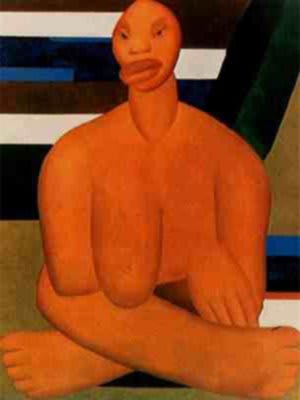
The Negra anticipates these aspects in terms of concepts and forms about five years earlier.
Later, a friend of Tarsila confided to her that the antropofágico paintings reminded her of her nightmares, and from then on, the artist identified the origin of the work.
Tarsila described Abaporu as 'a solitary, monstrous figure, enormous feet, sitting on a green plain, arm bent, resting on a knee, hand supporting the weight of the tiny head, in front of an exploding cactus flower.'
The artist related this character to the stories that the old black women from the farm used to tell her repeatedly at bedtime when she was a child.
They were stories about a room always closed, with an opening in the ceiling, from which one could hear: 'I fall, I fall.'
And a foot would fall, which the girl imagined enormous; 'I fall,' and another foot would fall.
'I fall!' and a hand would appear, and then another, and the whole body.
Abaporu presents the same hypertrophy of leg and arm as A Negra, and integrates into the landscape more than it does.
The enormous foot compensates for its precarious seat in a thinking pose, capable of such sadness that it atrophies the head and arm that support it.
Immobile due to the imbalance between its gigantism and its acuteness, it needs cactus, needs the cactus and the sun to maintain a stable relationship with the set.


