Biography of Odilon Redon: The Evolution of Color, Works, and Visionary Legacy
Biography of Odilon Redon: The Evolution of Color, Works, and Visionary Legacy
Odilon Redon always insisted that not only his work, but art in general, should inspire and not be defined in any particular form or terminology.
For him, the best was for his work as art to remain ambiguous and indefinable, it was his way of giving power to the viewer to be able to observe and form a narrative for themselves.
Guardian Spirit of the Waters - The drawing is typical of Redon's noirs in which he manipulated the charcoal medium to obtain a rich range of tones and textures. The artist employed cleaning, shaving, incision, and touches of chalk on cream-colored paper, and often allowed untouched areas of the sheet to shine through for emphasis.
A large head raised on wings floats above a calm sea, contemplating a small sailboat with enormously expressive eyes. Seagulls fly through the air and skim the surface of the water, while the water stretches out towards the distant horizon. A delicate halo surrounds the head, giving the strange creature a divine and benevolent aura, despite its brutal features. With its realistic representation of dreamlike images, this work anticipates the surrealism of the 20th century.
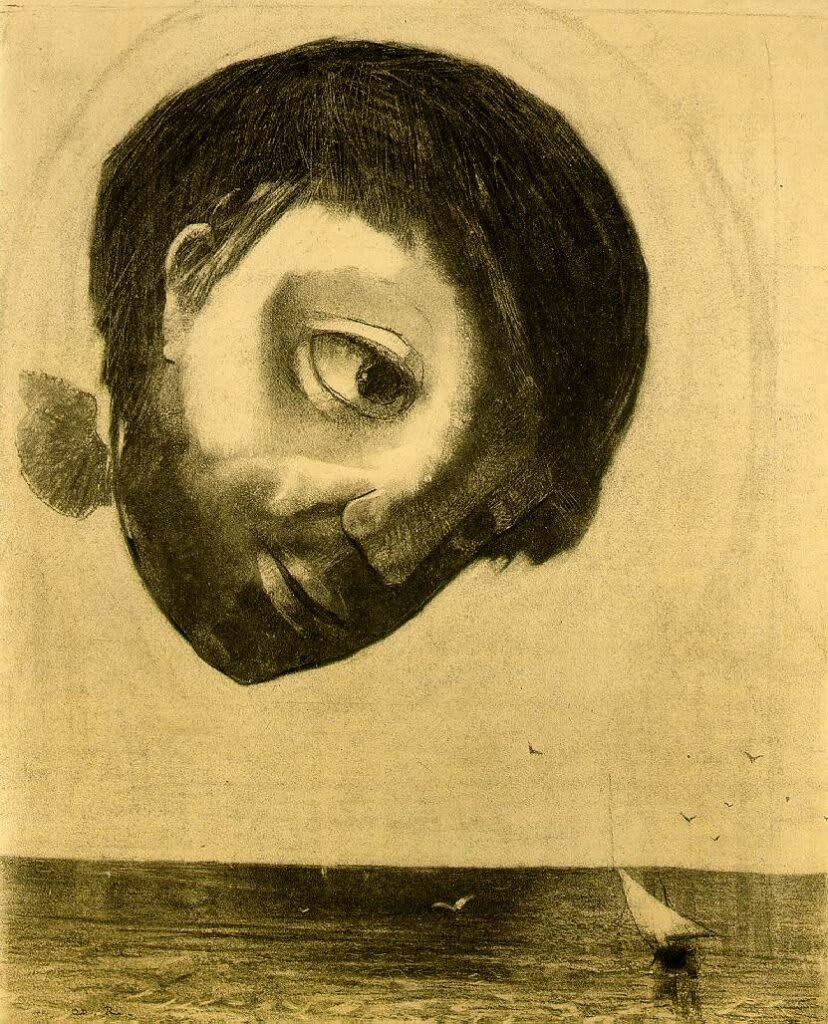
The Smiling Spider - The round and fluffy body of this figure, presents a human face, a flattened nose and a wide and smiling mouth that reveals a row of tiny teeth.
The creature leans slightly to one side on its thin legs, as if it had just descended from the ceiling by a thread of silk.
The grid pattern on the floor gives a sense of three-dimensional space, but the realism of the scene only increases the surprising effect of the subject.
A strange smiling spider with ten legs is the theme of this work.
Redon based his impression on a previous charcoal drawing, but the lithographic medium (which uses greasy ink or wax crayon applied directly to a smooth stone) was equally suitable for the artist's exploration of the application of black color.
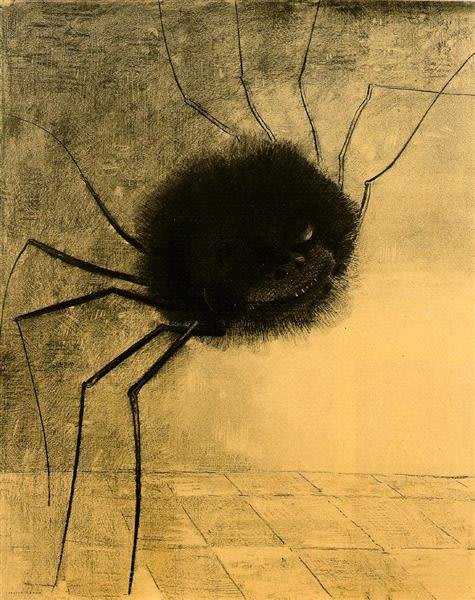
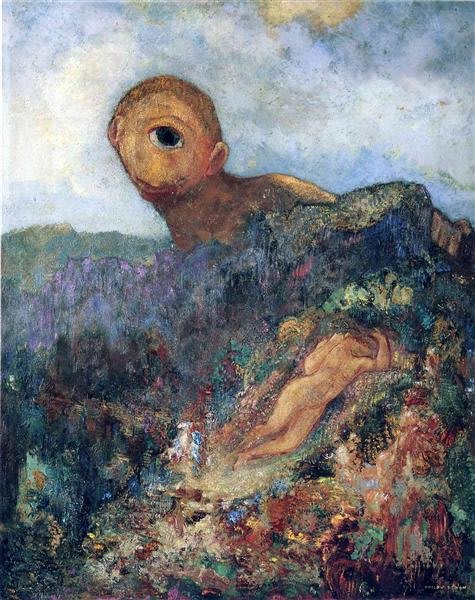
The Cyclops - Redon often depicted scenes from classical mythology in his later pastels and oil paintings, and he must have been familiar with Ovid's version of the story of Polyphemus.
In his painting, as in the poem, the Cyclops falls in love with the sea nymph. However, he should also be aware of the acclaimed works of Gustave Moreau, which portrayed the tragic story in the 1880s. Polyphemus, the mythological one-eyed monster of the Odyssey of Homer, spies behind a rocky hill while the nymph Galatea sleeps in her cave, surrounded by flowers.
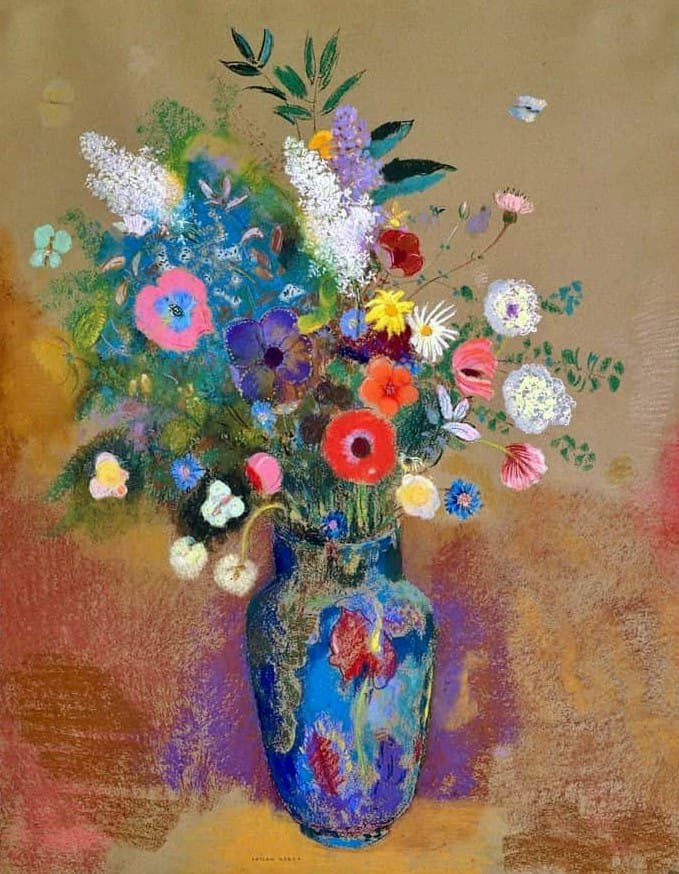
Floral Bouquet - Among the many floral still lifes that Redon created at the end of his career, this work is one of the most popular and recognizable, and was widely reproduced.
Here, a variety of brightly colored flowers, delicately drawn in pastel, bloom from a blue decorative vase, which was placed against an abstract background represented in shades of rust, ochre, violet, and pink. The vase, which is also decorated with a floral motif, seems to float in space, rather than resting on any obvious surface. Several small butterflies hover around the bouquet.
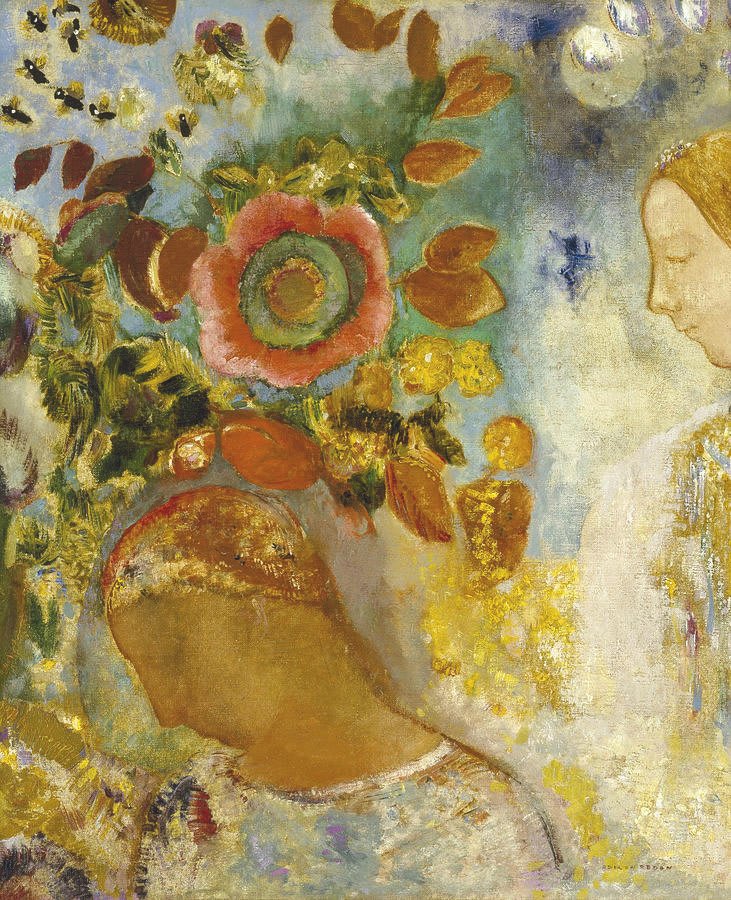
Two Girls among Flowers - The use of non-naturalistic colors by Redon in his later pastel tones and oil paintings foreshadows the development of the expressionism and abstraction. In portraits, still lifes, and decorative sets, Redon explored the expressive and suggestive powers of color. Many of these works include passages that are purely non-figurative, often seen in the ethereal chromatic backgrounds that he combined with figurative themes.
"Although recognizing the need for a basis in observed reality, true art is in a reality that is felt."