
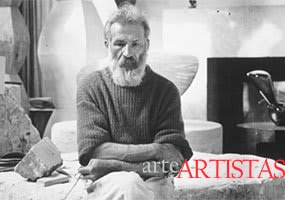
Constantin Brancusi
Constantin Brancusi: A Pioneer of Modern Sculpture
Brancusi is considered one of the most important sculptors of the 20th Century .
His visionary works often exemplify ideal and archetypal representations of his themes, in simple and reduced forms aiming to reveal hidden truths.
Unlike the imposing figure of Auguste Rodin whom he briefly assisted at the beginning of his career, Brancusi worked directly with his materials, being a pioneer in the technique of direct sculpture, instead of working with intermediaries such as plaster or clay models.
BIOGRAPHY
Constantin Brancusi was born on February 19, 1876, in Romania, in a small agricultural village of Hobitza.
He had a difficult childhood, partly due to the challenging relationship with his father, a monastery administrator, and his father's children from a previous marriage.
At the age of eleven, after several attempts to leave home, he finally did so in 1887 definitively.
After leaving home, he lived in the Romanian city of Craiova, working as a waiter and carpenter.
In 1894, he enrolled full-time at the Arts and Crafts School , where he excelled in carpentry and finally graduated with honors in 1898.
From 1898 to 1902, he studied modeling and live sculpture at the National School of Fine Arts in Bucharest, winning prizes in competitions for his work.
In 1904, he moved from Romania to Paris, having traveled most of the way on foot.
This story became part of the legend surrounding Brancusi as a peasant with an exotic heritage; the mythology was actively promoted by the artist himself, who began to wear Romanian peasant clothing, even in formal occasions, and carved all his own furniture.
From 1905 to 1906, he graduated in sculpture and modeling at the sculpture atelier of Antonin Mercie.
In 1907, he began working as an assistant in Rodin's studio, but left after only a month, explaining: "Nothing grows in the shadow of great trees" .
However, he recognized that this period in Rodin's atelier was fundamental in shaping his aesthetic as a starting point for developing his own drastically different artistic practice.
After leaving Rodin's atelier, Brancusi began to establish his own style, starting with square works such as The Kiss .
Despite sharing the same title as one of Rodin's most famous sculptures, the work was its complete opposite in material and treatment of form and theme.
In 1913, five of his sculptures appeared at the Armory Show in New York.
During this period, he lived in New York, he met Marcel Duchamp becoming an important friend, defender and collector of his sculptures.
In 1914, he began taking photographs, many of his photos were of his own atelier, recording the specific forms as he organized the arrangement of his works, which was highly significant for his creative process, as he considered the base of the sculpture as important as the sculpture itself.
From 1909, he began creating softer and more contoured sculptures in marble and bronze.
He produced multiple versions, but distinct, developed a method of creating series of versions on the same theme throughout his career, becoming a established practice in his work .
Although he lived in Paris for most of his life, making only a few trips to New York, he recognized the importance of American collectors and critics for his career, saying: "Without the Americans, I would never have been able to produce all this, nor perhaps even have existed."
GALLERY
Sleeping Muse. Constantin Brancusi. 1909
Mademoiselle Pogany. Constantin Brancusi. 1913 - Location: MOMA (New York)
Head. Constantin Brancusi. 1920
Flying Bird. Constantin Brancusi. 1928 - Location: MOMA (New York)
Fish. Constantin Brancusi. 1930. Location: Museum of Modern Art (MoMA), New York, USA
The Infinite Column. Constantin Brancusi. 1937


