
Cubism: The Artistic Revolution of Picasso and Braque (Part 1)
Cubism: The Artistic Revolution of Picasso and Braque (Part 1)
The Cubism was an artistic movement that emerged at the beginning of the 20th century with the artists Pablo Picasso and Georges Braque as its main representatives.
Thus described the art historian Ernst Gombrich: "The cubism was the most radical attempt to eliminate ambiguity and impose a reading of the image - that of a construction made by man, a colored screen".
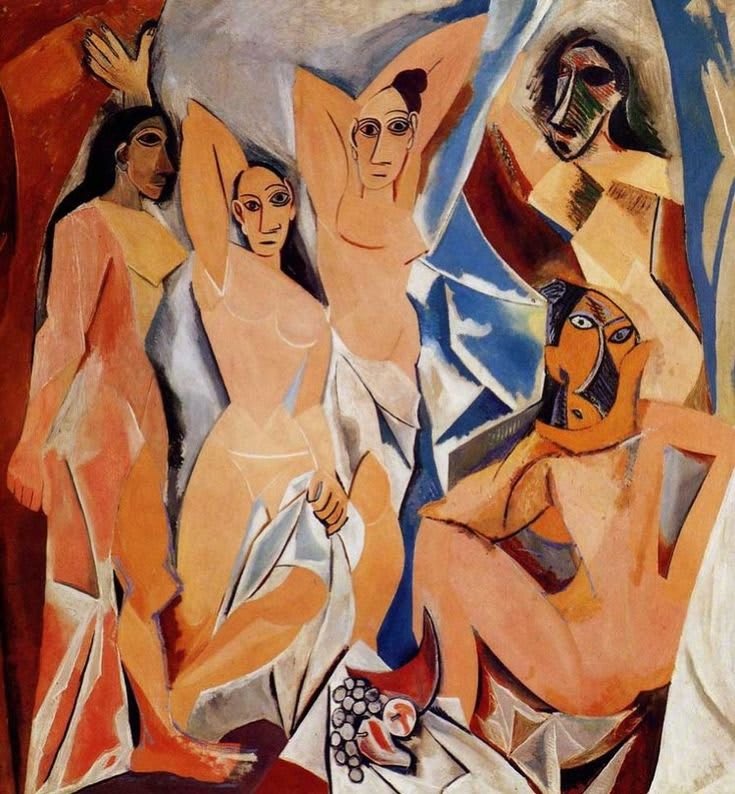
The cubist movement developed after Pablo Picasso launched the innovative painting Les Demoiselles d'Avignon, considered pre-cubist. In its radical distortion of figures, its representation of volumes as fragmented planes and its soft palette, it anticipated some of the main characteristics of subsequent cubism.
Braque was Picasso's partner in the first experiments and the development of cubism. Based on Paul Cézanne's emphasis on the underlying architecture of form, these artists used multiple viewpoints to break down images into geometric forms. Instead of modeled forms in an illusionistic space, the figures were represented as dynamic arrangements of volumes and planes where the background and the foreground merged.
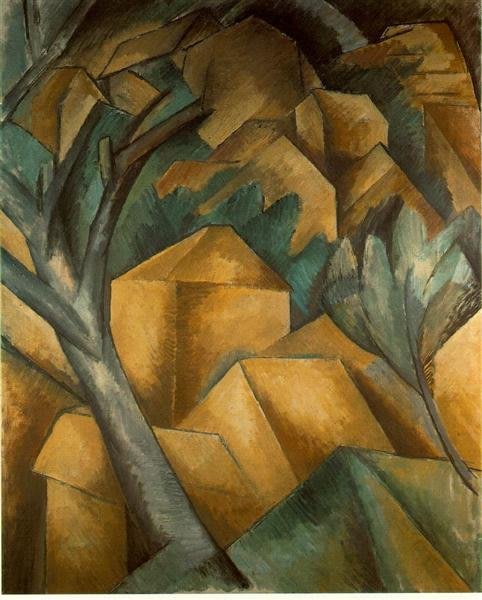
Upon seeing Picasso's Les Demoiselles d'Avignon in his studio, Braque intensified his similar explorations in simplifying form. He made a series of landscape paintings in the summer of 1908, where trees and mountains were represented as cubes and pyramids shaded, reminiscent of architectural forms. Cubism was presented to the public with Braque's solo exhibition, which led the French art critic Louis Vauxcelles to describe what he saw as "bizarre cubes," thus giving the movement its name. This period became known as cubism cézzaniano.
1907 was a decisive year for the development of cubism. Cézanne, who had died the previous year, had a posthumous retrospective of his work at the Salon de Paris. The use of geometric forms to simplify nature was incredibly influential for both Pablo Picasso and Georges Braque. The two artists regularly met to discuss their progress and, at times, it became difficult to distinguish their works. Both lived in Paris, in the famous bohemian neighborhood of Montmartre, in the years leading up to and during World War I, facilitating their collaboration.
In 1912, the German art collector Daniel-Henry Kahnweiler, who lived in Paris and was a great supporter of Picasso and Braque's work, gave his first public interview about cubism, undoubtedly in response to the growing interest in the movement.
When World War I began, Kahnweiler, as a German, was exiled from France. During the war, Léonce Rosenberg became the main art dealer in Paris, serving as Picasso's dealer during the interwar years.
During the 1910s, the salon cubists, so called because they showed their work in public exhibitions, did not work closely with Picasso and Braque, but were influenced by their experiments. It was through the work of the salon cubists that the movement became widely known to the public. The main artists are: Robert Delaunay, Albert Gleizes, Fernand Léger, Juan Gris, Henri Le Fauconnier, Roger de La Fresnaye and Jean Metzinger.
In 1911, these artists exhibited together at the Salon of Independents, presenting cubism to the general public. The Salon functioned without a jury, where the public's reaction depended on how and where the paintings were displayed. The cubists managed to control the committee of the neo-impressionists so that their works could be hung together in a room as a coherent school. The paintings caused a stir, as the artist Albert Gleizes observed: "While the newspapers sounded the alarm to warn people of the danger, and while they appealed to public authorities to do something about it, composers, satirists, and other men of intelligence and spirit provoked great pleasure among the idle classes by playing with the word 'cube,' discovering that it was a very suitable vehicle for inducing laughter, which, as we all know, is the main characteristic that distinguishes man from animals".
Like Picasso and Braque's cubism, the other artists did not remain faithful to the movement after World War I, having only sporadic exhibitions between 1918 and 1925.
The different phases of Cubism
Cubism cézzaniano or primitivo (1908-09)
This initial phase of the movement emerged from Paul Cézanne's retrospective in 1907, when many artists were reintroduced or first introduced to Cézanne's work, who lived in Aix-en-Provence, in southern France, before his death and did not exhibit in Paris for many years. Several artists who saw the retrospective were influenced by its lack of three-dimensionality, the material quality of his brushstrokes, and his use of uniform brushstrokes. This painting by Georges Braque is a good example of this type of cubism.
Cubism Analytic (1910-12)
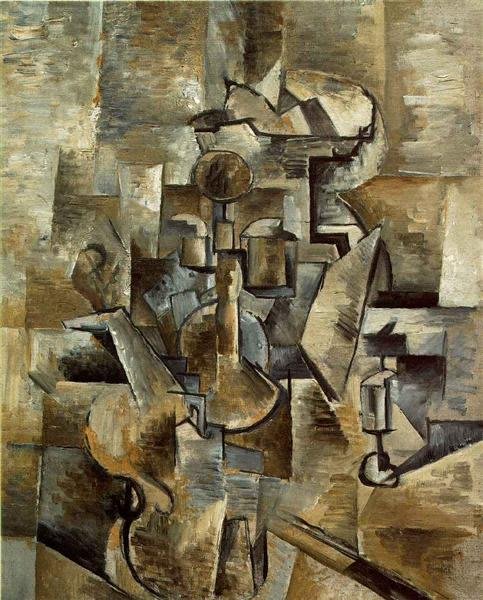
In this phase, cubism developed in a highly systematic way, which later became known as the analytic phase, which was based on the careful observation of objects in their background contexts, often showing them from multiple viewpoints. Picasso and Braque limited their subjects to traditional genres of portrait and still life and also limited their palette to earthy tones and soft grays to reduce the clarity between the fragmented forms of figures and objects. Although their works were often similar in appearance, their separate interests were revealed over time. Braque tended to show objects exploding or breaking apart into fragments, while Picasso made them magnetized, with forces of attraction compelling elements of the pictorial space to the center of the composition, as we can see in these two paintings:
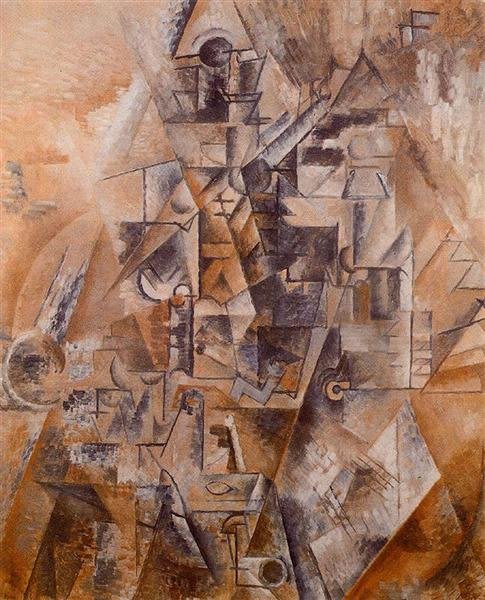
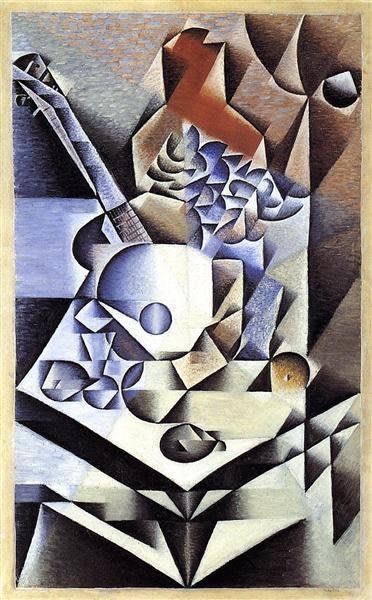
At the end of this phase of cubism, Juan Gris began to make contributions to the style: he maintained a clear clarity in his forms, provided suggestions of a grid composition, and introduced more colors to what had been a monochromatic and austere style.
To understand the rest of this journey, continue to our next article: Cubism: From Synthesis to Global Influences and in Brazil (Part 2).


