
Emiliano Di Cavalcanti: Consolidating Artistic Career and Recognition
Emiliano Di Cavalcanti: Consolidating Artistic Career and Recognition
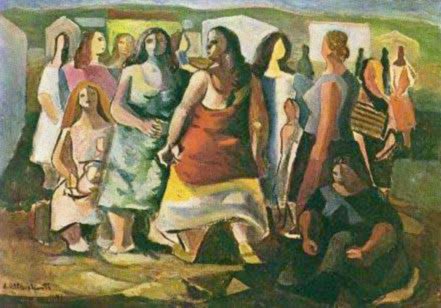
The influences of Pablo Picasso and Diego Rivera significantly changed the characteristics of his work. The Brazilian artist's paintings, which were previously 'dirty' with thick paint and visible matter, began to appear smooth and homogeneous more frequently.
This shift toward refined forms and atmospheric compositions also characterized other revolutionary waves in art history: Surrealism: A Global Artistic Movement and Contemporary Artists
The human figures are, in most cases, robust, with rounded bodies, in situations set in open spaces with a horizon, deserts, or coastlines. However, unlike, for example, the workers of Candido Portinari, who are strong and imposing, appearing in full effort or in the midst of the result of their labor, the fishermen, stevedores, and colonists painted by Di Cavalcanti are almost always in a moment of rest or waiting, sitting, lying down, or sleeping, in a pause.
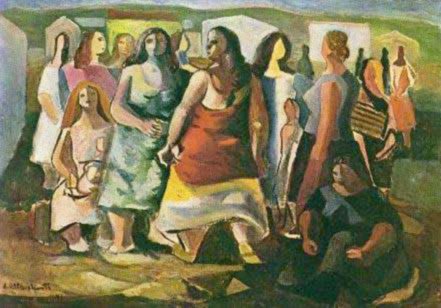
Before the image, the artist places the two characters in a resting position. However, note that the male figure leans on an object that appears to be a tool, and nearby are vegetables and fruits, which may be the result of their work, as indicated by the title of the work, "Colonos". This term is often used to refer to workers who plant and harvest land that does not belong to them.
Notice the background environment. At first, it seems deserted, but we perceive some cut trees, which are indicative that this location has been manipulated by humans.
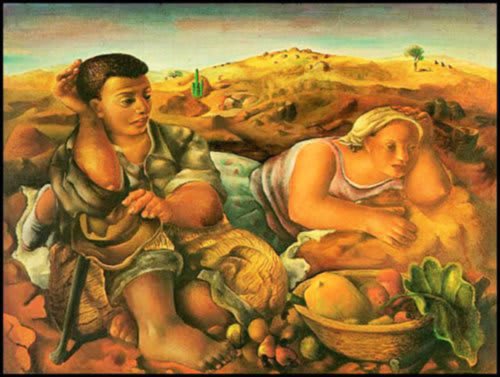
In the 1950s, Di Cavalcanti continued his career with success: the artist received a proposal made by Oscar Niemeyer to create images for a tapestry at the Palácio da Alvorada, as well as others to paint the stations for the Via-Sacra of the Brasília Cathedral.
Just as Di Cavalcanti helped define the Brazilian modernist identity, other artists were blending their heritage with local influences to create a unique visual language: Manabu Mabe - Life and Work
However, history holds a strange detail: In 1951, Di Cavalcanti was invited to participate in the I Bienal de São Paulo. He made a donation of over 500 drawings to the MASP (Museum of Modern Art of São Paulo). Beryl Tucker Gilman became his companion.
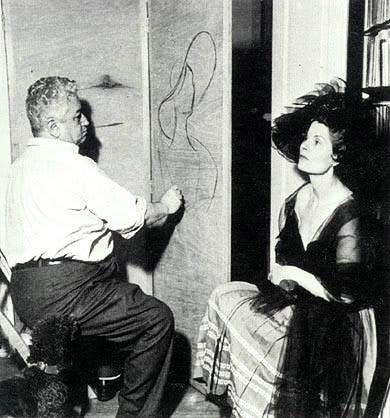
In 1956, he participated in the Bienal de Veneza and received the first Prize of the Mostra Internacional de Arte Sacra de Trieste. His works were exhibited in itinerant exhibitions in various European countries.
In the 1960s, the then President João Goulart indicated him to be the artistic attaché in France. He accepted the indication and embarked for Paris, but did not assume due to the 1964 coup.
Another strange detail: In 1966, Di Cavalcanti's works that had disappeared at the beginning of the 1940s were located in the basements of the Brazilian Embassy. His artistic centenary was celebrated with many tributes dedicated to him.
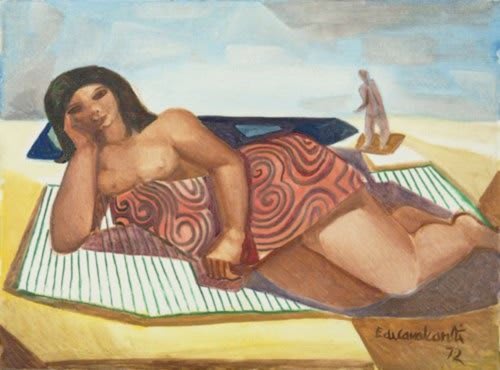
The painter declared: "I will continue to paint until death because, in addition to the benefits I obtain with my imagination, I do not aspire to anything else." (Di Cavalcanti)
He died on October 26, 1976, in Rio de Janeiro. His works significantly contributed to the formation of the modernist aesthetic and Brazilian art.
To understand the rest of this journey, continue to our next article:
Emiliano Di Cavalcanti: Themes, Muses, and Legacy in Brazilian Art.


