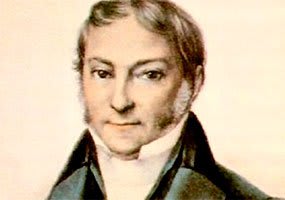
Jean-Baptiste Debret
Jean-Baptiste Debret was a French painter and draftsman, one of the most important artists of the first generation of the Imperial Academy of Fine Arts (AIBA) in Rio de Janeiro, where he lived and worked for fifteen years.
Article Index
Debret was a painter and draftsman who was one of the most important artists of the first generation of the Imperial Academy of Fine Arts (AIBA) in Rio de Janeiro, where he lived and worked for fifteen years.
He was born on April 18, 1768, in Paris, France.
In 1785, Debret began his artistic career in Paris, where Neoclassicism dominated the arts.
He started his art studies at the Paris School of Fine Arts in 1786 and later studied and worked in the studio of the famous painter Jacques-Louis David.
David was also one of the pillars of art-testimony of neoclassic aesthetics.
Under the guidance of his master, Debret transformed into a painter of historical scenes.
In 1791, Debret won the Grand Prize of Rome.
In the early 19th century, he regularly painted large canvases with Napoleonic themes.
In 1816, the King of Portugal, Dom João VI, invited Debret to move to Rio de Janeiro to teach art and create works for the Portuguese court.
Debret was one of the most important members of the French Artistic Mission to Brazil led by Joachim Lebreton.
The mission also included the architect Charles-Simon Pradier and the landscape designer Nicolas-Antonine Taunay and his brother, the sculptor Auguste Marie Taunay.
During his time in Brazil, Debret traveled extensively and produced a series of drawings and watercolors depicting Brazilian life and culture.
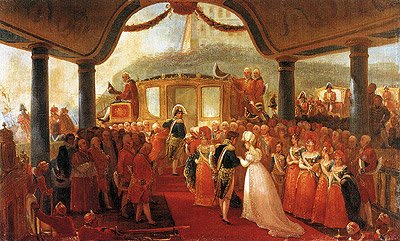
He created large paintings as a court painter, such as Arrival of Dona Leopoldina, the first Empress of Brazil.
In this painting, he framed her arrival with an architectural arcade and the crowd surrounded by military men and aristocrats.
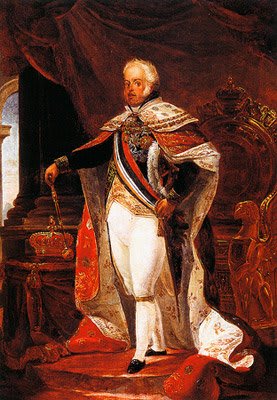
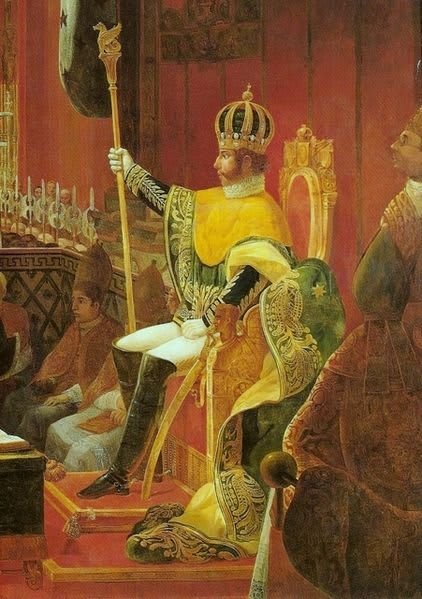
In 1817, he portrayed Dom João VI, reminiscent of the portraits of Napoleon Bonaparte in his blend of military and imperial symbolism.
In addition to his work as an artist, Debret also played an important role in the development of education and culture in Brazil.
He was one of the founders of the Imperial Academy of Fine Arts of Rio de Janeiro and served as a professor at the institution for many years.
In 1826, he became the soul of the Academy of Fine Arts.
It was at this time, acquiring a growing knowledge of the country's problems and reforms, that he gained a very clear view of the reality of Brazil.
Debret conversed with monarchs, ministers, politicians, and at the same time received students from various parts of the country who told him details of their regions that he did not know but could describe later in his book.
Debret returned to France in 1831, where he continued to produce and promote Brazilian culture in Europe.
During this period and until the end of the decade, Debret published images in an illustrated work with 220 engravings in 151 plates, made detailed descriptions of the events he witnessed.
These were three volumes titled Voyage pittoresque et historique au Brésil (Picturesque and Historical Voyage to Brazil).
In them, he recorded his observations, sometimes sarcastic, of Brazilian urban and rural life.
He portrayed the country's upper and lower classes, as well as its native peoples.
For the artist and writer, it was necessary to illustrate the uses and customs of Brazil so that there would be no doubt about the advancement of civilization, promoted by the imperial family.
In Europe, Debret practically did not alter the watercolors he painted in the country during his stay.
Preoccupied with his Brazilian project, he made a selection of the material, selecting what interested him to prove his vision of the country's future and to disseminate his ideas even more.
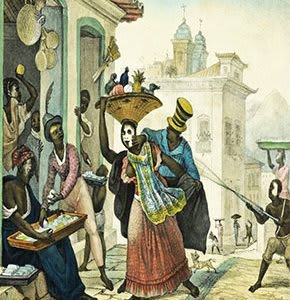
He transformed his watercolors into lithographs, a means of disseminating to the world and getting to know the Brazil he learned to love.
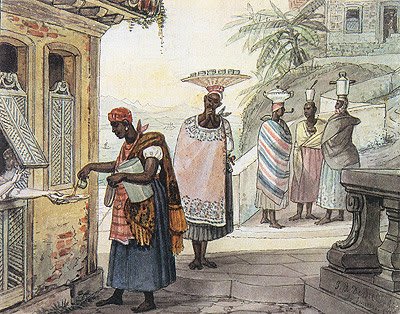
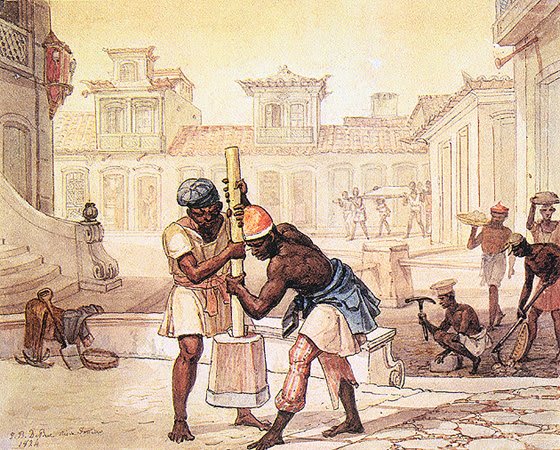
Debret's urban imagination frequently examined the daily life of Afro-Brazilians, as recorded in his most important paintings, Carnival Scene, in which a woman carrying a large tray of fruits flees from the advances of a man while costumed revelers watch.
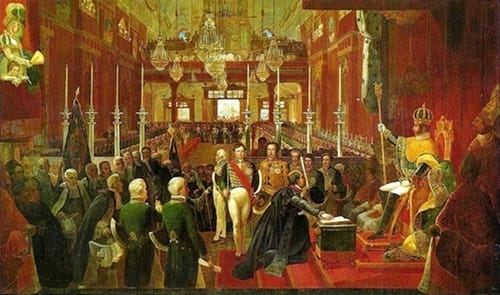
Thus Debret represented, following the ritual of the Coronation and the Coronation that was entirely governed by the Solemnity of the Roman Pontiff, which established in a precise and detailed manner, the actions to be invested by the members of the clergy present, as well as by the aspirant to become Emperor.
Debret died at the age of 80, on June 28, 1848, in Paris.
He left an important artistic and cultural legacy in Brazil and France.
GALLERY
ARTWORK READING - Coronation of D. Pedro I