Leonilson: Life and Work
Leonilson: Life and Work
Article Index
Painter, draftsman, and sculptor, Leonilson is considered one of the artists of the so-called Geração 80, but he does not fit into the movements and generations of his contemporaries.
His poetry deals with his existence, debates feelings, joys, conflicts, doubts about his anxieties, fears, and mainly at the end of his life, when he discovers he is a carrier of the HIV virus.
His work is considered by Brazilian and international critics of great conceptual value for art in Brazil, being the authentic and tireless portrait of a generation, and which, by addressing crucial issues inherent to human subjectivity, is capable of generating identification and universal dialogue in contemporary art.
BIOGRAPHY
José Leonilson Bezerra Dias was born on March 1, 1957, in the city of Fortaleza (Ceará).
In 1961, his family moved to São Paulo, settling in the state capital.
In the late 1970s, the young Leonilson began studying at the FAAP (Fundação Armando Álvares Penteado), where he was a student of Nelson Leirner, Julio Plaza, and Regina Silveira.
From 1978 to 1981, he attended the Centro de Estudos Aster, taking classes in watercolor with Dudi Maia Rosa.
At the end of 1981, he traveled to Madrid (Spain), where he held his first individual exhibition at the Galeria Casa do Brasil and took advantage of his trip to visit other European countries.
In Italy, while in Milan, he met the Brazilian artist Antonio Dias, which later influenced his work.
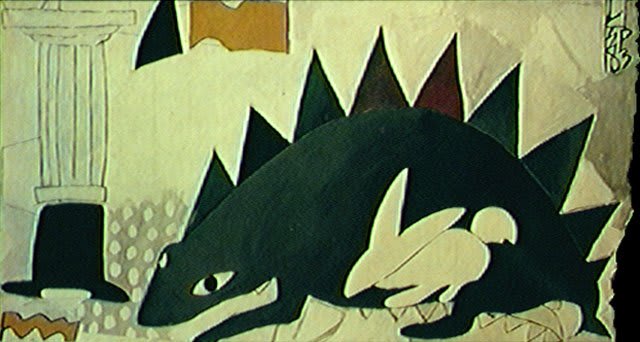
In 1982, he returned to Brazil, and initially his works approximated the aspect of Antonio Dias' work, but with more emphasis on eroticism.
The forms in the drawings are enveloped in a dark contour with the use of graphite.
He soon began to elaborate elements that are permanently retaken until the end of his life.
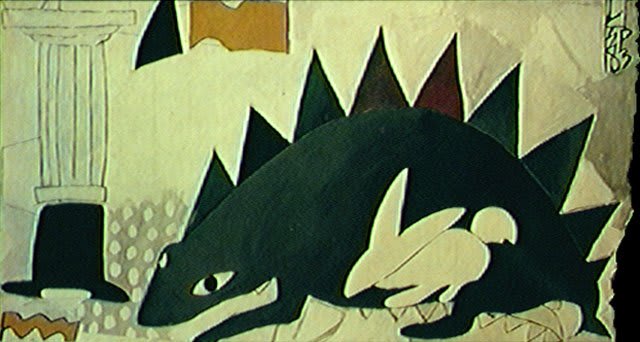
Acrílica on canvas, (91 x 180cm )
Coleção Gilberto Chateaubriand - Museu de Arte Moderna do Rio de Janeiro
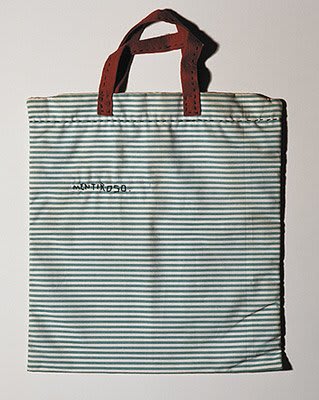
In the late 1980s, he began to use sewing and embroidery, which became recurring in his production.
The universe of sewing is a family heritage, as he is the son of a textile merchant and also had the habit of seeing his mother sewing.
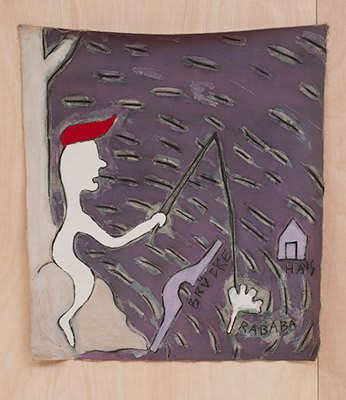
Acrílica on canvas
Coleção particular
In 1989, he exhibited 'Travel Notes' at the Galeria Luisa Strina in São Paulo, presenting pieces made with buttons, semi-precious stones, and embroidery, which introduced new elements originating from sewing in his works.
These pieces remind us of the embroidery of Arthur Bispo do Rosario (1911-1989), a highly respected and admired artist.
In 1991, the artist discovered he was a carrier of the HIV virus, which had a dominant impact on his future works.
In 1992, he realized a series of seven drawings entitled 'The Perilous', which treats with irony his own condition.

Black ink on paper (30.50 x 23 cm)
Coleção Inhotim
The artist died young, at 36, on May 28, 1993, in São Paulo, due to AIDS.
He left a work that still resonates today, due to the intimate language used and the courageous gesture of exposing himself to the public about his life.
In the same year, his family and friends founded the Leonilson Project, with the goal of organizing the artist's archives and researching, cataloging, and disseminating his works.
Working in drawing, painting, object, embroidery, fabric, and installation, Leonilson intensely expresses his passions and emotions, whose works address themes such as love, abandonment, loss, solitude, and disease.
When he discovered he was a carrier of the HIV virus, living with the disease dominated his work.
Some works from this phase can be seen as self-portraits.
An example of this is 'Leo Can't Change the World', which shows that inconformity is linked to impotence.
His production began to suffer a formal stripping, but the content did not change: he used words loaded with moral value such as 'sincerity', 'honesty', and 'integrity'.
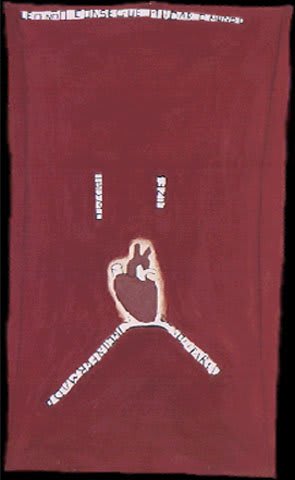
Coleção Dias Reichert
His last work, made for the installation 'Capela do Morumbi', has a spiritual sense.
On the light and white fabrics, he expresses the fragility of life.
There are ironic references to authority and hypocrisy in the soft shirts that cover the chairs and the embroidery 'of false morality' and 'of good heart', but also to hope, in the embroidery 'Lázaro'.