
Liberty Leading the People - Eugène Delacroix
Liberty Leading the People - Eugène Delacroix
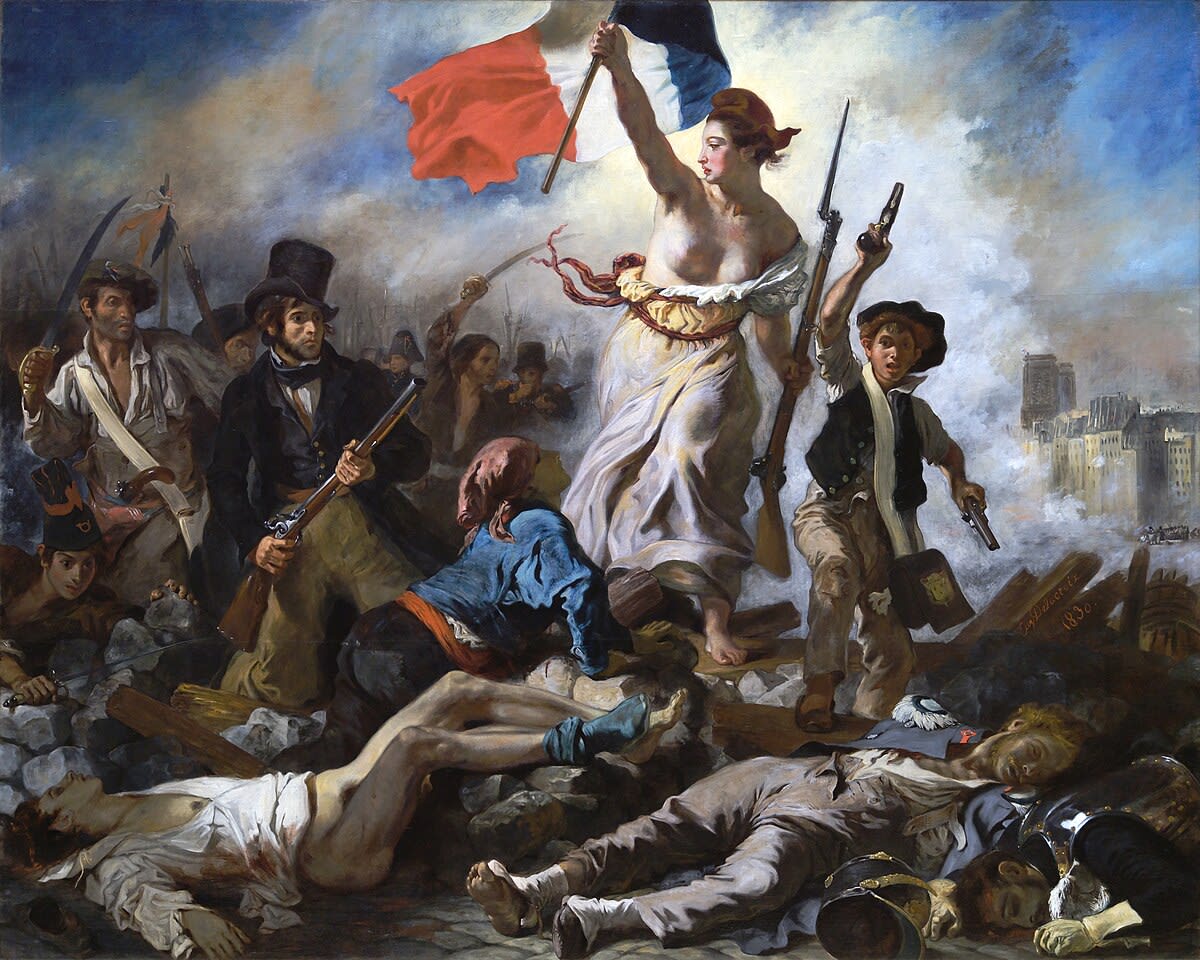
The painting 'Liberty Leading the People', painted in 1830 by Eugène Delacroix, can be considered a powerful icon of the revolutions that took place during the late 18th and early 19th centuries and of the struggles of the common people for the longed-for equality, one of the most important works representing the Romanticism in the visual arts.
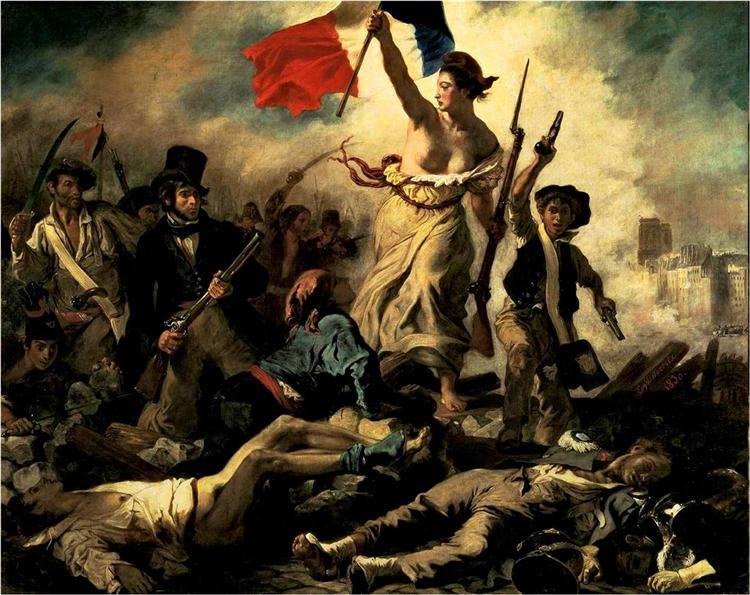
Surprisingly, the work was acquired by the State for 3,000 francs and returned to the artist, who left it in the country house of his aunt.
Delacroix made the painting quickly, in just over three months, and exhibited the work at the Salon of 1831.
The painting shows the uprising of the oppressed classes, a crowd of men and young people with arms and swords in their hands, emerging from a cloud of dust and smoke, knocking down barricades and coming implacably to meet the spectator, a boy with pistols in his hands and a battle cry in his mouth, advancing on the right foot and exhorting his companions to battle.
The main protagonist of the work is Liberty, represented by a woman, bringing the bodies of the dead enemy soldiers to her feet.
It is quite striking the way she is portrayed: a daughter of the people, born of the people, alive, determined and impetuous, embodying the revolt, emerging from the shadows to the light like a flame and holding the French flag as a symbol of struggle.
Liberty here, even wielding a rifle, is an allegory with a modern, current and real vision.
'Liberty Leading the People' is a romantic vision of the July Revolution of 1830.
At the time, France was ruled by King Charles X, who remained in power for six years.
When Charles X tried to abolish freedom of the press and dissolve the newly elected assembly, the revolution began.
The king is deposed, and Louis-Philippe, a more liberal member of the royal family, takes power.
He is the last king of France, having abdicated in 1848.
Eugène Delacroix did not participate in the revolution.
To make this painting, he probably drew inspiration from prints of the conflict, especially the work of Nicolas Charlet.
The painting disturbed both the realists and the revolutionaries.
It was acquired by the State for 3,000 francs and returned to the artist, who left it in the country house of his aunt.
For a long time, it was avoided being exposed publicly.
It was only in 1874 that the painting was acquired by the Louvre Museum and exhibited with honors.
Notable features of the work:
The brushstroke: Delacroix's brushstrokes are visible on the canvas, which goes against the academic rules that determine that the brushstroke should be 'invisible'.
Liberdade: represented as a classical goddess, synonymous with virtue and eternity.
However, her robust features are common to the French people, there are hairs in the armpits and the woman does not float above the battlefield, but mixes with it, soiling her own hands.
She wields a modern firearm - a musket.
The corpses: the dead are members of the elite guard of the king.
Since it is a civil war, the revolutionaries fight against people very close to them, their neighbors and fellow citizens.
The realism of the corpses is inspired by the works of Antoine-Jean Gros, a painter that Delacroix admired.
The man without pants: another factor that makes the work complex and ambiguous is the presence of this naked corpse, a man deprived of his dignity.
His clothes were stolen, and probably by the rebels.
Other characters in the painting present themselves with stolen objects from the corpses.
Thus, even among those who fight for liberty, there are censurable attitudes.
The flags: two flags are depicted in the painting, one wielded by Liberty, and another over the Notre Dame Cathedral.
The tricolor flag was used in the French Revolution of 1789 and in Napoleon's wars.
After his defeat in Waterloo, the flag was no longer used.
The return of this symbol is charged with emotion, as if the people were regaining their pride, after the restoration of the monarchy.
The battlefield: the center of the 1830 revolution was the Pont d 'Arcole, and probably this is the scene of the painting.
However, no observation post allows this view of Notre Dame.
Like other Romantic painters, Delacroix abdicates a literal fidelity to the facts in favor of a greater dramatic effect.
He converts contemporary events into mythic images.
The composition: it is a classical composition, in pyramid, in which Liberty occupies the apex of the pyramid.
The musket with bayonet wielded by Liberty creates a line parallel to the weapon wielded by the child.
In the rest of the painting, several diagonal lines bring dynamism to the composition.
The colors: the bright colors of the flag help to highlight the woman who symbolizes Liberty.
It is worth noting that the red of the flag is over the blue sky, which makes it stand out even more.
The colors are repeated in the clothes of the worker at the feet of Liberty.
Liberty's clothes are painted in a lighter tone than those found in the rest of the painting, making it easier to read.


