
Lygia Clark: The Art of the Body, Therapeutic Legacy and Notable Works
A biography of Lygia Clark: The Art of the Body, Therapeutic Legacy and Notable Works
Article Index
In 1972, she was invited to teach a course on gestural communication at the University of Paris, Sorbonne, which allowed her to explore collective sensory experiences with large groups of students.
She became increasingly critical of art institutions, particularly museums, and began to think of her work in terms of abandoning traditional art.
During this period, she went through a series of psychological and sexual crises, underwent psychoanalysis, and in 1974, she ended the treatment in favor of an alternative therapeutic regimen.
Lygia Clark returned to Rio de Janeiro in 1976, where she established a practice as a therapist and healer, treating individual patients in her home.
These sessions involved the application of relational objects or self-conceived relational objects to the bodies of her patients.
She called her therapeutic method Structuration of the Self and, in the early 1980s, she was already training psychologists, artists, and therapists.
Brazil in 1976 was a very different place from the radical cultural environment that Clark had left in 1968.
A new cultural program sponsored by the government, prioritizing entertainment for the masses, replaced the atmosphere of experimentation and dialogue that shaped the artistic scene in the 1950s and 1960s.
Several important cultural figures had died, including the former leader of the Front Group Ivan Serpa and her close friend, Hélio Oiticica, who had suddenly suffered a stroke in 1980.
These last years were particularly difficult for her, as she was struggling financially and emotionally, and her health was deteriorating, exacerbated by excessive alcohol consumption.
In 1988, the artist suffered a fatal heart attack and died in her apartment in Copacabana on April 25th at the age of 67.
LEGACY
By breaking down the barriers between art and life, Clark challenged conventional ideas about what art could or should be.
In this sense, she is an important reference for contemporary artists who deal with the limits of conventional forms of art.
GALLERY

COMMENTED WORK: Walking

The Moebius Strip (an object created in 1858 by the German mathematician August Ferdinand Möbius) had a particular fascination for Lygia Clark.
Although it is a line, it does not perform the function that the form implies: it does not make any distinction between inside and outside, interior or exterior, front or back.
The work is, therefore, a non-functional line that exists as an action and not as a physical object.
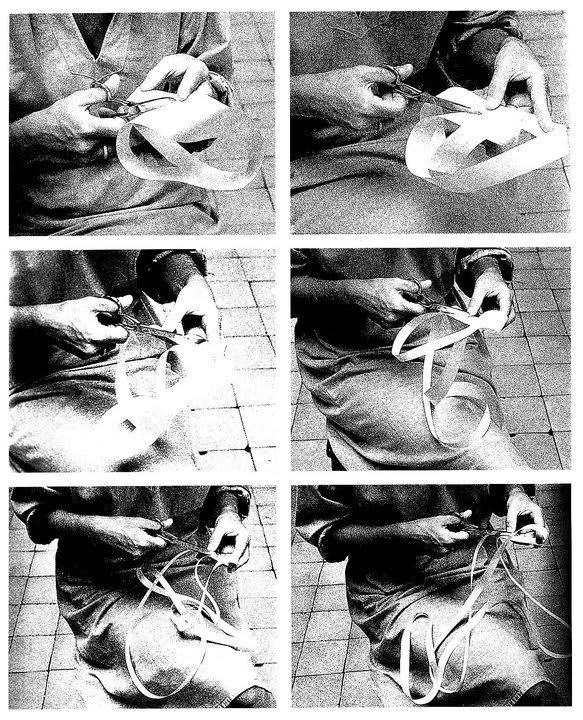
The act of walking animates and activates the static line that exists in drawings or paintings, recreating the line as an event that is necessarily finite, lasting only until the paper is cut so thin that the line cannot continue, unlike a drawn or painted line.
The artist declared: "the act is what produces Walking, nothing exists before and nothing exists after".
Suggesting the dematerialization of the art object and the shift towards a process-based and participatory art, the artist invited those interested to participate in this experience, cutting a Moebius Strip with the help of scissors along its length at its narrowest width, without breaking it.
After cutting the first length (basically a circumference of a circle), the participant (who had now become the author of the work, challenging preconceived notions of artistic authorship), he should choose to direct his scissors to the left or right of the existing cut.
From that point on, Lygia Clark began to describe all her works as 'propositions', a term that emphasizes the freely chosen action of a participant as the basis for the work; the result depends on the propositions of each human being, just as it is with life.


