
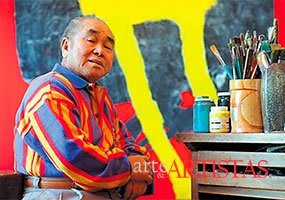
Manabu Mabe - Life and Work
Discover the life and art of Manabu Mabe, a Japanese-Brazilian artist known for his unique style that blends Eastern and Western influences.
Manabu Mabe was a Japanese-Brazilian artist known for his contribution to abstract art and his distinctive style, which was a unique synthesis of Japanese and Western influences.
Throughout his career, the artist experimented with various techniques, primarily painting, engraving, and illustration.
His focus on abstraction and his ability to express deep emotional depth made him an important figure in Brazilian art history and abstract art in general.
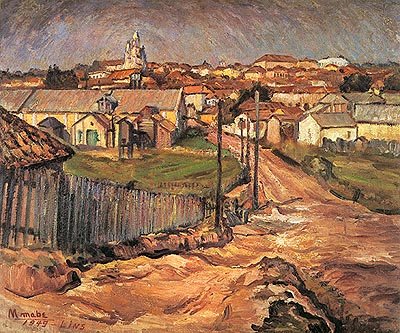
He was born on September 14, 1924, in Kumamoto, Japan.
He emigrated to Brazil with his family in 1934, where they settled in Lins, a city located in the interior of São Paulo, to work on coffee plantations.

In 1945, to the dismay of his father, Manabu began painting informally.
In 1947, he traveled to São Paulo and met the artist Tomoo Handa, who recognized his talent and encouraged him to continue painting.
The 1950s were a tumultuous and promising decade for the young artist.
Mabe became a prominent figure in the Brazilian art scene.
His work was characterized by a unique fusion of elements from traditional Japanese painting and Western abstract expressionism.
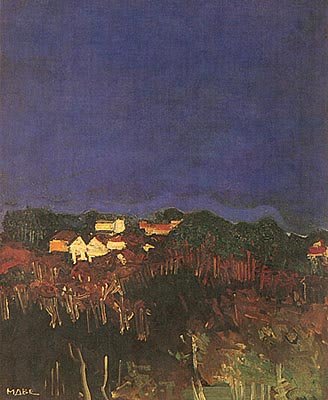
In 1950, he held his first exhibition at the São Paulo Association of Artists.
In 1951, he exhibited at the National Salon of Fine Arts in Rio de Janeiro.
In 1953, he participated in the II Bienal Internacional de Arte de São Paulo and continued to participate in the event throughout the decade, winning the "Best National Painter" award in the 1959 edition.
In 1957, he moved to São Paulo, in the Jabaquara neighborhood, a district near the Liberdade neighborhood, which housed the Japanese colony in the capital city, and continued to live there until today.
In 1957 and 1959, he exhibited in his native country, participating in the International Exhibition in Tokyo.
In 1959, Mabe received the Braun Editions prize at the I Bienal de Jovens Artistas in Paris, which led Time magazine to proclaim 1959 as "The Year of Manabu Mabe".
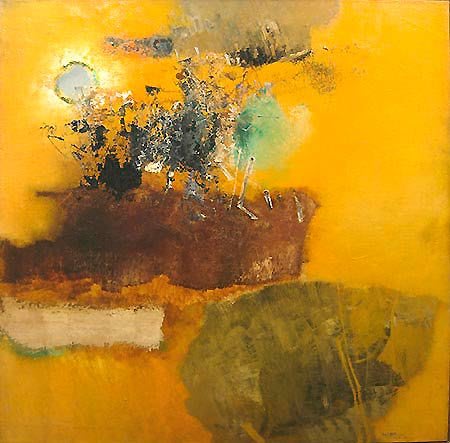
In 1960, as an internationally acclaimed artist, he received the Fiat prize at the 30th Venice Biennale.
His association with other Japanese-Brazilian artists strengthened in the 1960s, with his first exhibition in 1961 at the OEA (Artists of the Americas) and in 1964 at the Modern Art Museum in Rio de Janeiro and various other shows throughout the century.
On January 30, 1979, after an exhibition in Tokyo, 153 of his paintings were on board a Varig Boeing cargo plane, flying from Tokyo to Rio de Janeiro via Los Angeles.
The plane disappeared in the Pacific Ocean, about 30 minutes (200 km ENE) from Tokyo.
The causes are unknown, as the wreckage was never found and the paintings were lost.
They were valued at over US$ 1.24 million.
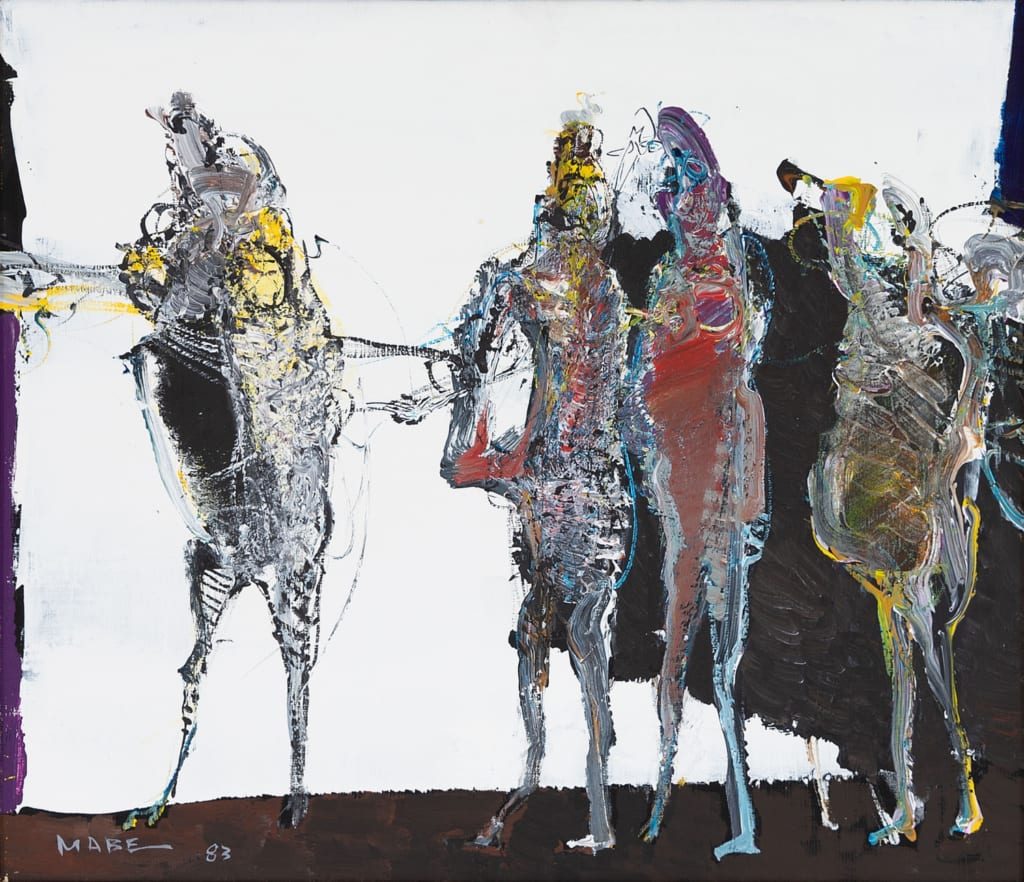
In the 1980s, he created a mural in Washington for the Pan American Union; illustrated the book Hai-Kais; designed the backdrop for the Provincial Theater in his hometown (Kumamoto), Japan.
Mabe continued to paint and exhibit and was honored in 1986 with a retrospective at the Modern Art Museum in São Paulo.
He maintained three studios in different countries where he lived, São Paulo, New York, and Tokyo, where he absorbed different influences and left his mark wherever he went.
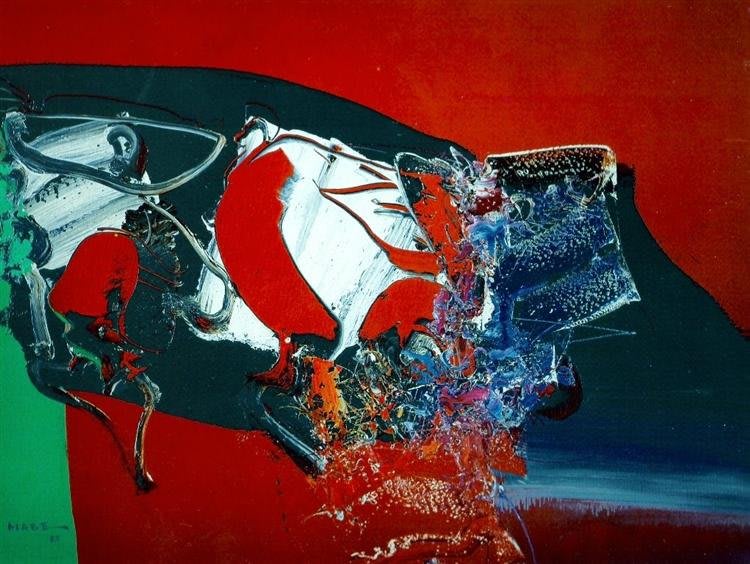
Manabu Mabe passed away in São Paulo on September 22, 1997, after a kidney transplant infection.
His legacy lives on through his work, which can be found in museum collections and in the hands of collectors around the world.
GALLERY - COMMENTED ART
Manabu Mabe's paintings are often associated with those of the Catalan artist Antoni Tàpies and European informal art.
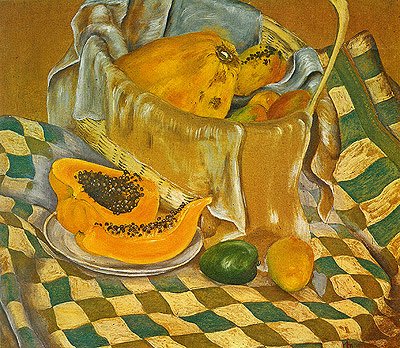
'I possess a painting style that I developed through great effort and perseverance, which is easily identifiable.
As a joke, I called it 'mabismo'.' - Manabu Mabe, September 1994
Artwork Reading - Agonia, 1963
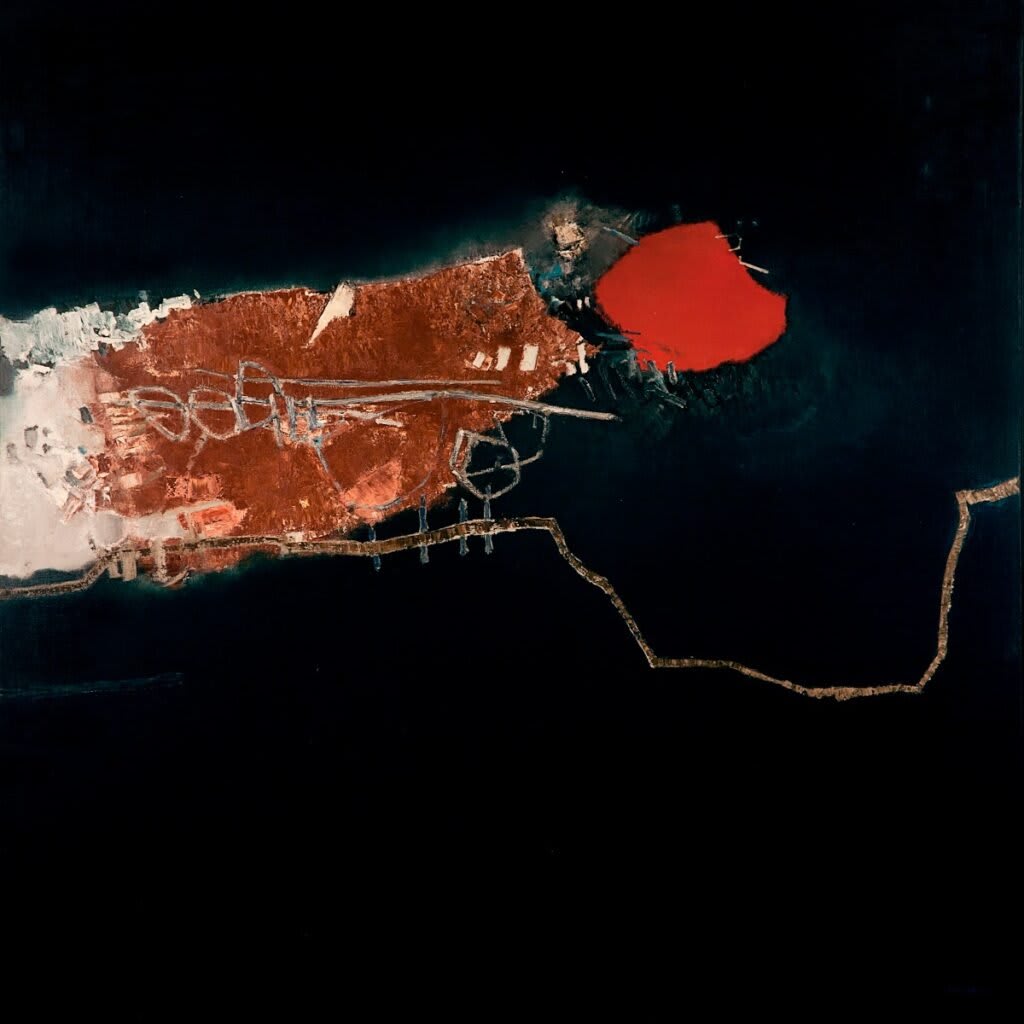
The painting titled 'Agonia' was created by the artist gathering and scraping paint with a spatula, allowing him to develop various textures.
He described his theme as an expression of existential anguish produced by the binary oppositions of human experience.
He explained: 'From the most remote antiquity to the present day, man survives under the signs of life and death.
The spirit of life is constructive, and the spirit of death shines splendidly in space.'
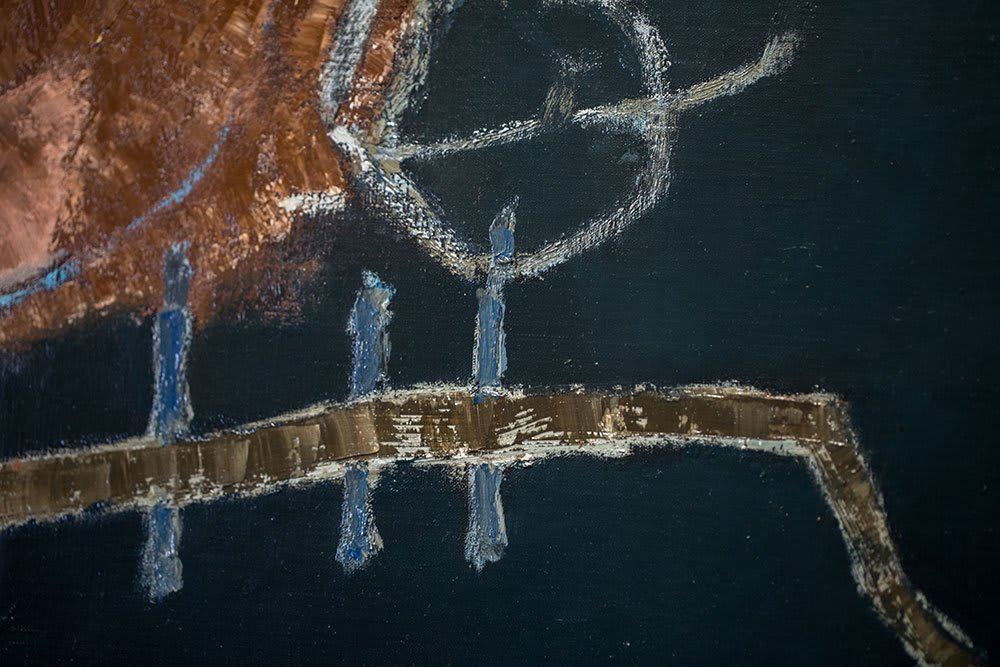
To create the composition, he represented these contrasts using a warm and cold palette and a game of different textures.
A relatively uniform blue field dominates the painting, interrupted by a gestural mass of rust, gray, and white, perforated by a burst of vibrant red.
He scribbled enigmatic signs on the gestural mass and extended a linear fissure laterally, implying that the line could extend infinitely.
Although it is doubtful that he encouraged a specific symbolic reading of the forms or palette, the oppositions and divergences he constructed suggest formally the contrast of emotions that define humanity.
Agonia, by Manabu Mabe, was included in the VII Bienal de Arte de São Paulo and later acquired and donated to the Visual Arts Section by the Bienal's president, Francisco Matarazzo Sobrinho.


