
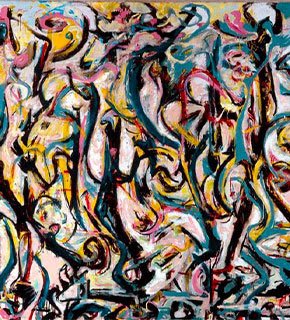
Mural, Jackson Pollock
Mural, Jackson Pollock
Mural by Jackson Pollock is a monumental work that marks a crucial point in his career and the development of modern art.
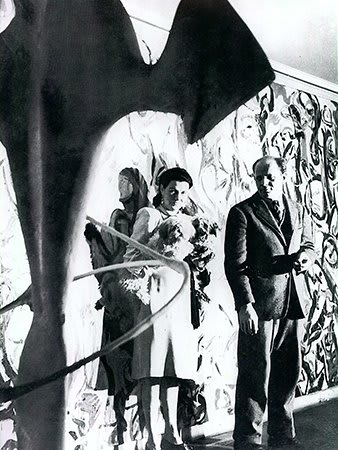
Created in 1943 on commission from Peggy Guggenheim for her apartment in New York, the painting showcases many of the distinctive elements of Pollock's style that would later make him famous.
Measuring over 2 meters in height by 6 meters in length, 'Mural' is an explosion of lines, forms, and colors that seem to dance and intertwine across the canvas.
This work was fundamental to Pollock's transition to the dripping technique that made him famous, representing a landmark in the history of modern art.
The Mural is one of the most important paintings by Jackson Pollock and is recognized as the principal work that gave a turning point to American art.
In the summer of 1943, the patron and art collector Peggy Guggenheim, commissioned the then little-known artist Jackson Pollock to create a mural for the foyer of her apartment in Manhattan, with the requirement that the artist cover an entire wall, with the theme choice left to his discretion.
At the suggestion of her friend and advisor Marcel Duchamp, the mural was to be painted on canvas, not on the wall itself, making it portable.
They were eager to showcase in their home a work that would symbolize their support for the new American art.
The request was accompanied by a contract, a rare occurrence at the time, with a salary of $150 per month. The money was essential for Pollock and his future wife, the painter Lee Krasner, who were already living together in a small apartment in New York and struggling financially.
To place the canvas in the designated location, several walls had to be demolished. However, time passed, and the canvas remained intact. Guggenheim, concerned about the situation, began to pressure the artist, threatening to stop paying what had been agreed upon if he did not complete the project. This pressure did not help, Pollock spent weeks staring at the blank canvas and complaining that he couldn't find inspiration for such a large work.
Obsessed with the work and on the brink of depression, he finally manages to complete it.
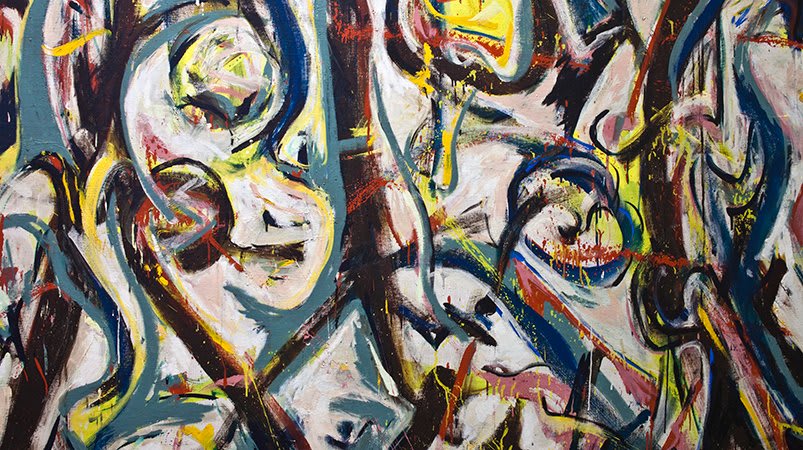
There is a myth that Pollock painted the entire mural in a single night, the night before the deadline. In fact, a recent restoration revealed that he painted multiple layers, using over twenty colors, which were slowly drying over weeks. It is true that the final part of the painting, which shows splatters and reflects the gestures and brushstrokes of the author, could have been done in a very short period. However, the apparent spontaneity of the mural is, in fact, very calculated. The work is full of passion, energy, and dynamism. We can imagine the artist executing it, using the force of his entire body to paint the almost three meters high by six meters wide canvas. Pollock's pictorial fury makes his brushstroke aggressive and energetic.
This mural was exhibited in Guggenheim's apartment for several years. However, at the end of World War II, she decides to return to Europe, where she does not have space for a painting of this size, and begins to look for a new home for the Mural. After several negotiations with Lester Longman, then head of the Art and History of Art School at the University of Iowa, Guggenheim decides to donate the work and, in exchange, asks Lester to be responsible for transferring it to Iowa, where it remained and is currently exhibited at the museum of that institution.
MURAL: MEANING
The mural is halfway between abstraction and figuration: it leaves the viewer some freedom to interpret mysterious forms, moving figures. Pollock told a friend years after making the mural that, to create it, he had a vision, explaining it as follows: “It was a stampede of all the animals of the American West, cows and horses, antelopes and bison. Everything was charging against that accursed surface.” Although there is some suggestion of figuration in the Mural, its overall impact is that of abstraction and the freedom from the restrictions imposed by figures.
Mural is the largest canvas that Pollock painted and is often seen by art historians as a moment of liberation, as the artist goes beyond the restrictive traditions of easel painting. Stylistically, this marks a moment of transition from his biomorphic abstraction inspired by surrealism to a more gestural and active painting. The pronounced brushstrokes and occasional drips point to a creative and rhythmic expression that the artist will explore more fully in the future.
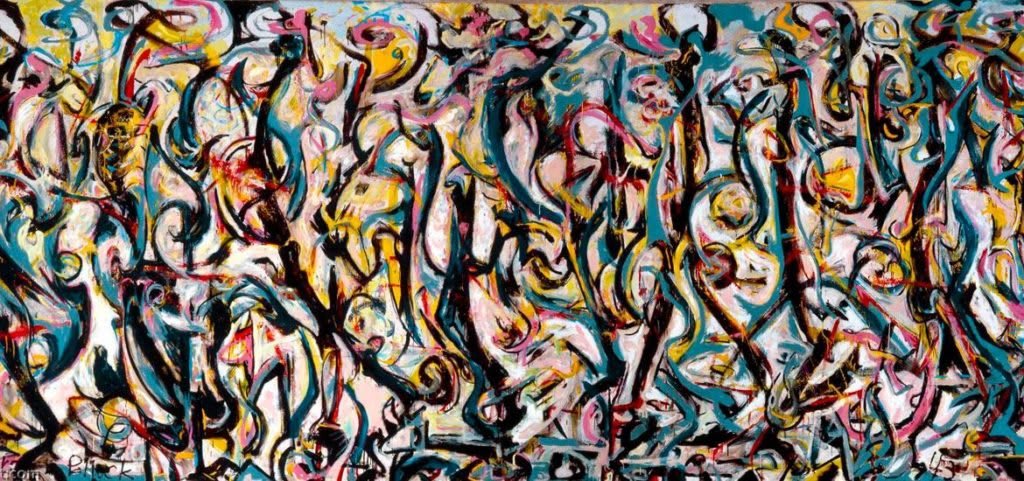
TITLE: Mural
YEAR: 1943
TECHNIQUE: Oil and water-based paint on linen
DIMENSION: 242.9 x 603.9 cm
LOCATION: University of Iowa Art Museum


