Paul Gauguin: The Journey to Tahiti, Legacy, and Essential Works (Part 2)
Paul Gauguin: The Journey to Tahiti, Legacy, and Essential Works (Part 2)
Article Index
"Before dying, I pour all my energy here, into a passion full of suffering, and into a vision so clear and uncorrected, that premature maturity vanishes and life blossoms."
Gauguin died alone in his house of pleasure.
He passed away on May 8, 1903.
His body remains buried on Hiva Oa Island.
The Broken Family: The Price of Gauguin's Art
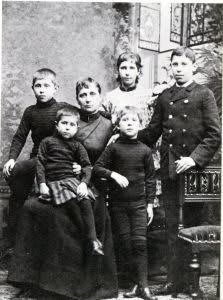
Paul Gauguin's decision to become an artist led him to a life of intense travel.
This compulsion, however, resulted in his gradual estrangement from his wife and entire family.
His eldest son, Emil, recounted about his mother: “She agreed to let him go, not because she believed he would become a genius, but because she respected his passion for art."
"It was an act of courage on my mother's part," Emil continued. "It meant she had to bear the burden of supporting and educating me and my siblings, who were still children.”
Despite being separated for eighteen years, Paul and Mette-Sophie never officially divorced.
They maintained regular correspondence until 1897.
With his official wife, Mette-Sophie, Gauguin had five children: four sons and one daughter.
Regrettably, Gauguin outlived two of them, a personal tragedy that deeply affected him.
His daughter Aline died of pneumonia, and his son Clovis passed away due to a blood infection after a surgical procedure.
Emile, his other son, pursued a career as a construction engineer in the United States, where he is buried in Florida.
Jean Rene, who also inherited his father's artistic talent, became a recognized sculptor, dying in Copenhagen on April 21, 1961.
As for Paul Rollon, better known as Pola, he dedicated himself to art criticism and left an important legacy with the memoir My Father, Paul Gauguin, published in 1937.
Mette-Sophie was instrumental in promoting Gauguin's work.
She organized several exhibitions and was responsible for selling many of his pieces.
Many of the exhibited works belonged to her or passed through her hands at some point.
Mette-Sophie passed away in Denmark on September 25, 1920.
Gauguin’s relentless pursuit of his vision often mirrors the resilience and hardship found in the biographies of his 19th-century contemporaries. Auguste Rodin: Birth, Struggle, and Early Notable Works (Chapter 1/3)
Tekha'amana, A Chapter Apart
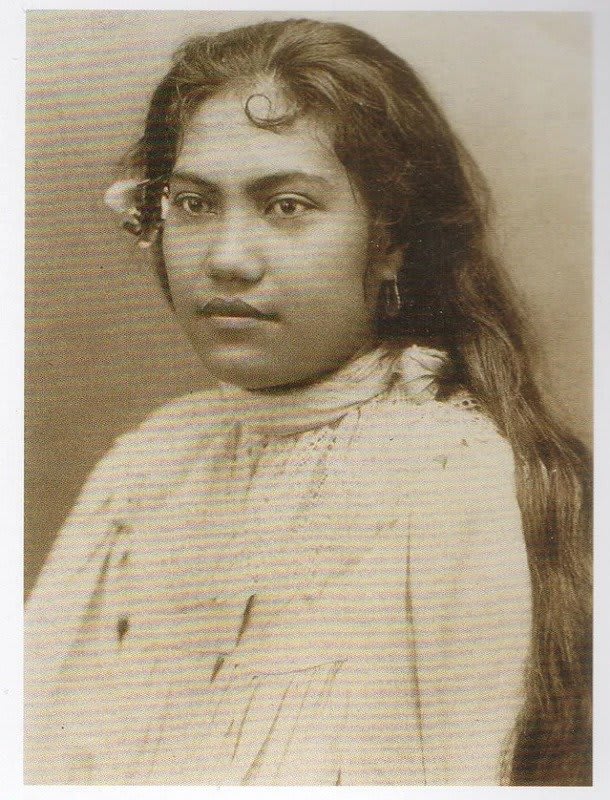
In Tahiti, Gauguin met Tekha'amana and was completely captivated by the beautiful native woman.
He affectionately began to call her Tehura.
The couple married according to the local laws of the island, where the union could be unilaterally rescinded by either the husband or the wife.
Natives, in fact, often considered these marriages a temporary phenomenon.
This allowed them to return to their parents' homes at any time or find a new partner among visitors or locals.
Curiously, according to local traditions, Tekha'amana had two sets of parents: biological and adoptive.
Gauguin had to introduce himself and ask permission from both of Tehura's parents for the marriage.
This peculiarity can be seen in the painting "The Ancestors of Tekha'amana", where he recorded the complexity of his beloved's lineage, with Tehura having many "parents."
Tehura was implicitly obedient to all the artist's desires.
She was tolerant and, most importantly, unlike any woman Gauguin had met before.
Perhaps it was this exoticism that became Tehura's most attractive characteristic for the painter.
Certainly, he was enamored with his Tahitian "nymph."
For some time, she became his inspiring muse, the embodiment of his dream of a humble and passionate wife.
He wrote about her enthusiastically, listened to her recount local legends, and savored her beauty and youthful trepidation.
Soon, she gave birth to a son of his.
But the story holds a bizarre detail:
For a short period, Gauguin had to travel to Paris to try and sell his paintings.
Upon returning to Tahiti and his Tehura, she refused to accept him, rejecting all his gifts.
No entanto, the artist suffered little from this rejection.
He soon found solace in the arms of other exotic brunettes, following the pattern that had alienated him from his first family.
It is believed that Gauguin married other native women and, with them, had three more children.
Gauguin's Enduring Legacy: Influence on Modern Art
Gauguin's legacy lies, in part, in his radical decision to reject the materialism of contemporary culture.
He opted for a more spiritual lifestyle, free from the constraints imposed by society at the time.
His importance also lies in his tireless artistic experimentation.
Scholars have long identified him with a series of movements.
His late work, in particular, attests to the uniqueness of his artistic vision.
Alongside the work of his great contemporaries, such as Paul Cézanne and Vincent van Gogh, Gauguin's innovations inspired an entire generation of artists.
Between 1889 and 1890, many young followers who gathered in Pont-Aven utilized Gauguin's ideas.
From there, they formed the influential Nabis Group.
Fauvist painters, especially Henri Matisse, were deeply inspired by his work.
Matisse, for example, explored the bold use of color in his compositions, a clear influence from Gauguin.
In Germany, Gauguin's influence was notable in the work of Expressionists like Ernst Ludwig Kirchner.
Gauguin's use of Oceanic iconography and his stylistic simplifications profoundly affected Pablo Picasso.
This inspired Picasso's own appreciation for African art, contributing directly to the evolution of Cubism.
Thus, through his stylistic advancements and the rejection of empirical representation in favor of conceptual representation, Gauguin opened crucial doors for the development of 20th-century art.
The radical shift toward conceptual representation paved the way for other pioneers of modernism who transformed the artistic landscape across Europe. Gabriele Münter
Paul Gauguin: CITED WORKS
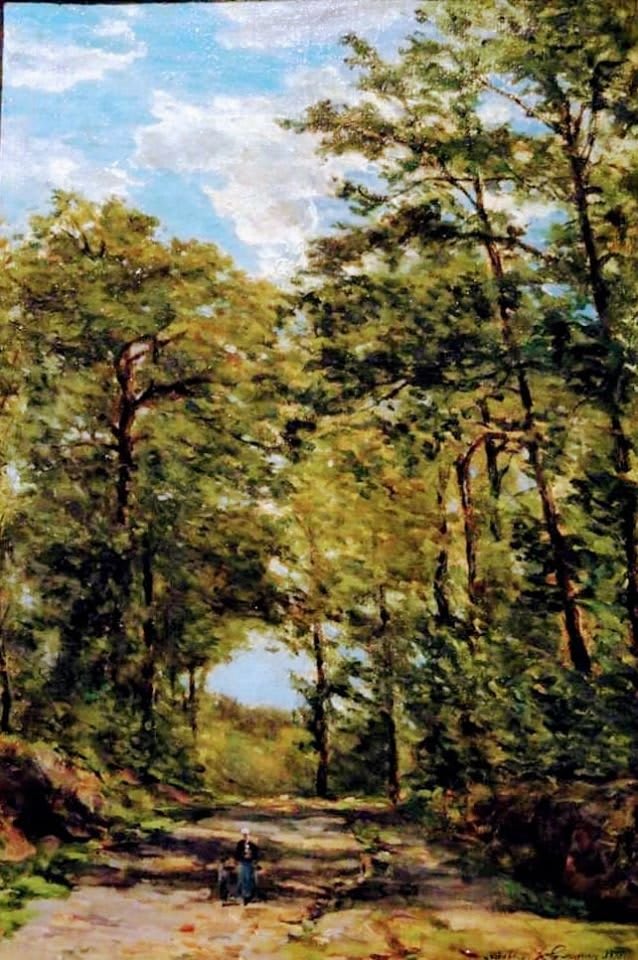
In Landscape at Viroflay, from 1876, Gauguin explores the first traces of his sensibility, with brushstrokes that evoke the atmosphere of the scene.
This work, still close to Impressionism, shows his search for a personal language, focusing on light and color.
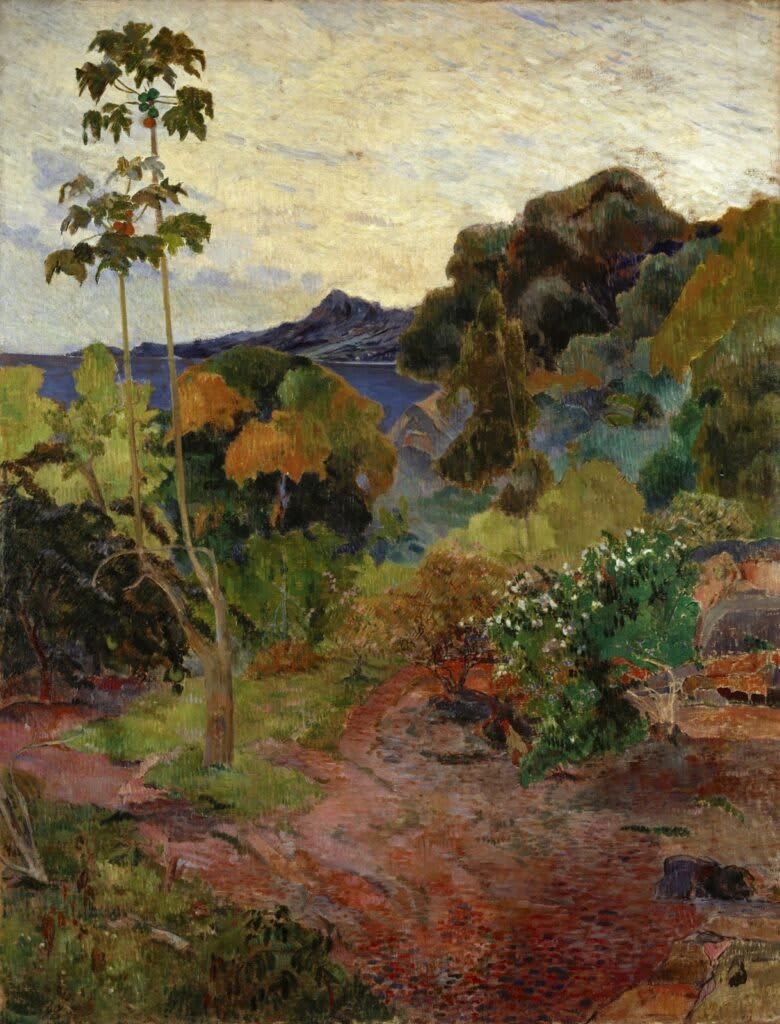
Tropical Vegetation (1887) reveals Gauguin's initial fascination with exotic settings.
The canvas features vibrant colors and luxuriant forms, foreshadowing his future immersion in Tahitian culture and the exploration of symbolism.
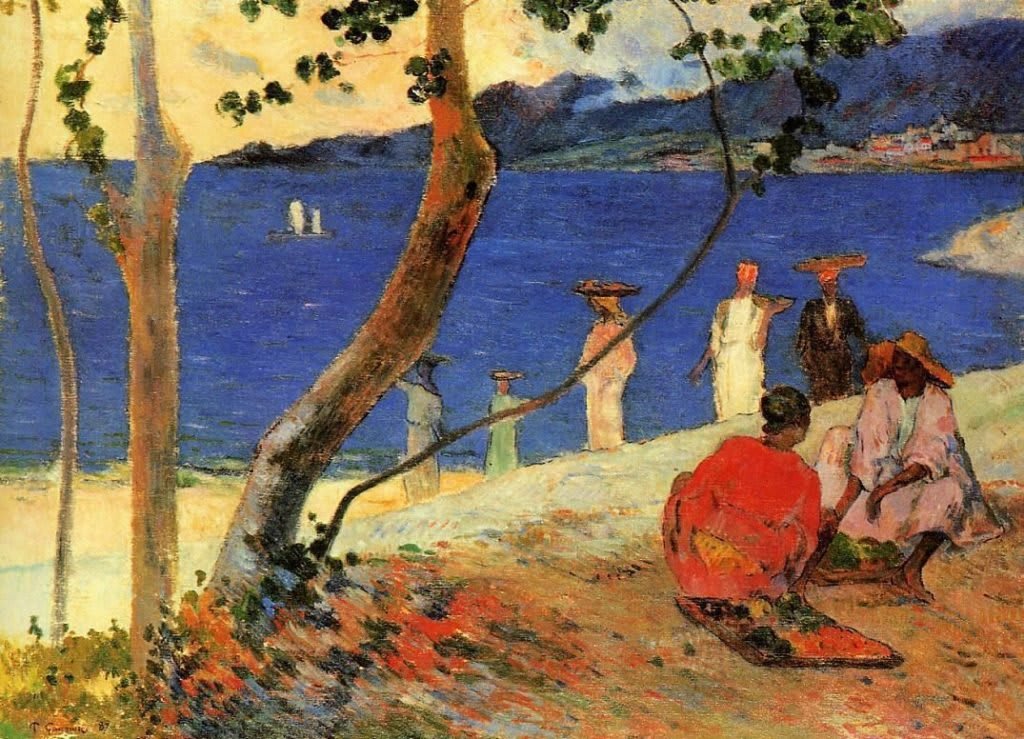
In By the Sea (1887), Gauguin transports the viewer to a coastal scene with a palette of strong colors and defined contours.
This work already signals his transition from Impressionism to a more personal approach, where reality is interpreted and not merely reproduced.
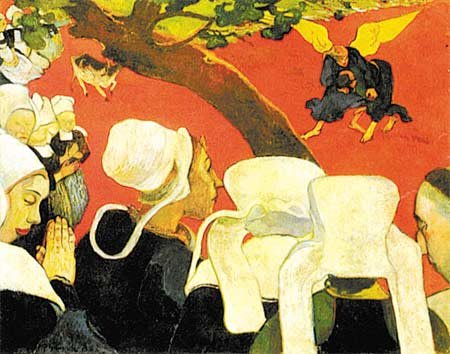
Vision After the Sermon, or Jacob Wrestling with the Angel (1888), is a seminal work that marks Gauguin's turn towards Synthetism.
In it, the artist breaks with naturalistic representation, using non-descriptive colors and an intense red background to express the spiritual and visionary experience of Breton women after the sermon.
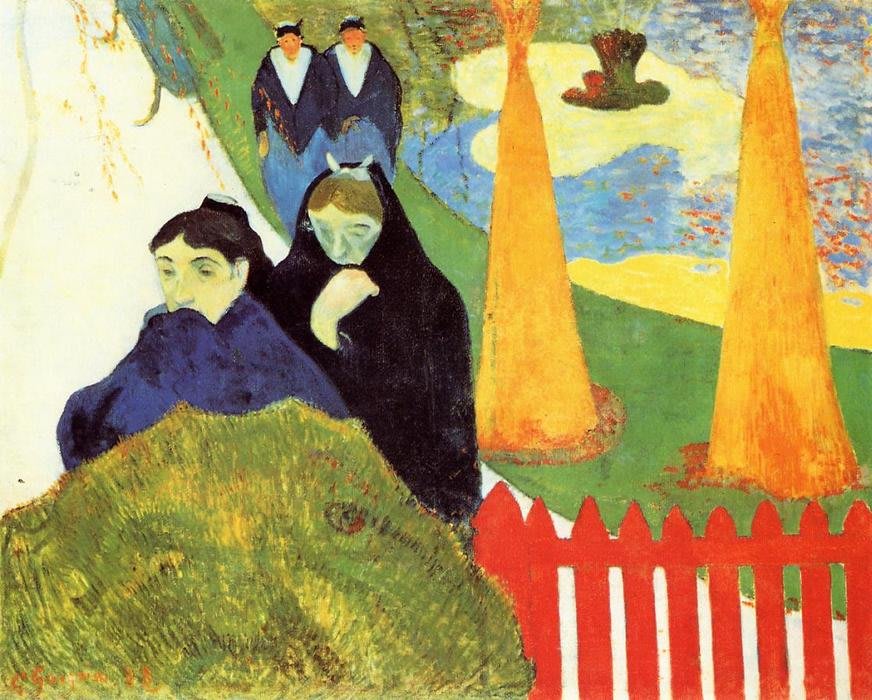
Old Women of Arles depicts a group of women moving through a landscape.
The scene is composed with a flattened and arbitrarily conceived perspective, creating a solemn procession.
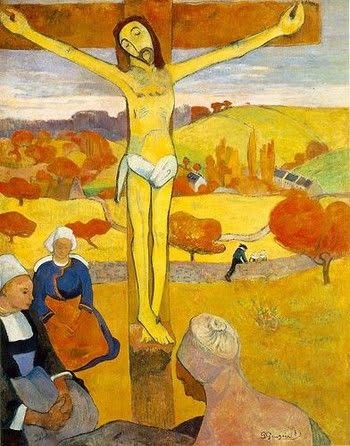
In The Yellow Christ (1889), Gauguin merges Christian faith with the rural scenery of Brittany.
The figure of Christ, painted in an intense yellow, reflects his search for a primitive spirituality and a simplification of forms, far from academic standards.
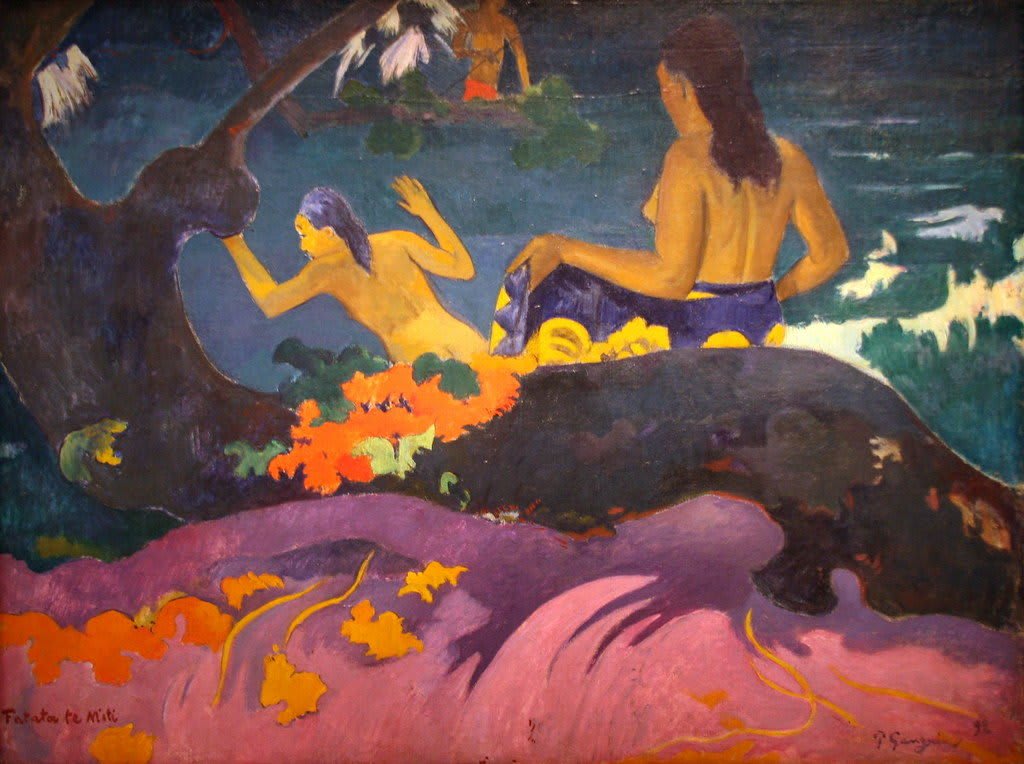
Miti de Fatata Te (or By the Sea), from 1892, directly transports the observer to the beaches of Tahiti.
The work is marked by the tranquility of the landscape and vibrant colors, capturing the essence of the simple and harmonious life Gauguin sought in the Pacific.
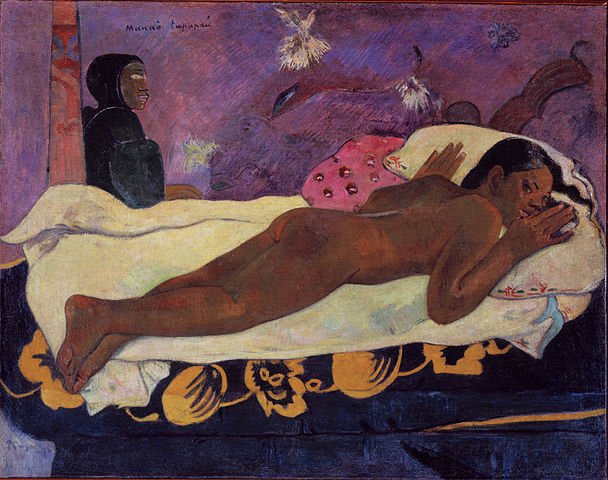
In Manao Tupapau (1892), Gauguin explores the theme of fear and Tahitian spirituality.
The work portrays a young native woman lying down, with a spectral figure in the background, suggesting the presence of a night spirit, capturing the mystical atmosphere of the island.
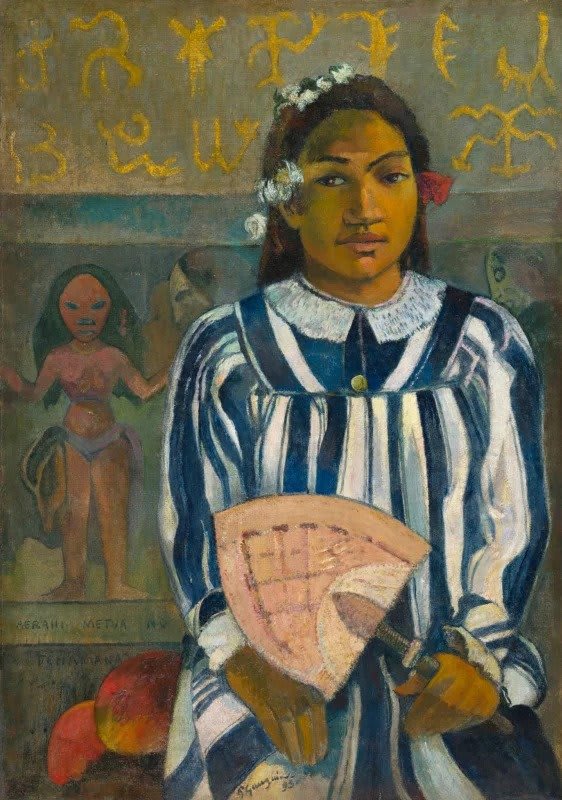
The Ancestors of Tekha’amana (1893) is a significant painting that connects Gauguin's Tahitian muse to her complex ancestry.
The work reinforces the narrative that Tekha'amana had multiple parents, whether biological or adoptive, an aspect that fascinated the artist.
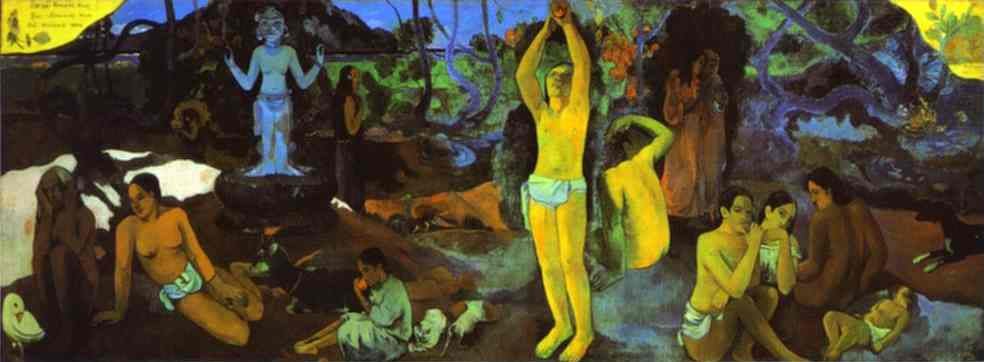
Where Do We Come From? What Are We? Where Are We Going? An existential question transformed into art, one of Gauguin's most profound.
The artist himself stated that after completing this painting, he attempted suicide.
Whether true or not, the reality is that months before creating this masterpiece, his personal life was crumbling.
Things went so poorly that everything pointed to a tragic end for the painter.
Gauguin was going through a period of overwhelming losses: he was financially ruined, facing separation from his wife, and mourning the death of his beloved daughter.
This is not simply the most colossal work Gauguin painted in his career (measuring 139 x 375 cm).
It also fully develops the artist's philosophical and pictorial doctrine, serving as a strong reflection of his worldview.
With a markedly horizontal format, the canvas follows a fascinating inverse chronological evolution.
It begins on the far left with the desolate figure of a mummy who, in a fetal position, covers her ears, as if trying to remain oblivious to the entire scene.
Meanwhile, on the far right, a baby, a symbol of innocence and life, is cared for by three young Tahitian women.
In the center, the figure of the man picking a fruit symbolizes temptation and the fall of humanity.
By structuring the painting in this inverted chronological sense, Gauguin seems to suggest the primitive and the innocent as the only true path for the artist to follow.
COMMENTED ART
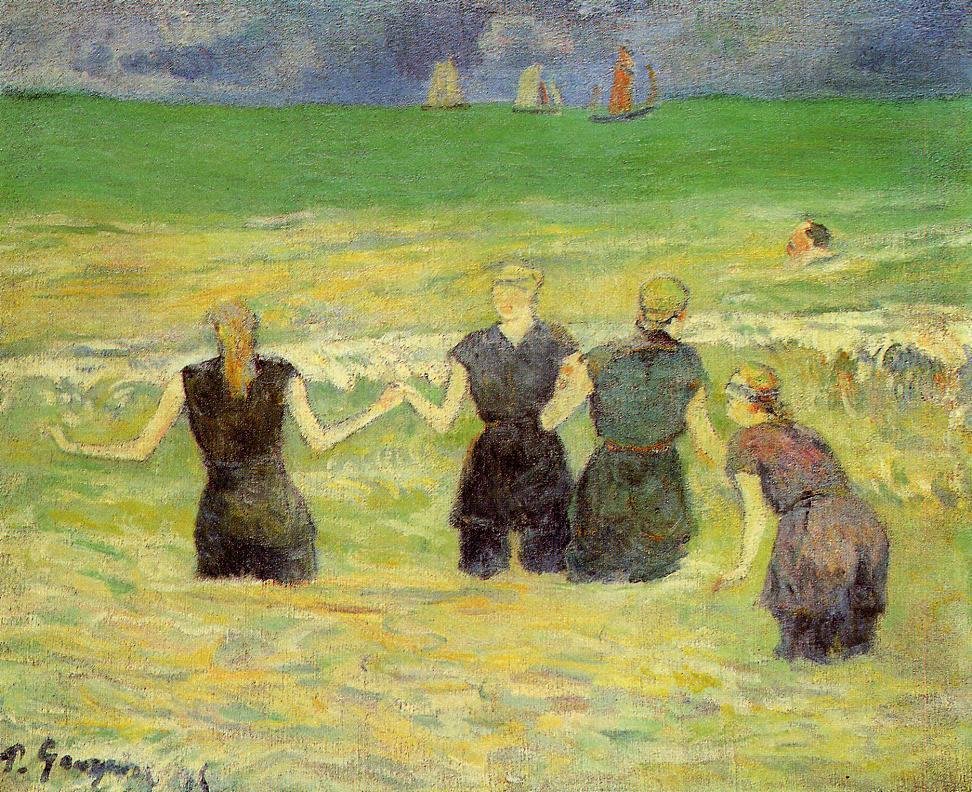
Women Bathing in Dieppe was painted during the period when Gauguin lived in Dieppe, on the coast of the English Channel.
The work was exhibited at the 8th Impressionist Exhibition in 1886.
Its composition, based on a horizontal strip and simplified figures with thick outlines, demonstrates the artist's growing need to distance himself from the predominant Impressionist style of the time.
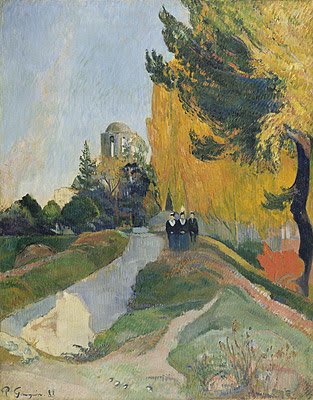
Les Alyscamps, also known as The Three Graces at the Temple of Venus, is a prominent work.
With its juxtaposed masses and the "hatching" style of color, this painting is characteristic of Gauguin's Synthetism.
The brushstrokes, which bear some resemblance to Cézanne's style, allowed him to transcribe the motif without being bound by the imitation of the real world.
The highly saturated tones employed in the canvas are a subjective and decorative interpretation of the landscape.
It is interesting to note that this serene vision of Les Alyscamps contrasts sharply with the contemporary, and often tormented, compositions that Van Gogh painted of the same location.
Much like Gauguin’s search for meaning in far-off lands, other historical masters underwent profound geographical and stylistic journeys to find their voice. Biography of El Greco: The Greek Origins and Journey to European Renaissance
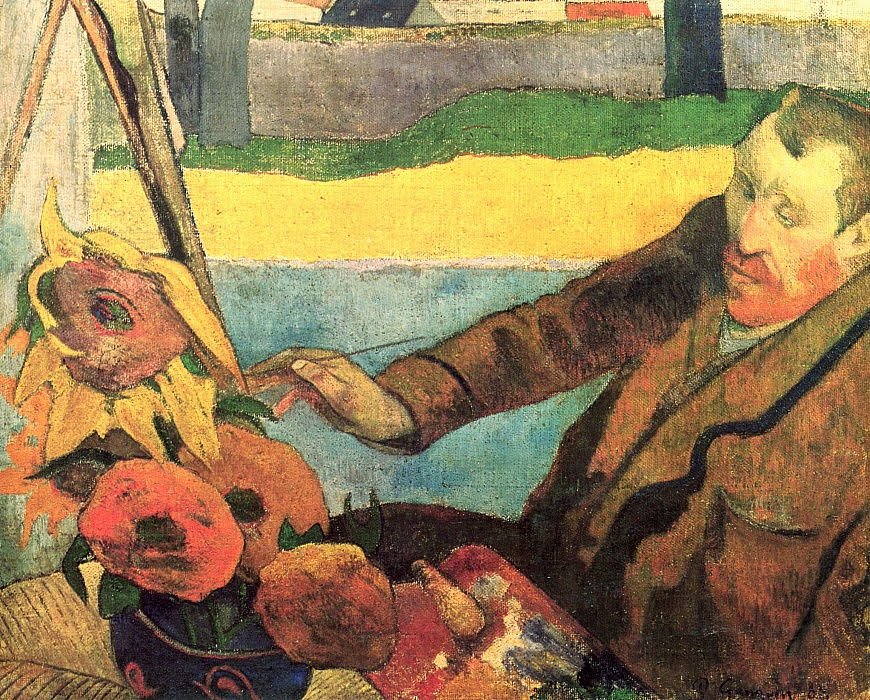
The Portrait of Van Gogh is a piece that generated controversy.
Vincent's first impression, upon seeing this painting of himself, was that Gauguin had portrayed him as a madman.
Later, he softened his view in a letter to his brother Théo, writing: "My face has brightened a lot since then, but it was indeed me, extremely tired and charged with electricity as I was at the time."
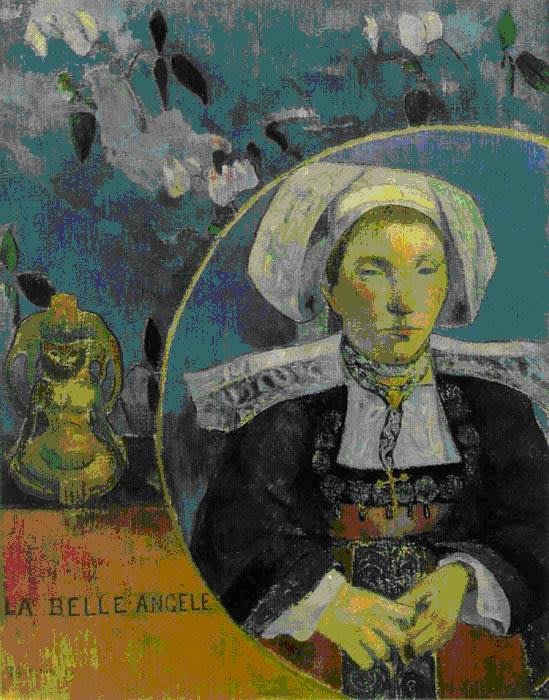
The Beautiful Angele was a painting with an interesting destiny.
The work was acquired by the renowned artist Edgar Degas at an auction.
This auction was organized by Gauguin himself, with the aim of raising funds to finance his long-dreamed-of trip to Tahiti.
The model for this portrait, posing in a typical Breton costume, was Marie-Angèlique Satre.
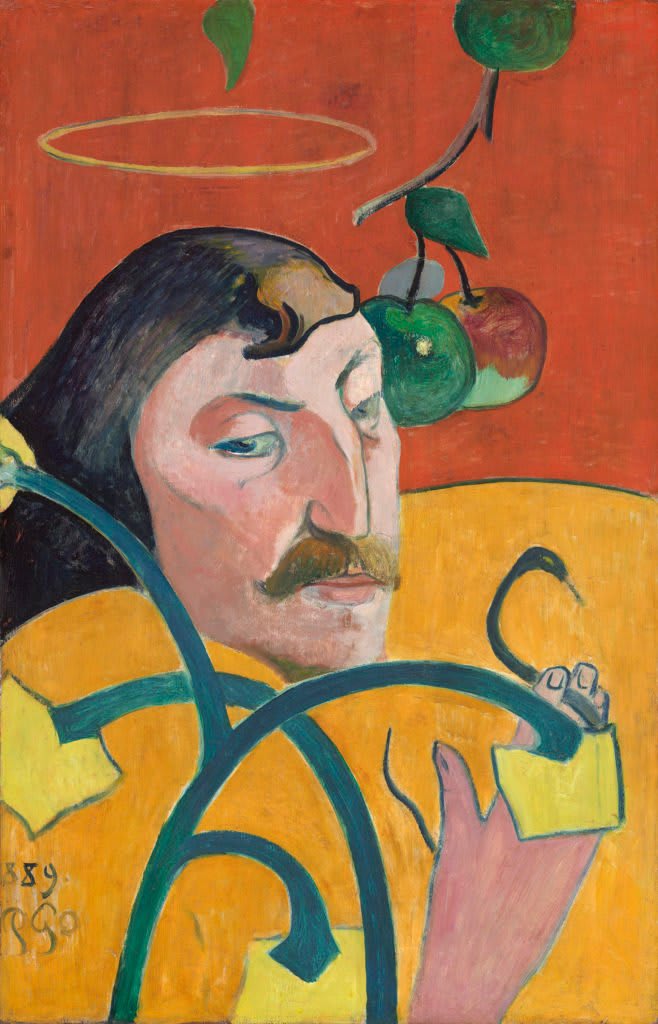
The Self-Portrait with Halo is, without a doubt, one of Paul Gauguin's most important and radical paintings.
In it, the artist represents himself with a halo, almost bodiless, with only one hand visible.
A snake, a complex symbol, is inserted between his fingers, all floating in amorphous zones of yellow and red.
These elements of the composition add an ironic and aggressively ambivalent inflection to the work.
The painting presents us with his perception of artistic superiority, making him the precursor of a new and audacious aesthetic outlook.
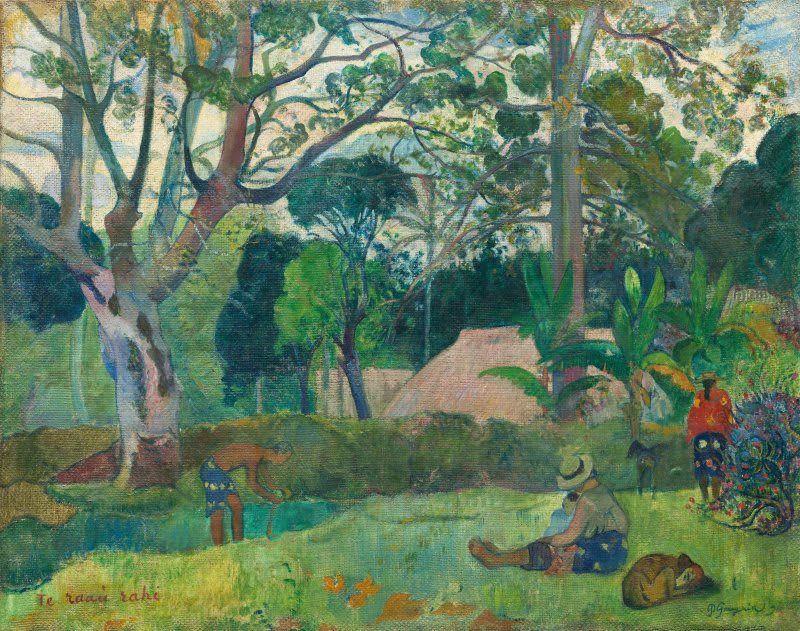
Upon arriving in Tahiti in June 1891, Gauguin was deeply interested in observing and understanding the local vegetation.
The large tree mentioned in the title of this painting is, specifically, the hotu tree, which stands out to the left of the composition.
The work is imbued with intense and dreamlike colors, striking characteristics of his Tahitian period.
The composition is highly decorative, organized around curved and exuberant lines that transcend the merely topographical, seeking a more symbolic and sensorial representation.
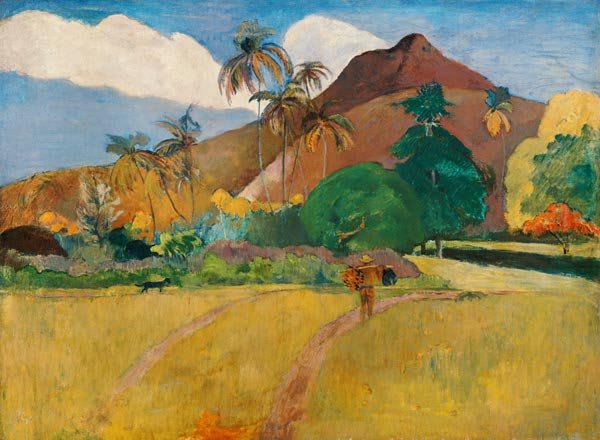
In Tahitian Landscape, Gauguin was deeply touched by the unusual silence and the atmosphere of eternity of this paradisiacal place.
The peaceful atmosphere pervades the ample composition, which surprisingly includes few elements, inviting contemplation.
Suggested by the presence of a small solitary figure, the scene's proportions are immense, amplifying the sense of vastness before the light and depth.
The harmonious colors, the succession of curves, and the expanse of the surfaces are elements that characterize Gauguin's unique style during this period.
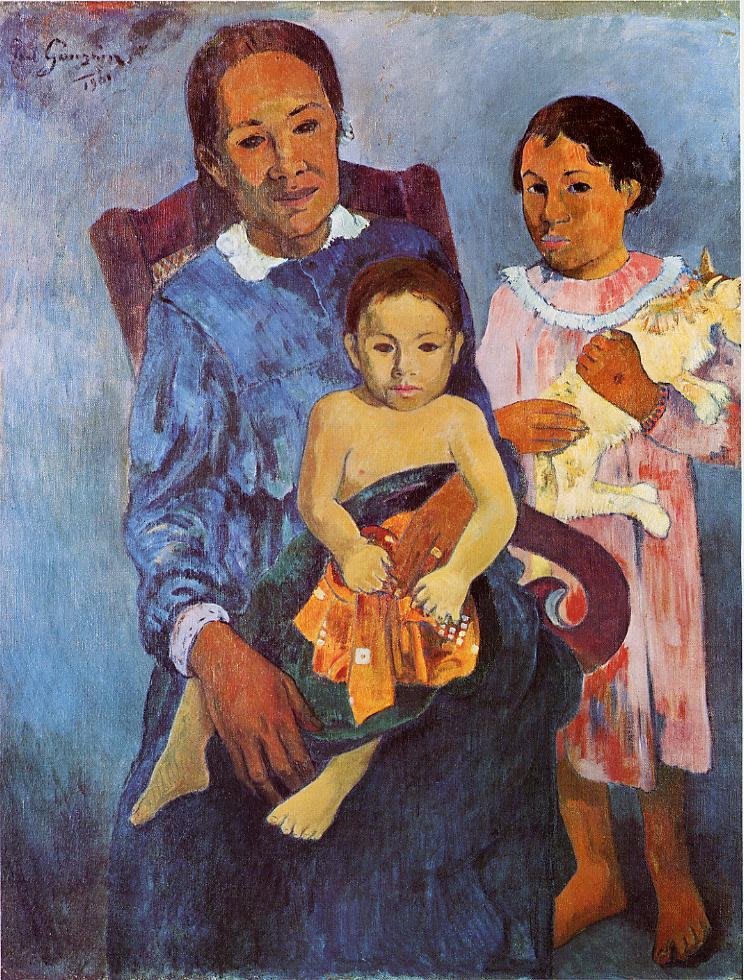
The composition of Tahitian Woman and Two Children evokes the Christian image of the Virgin Mary with the Infant Jesus and the young Saint John the Baptist.
However, here, the "elder son" is presumably the girl in the right corner of the canvas, adapting the iconography.
It is possible that the boy portrayed in the woman's lap is one of the artist's own children, born to his Tahitian mistress Pahura.
The boy was named Emil, in homage to Gauguin's eldest legitimate son.
The older woman in the painting could, hypothetically, be the boy's maternal grandmother, a detail that adds familial depth to the scene.
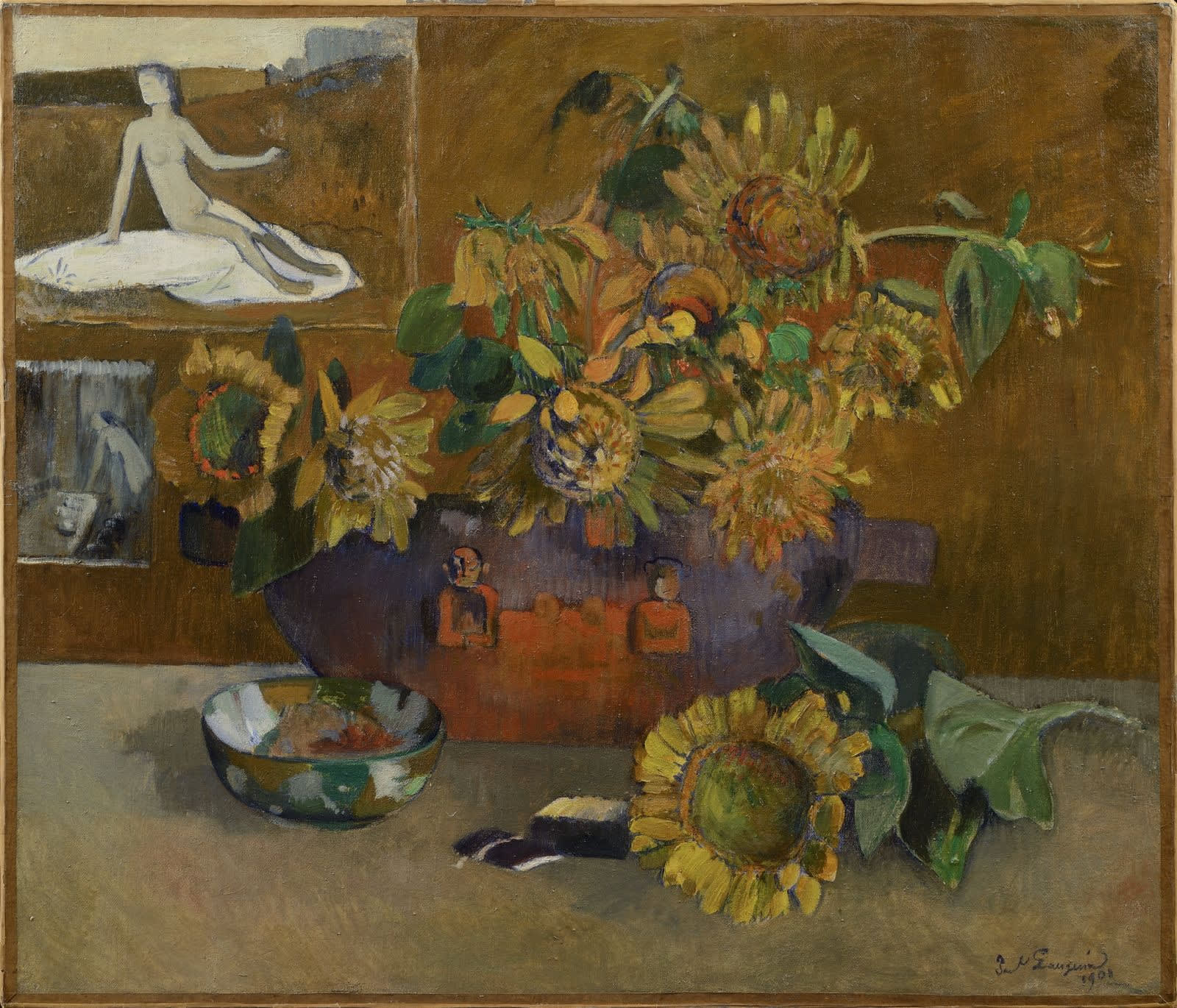
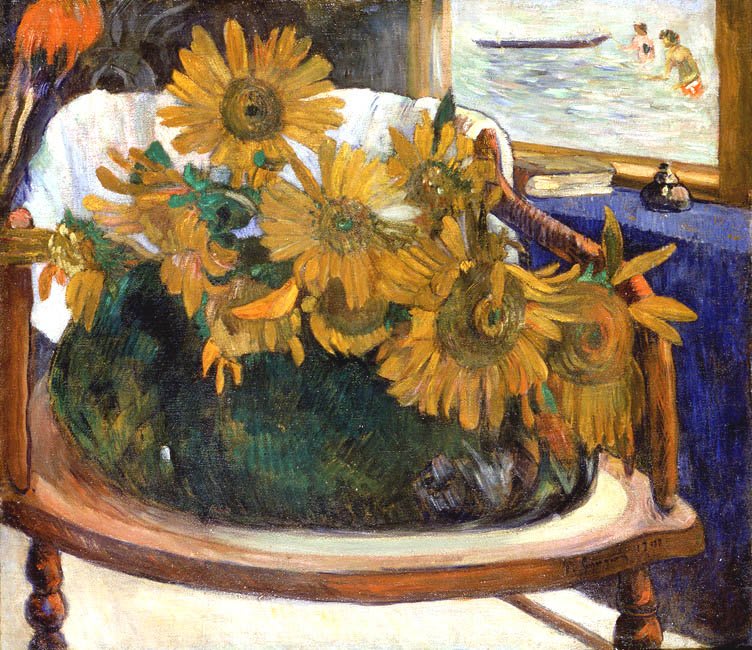
Gauguin's first still lifes, including sunflower arrangements, were painted in Brittany between 1888 and 1890.
Georges Wildenstein, commenting on this painting, refers to a letter from Gauguin to his friend, the sculptor Daniel de Monfreid, dated October 1898.
In the letter, the artist asks for seeds and bulbs for his small garden in Tahiti, showing his personal involvement with nature.
His painter's eye was visibly enchanted and inspired by these sunflowers he himself cultivated.
This is evidenced by the four sunflower still lifes that Gauguin produced in quick succession in Tahiti in 1901.
For him, whose thoughts always floated between Tahiti and France, sunflowers always evoked memories of Van Gogh and their joint stay in Arles in 1888.
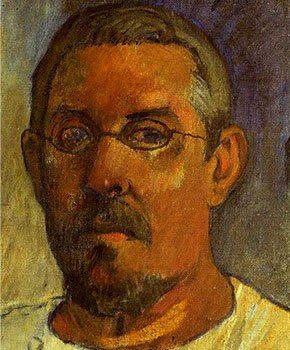
Gauguin portrayed himself numerous times throughout his life, exploring his own image and identity.
This, in particular, is his last self-portrait, painted in the same year he passed away.
Alongside the work, he left a profound reflection: "Life is but a fraction of a second. So little time to prepare for eternity!"