São Paulo - Tarsila do Amaral
Discover the iconic work 'São Paulo' by Tarsila do Amaral, a key figure in Brazil's modernist movement.
We invite you to explore the work 'São Paulo' by Tarsila do Amaral, a pioneering figure in Brazil's modernist movement.
Painted in 1924, this piece captures the city of São Paulo in a unique and symbolic way, representing the city's development and diversity during a time of transformation.
With vibrant colors and simplified forms, Tarsila captured the dynamic and pulsating essence of the city, making it a landmark in Brazilian art history.
Painted by Tarsila do Amaral in 1924, a pivotal year in the development of her work, the canvas 'São Paulo' is one of the key works of the 'Pau-Brasil' phase, characterized by her reconciliation of a rediscovered Brazilian visuality with a highly particularized reworking of the lessons she received from the Cubists, André Lhote (1885-1962), Fernand Léger (1881-1955), and Albert Gleizes (1881-1953) in Paris.
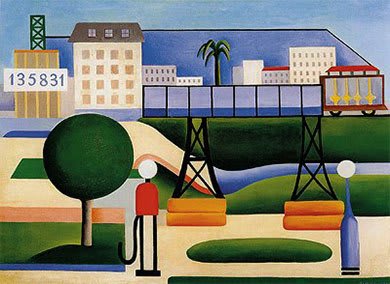
Modernity is the focus of this work, with Tarsila placing both the national landscape – the cheerful and innocent colors of the rural scene that reunites with joy in the historic trip to Minas Gerais – and the transformation of the small town into a metropolis in the foreground.
What the painter does in canvases like 'São Paulo' is to situate the perception of Brazil from the open perspective opened up by industrialization.
We are faced with a very incipient modernity, symbolized above all by the buildings that begin to emerge in the city's sky, the iron structures that support the viaduct, and mainly the tram that, in the top right corner of the canvas, seems to be responsible for the dynamism of the set.
The constructions in the background, worked with depths only suggested, appear contained and led by a single line.
This line organizes and gives meaning to the group led by the wagon, which refers more to the interior landscapes than to a thriving view of a developing city.
What gives movement to the canvas is not so much the representation of these few symbols of modernity.
It is the succession of lines that cut it horizontally and lead the gaze from left to right, giving logic to the movement.
These straight (passeio and train line) or curved (river and outline of buildings) courses, often fragmented by strong vertical elements (figures, tree trunk, buildings, iron girders, etc.), create a fabric that sustains and animates the entire set.
Color continues to be used as a defining element of forms, but the artist uses a subtle game of shadows, influenced by Fernand Léger's painting, to help demarcate the volume of the elements in the canvas, distancing herself from the one-dimensional movement inaugurated a decade and a half earlier by Pablo Picasso (1881-1973) and Georges Braque (1882-1963).
What Tarsila seems to be looking for here is not the effect of chromatic contrast, but a harmonization of possible tones, derived from this particular landscape, giving body to the fertile clash of the period, driven by the double desire for modernity and local rooting.
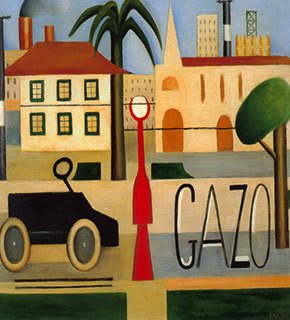
In 'São Paulo 'Gazo', Mario de Andrade wrote: 'Observe São Paulo, it would be vain to prove the eminent plasticity, even violence of this work. But the objects chosen for creation form an intense and nationalist expression of what is the city of São Paulo. There is in Gazo the [sic] fury of the announcement that characterizes the great industrial agglomerations. On the wide avenue of the modern city, with trees that remind us of the richness of our arborization, tram tracks, the extravagant figure of the Ford. And there is the Motano gasoline distributor, as the matrix force of this enormous movement. It is also worth noting that the choice of Ford and not a Cadillac was not made at random. The interior of the wealth flowing, competing for the greatness of the strange capital of São Paulo. The colonial part of the city has not been forgotten. But in this, the chimneys dominate and stand out the skyscraper.'
Alongside the geometrization and the weaving of the scene, it is essential to highlight the importance of the choice, treatment, and combination of colors, a question that plays a central role in Tarsila's work and is particularly striking in this painting.
The greens, blues, and reds make up a less intense and contrasting palette than other works of the same period, but they still have something of innocence, a strange innocence to the cultivated art of the time.
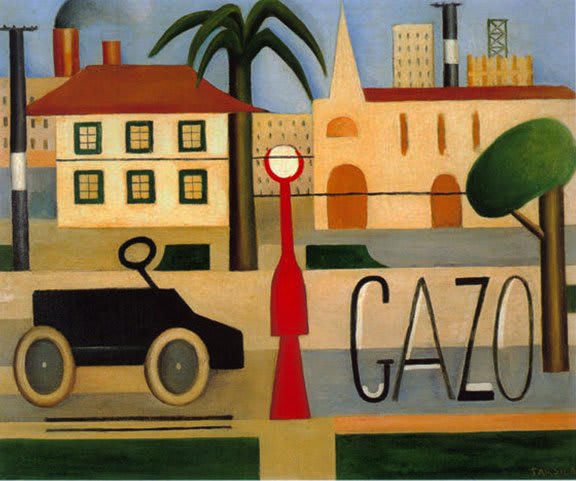
Color continues to be used as a defining element of forms, but the artist uses a subtle game of shadows, influenced by Fernand Léger's painting, to help demarcate the volume of the elements in the canvas.
But history holds a bizarre detail: Color continues to be used as a defining element of forms, but the artist uses a subtle game of shadows, influenced by Fernand Léger's painting, to help demarcate the volume of the elements in the canvas.