
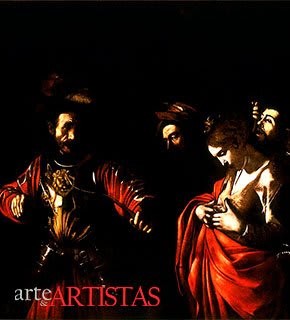
The Martyrdom of Saint Ursula, Caravaggio
The Martyrdom of Saint Ursula, Caravaggio
The Martyrdom of Saint Ursula is likely Caravaggio's last completed painting. In fact, through this work, he makes his final self-portrait.
Before understanding the painting, it's essential to know the story of Saint Ursula. She is a saint in the Catholic Church from Britain, martyred around 383 in Colonia in Germany. According to the Golden Legend by Jacques de Voragine, Ursula, a British princess, accompanied by her 11,000 companions, is captured by the Huns who besiege Colonia while returning from a pilgrimage to Rome.
After her refusal to marry her leader Atila and deny her faith, she and her followers are pierced by arrows.
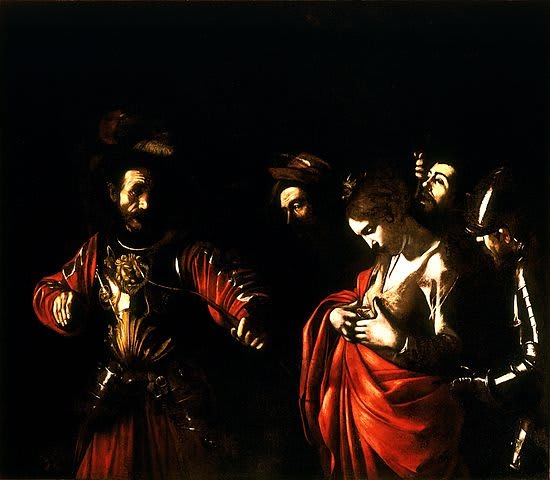
The life of Saint Ursula:
Ursula is the patron saint of the city of Colonia and of textile manufacturers, and she gave her name to the Order of the Ursulines, which dedicates itself to the education of girls. Her feast day is celebrated on October 21.
Reading the work...
This painting was commissioned by the Doria Family of Genoa and remained in their possession until 1973, when it was purchased by the Naples subsidiary of the Italian Commercial Bank. It is currently housed in the Zevallos Stigliano Palace on Toledo Street in Naples.
Classical iconography often represents her surrounded by her companions or in cycles of Saint Ursula showing her departure, pilgrimage, and torture. Caravaggio, as always, focuses the action on a small number of characters.
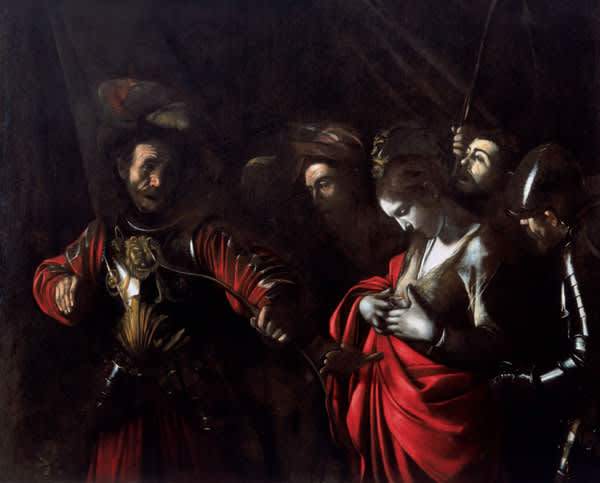
In the foreground, we find a soldier, probably represented by Atila, armored in gold and dressed in red, releasing the string of his bow, whose arrow penetrates the heart of the Saint who
looks at her wound, whose blood flows onto the red of her clothing, merging with it. Behind Ursula, the heads of two people emerge, and that one, with the stretched neck, would be Caravaggio's self-portrait.
The restoration of the painting revealed, in addition to the original colors, an open hand that seems to push the viewer away to leave the protagonists in a dark and dramatic scene, like all the paintings of the Baroque.


