
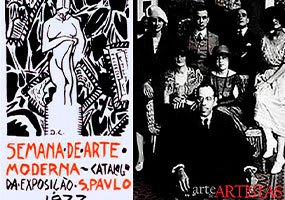
The Modernist Week of 1922: A Turning Point in Brazilian Art
Discover the significance of the Modernist Week of 1922 in Brazilian art
Immerse yourself in the Modernist Week of 1922, a pivotal moment in Brazilian cultural history.
Hosted at the Theatro Municipal de São Paulo, this groundbreaking event brought together artists, writers, and intellectuals who challenged the aesthetic norms of the time, promoting freedom of expression and the valorization of national identity.
The Modernist Week of 1922 marked the beginning of Brazilian modernism, profoundly influencing literature, music, painting, and sculpture in the country.
As you explore this historic event, you will discover a moment of rupture and innovation that transformed Brazilian art forever.
February is an important month for culture in Brazil.
In 1922, an event took place at the Teatro Municipal de São Paulo that completely changed the course of art in Brazil.
Launched during Carnival, the Modernist Week shocked the São Paulo elite and revealed to Brazil the existence of a vanguard movement in the country.
The Peak of Catcalls: "The Frogs"
Imagine the Teatro Municipal transformed into a massive noisy greenhouse.
The most tense moment of the Week occurred when Ronald de Carvalho took the stage to recite Manuel Bandeira's poem "The Frogs".
The audience, feeling provoked by the satire of parnassianism, reacted with choruses of frogs, barks, and deafening catcalls echoing through the galleries.
This was the living proof that modern art had fulfilled its role: to take the public out of its inertia.
Notable figures from Brazilian culture stood out, including Mario de Andrade, Oswald de Andrade, Menotti del Picchia, Heitor Villa-Lobos, Di Cavalcanti , Anita Malfatti ,Víctor Brecheret and others who will be mentioned later and who also participated in this event.
Where was Tarsila do Amaral?
Although she is the most recognizable face of Brazilian modernism, Tarsila do Amaral did not physically participate in the Week of 22.
At that time, the painter was living in Paris, studying European vanguard movements and refining her academic technique before the great rupture.
She would only join the group months later, brought by the enthusiastic letters of Anita Malfatti, completing the "Group of Five" that would change the course of our culture.
Adding the efforts since Anita Malfatti's Exhibition in 1917, the defenders of modern art decided to make their ideas public.
The suggestion came from Di Cavalcanti, and Graça Aranha was the one who made the connection between this and the future sponsors of the event.
Thus, in the year of the centenary of Independence, the activities of the Modernist Week were inaugurated at the Teatro Municipal, with a conference by Graça Aranha, received both with applause and catcalls.
Who Paid the Bill?
There is a fascinating irony in the backstage of 1922: the aesthetic revolution that aimed to shock the bourgeoisie was financed by it.
The "coffee barons," such as Paulo Prado, were the great patrons of the event.
This coffee elite, conservative in its business, but cosmopolitan in its European travels, wanted São Paulo to stop being a provincial city and become a modern metropolis, even if it meant sponsoring its own social critique.
The Modernist Week was inaugurated on February 13, 1922, and lasted until February 18.
We highlight some of the works:
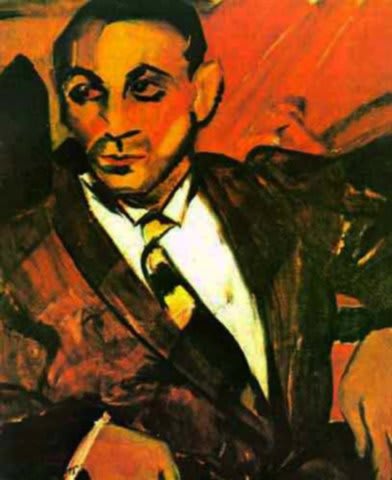
1. Anita Malfatti with the painting: The Yellow Man
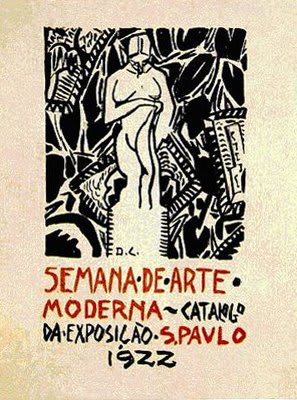
2. Di Cavalcanti and the Visual Heritage
Notice the break from traditional perspective in the iconic cover of the Modernist Week catalog.
As Di Cavalcanti drew the figures that illustrated the event, he did not seek anatomical perfection, but rather a visual synthesis that combined cubism and expressionism with a deeply Brazilian theme.
This was the first sign that Brazil did not want to simply copy Europe, but "devour" it.
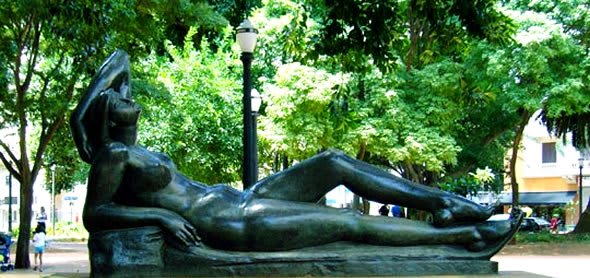
3. Víctor Brecheret
Victor Brecheret participated in the Modernist Week even though he was physically distant.
He was friends with Di Cavalcanti, Mário de Andrade, Menotti Del Picchia, and Oswald de Andrade.
At the time, he was living in Paris, but decided to participate with twenty sculptures that were displayed in the foyer and corridors of the Teatro Municipal de São Paulo.
The visual arts exhibition, which included around 100 works, had the support of influential politicians and coffee millionaires.
Paintings and sculptures were scattered throughout the foyer of the Teatro Municipal for three nights, competing with poetry and music sessions.
The visual exhibition provoked a reaction of amazement from the public, while the poetry and music sessions were met with catcalls, causing great euphoria.
To open the Modernist Week, we highlight a passage from Graça Aranha's conference, titled “The Aesthetic Emotion in Modern Art”:
"For many of you, the curious and suggestive exhibition, which we gloriously inaugurated today, is a collection of "monstrosities." That Genius supplicated, that Yellow Man, that Carnival, that Inverted Landscape, if they are not games of the fantasy of zany artists, are certainly wild interpretations of nature and life. Your astonishment is not yet over. Other "monstrosities" await you. Soon, joining this collection of absurdities, a free poetry, an extravagant but transcendent music, will come to revolt those who react driven by forces of the past."
The Names Behind the Rupture
The Municipal stage received a constellation of talents that, although diverse, shared the urgency of the new.
From consolidated names to young promising ones, these articulators were the architects of a national identity that still resonates in our artistic production today.
ORGANIZERS:
Di Cavalcanti, Graça Aranha, Guilherme de Almeida, Mario de Andrade, Menotti Del Picchia, Oswald de Andrade, Ronald de Carvalho, and Rubem Borba de Moraes
Who Took the Stage
Between musicians, writers, and plastic artists, the list of participants reveals the collective effort of a generation.
Each name present carried the weight of facing traditionalism in search of an authentically Brazilian voice, free from the shackles of colonial past.
MEMBERS:
Anita Malfatti, Di Cavalcanti, Ferrignac, John Graz, Martins Ribeiro, Paim Vieira, Vicente do Rego Monteiro, Yan de Almeida Prado, and Zina Aita (Painting and Drawing);
Hildegardo Leão Velloso, Victor Brecheret, and Wilhem Haarberg (Sculpture);
Antonio Moya and Georg Przirembel (Architecture);
Ernani Braga, Guiomar Novaes, and Heitor Villa-Lobos (Music);
Afonso Schmidt, Graça Aranha, Guilherme de Almeida, Menotti del Picchia, Oswald de Andrade, Plínio Salgado, Ronald de Carvalho, and Sérgio Milliet (Literature), among others.
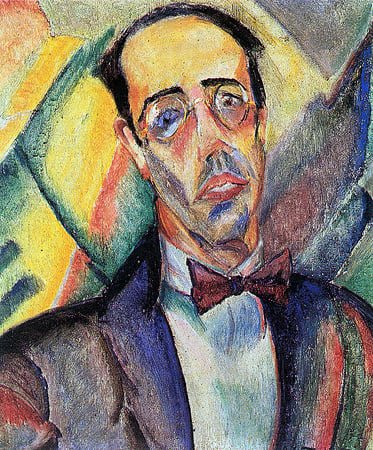
The poet Mário de Andrade, one of the main idealizers of the Modernist Week, recited the second day, the poem Ode to the Bourgeois which is part of his book Paulicéia Desvairada. It was published in 1922 and is recognized by many as the first vanguard work of the modernist movement.
Below, a video with selected scenes from the Mini-series "One Heart Only", broadcast in 2004. (Credits: Rede Globo)
Beyond the Centenary: The Living Legacy
More than a dated celebration in 2022, the centenary of the Modernist Week served to reaffirm that the movement was not an isolated event, but a continuous process.
Today, the legacy of 1922 is not just in the history books, but in the freedom of each contemporary artist to experiment, provoke, and reinvent what it means to be Brazilian through art.
During the year 2022, many activities were carried out to commemorate the 100th anniversary of the Modernist Week.
To celebrate the event so important for the History of Brazilian Art, the Secretariat of Culture realized projects of actions in conjunction with the Economy of Creativity of the Government of the State of São Paulo.


