
Vincent van Gogh: Biography, Early Life and Notable Early Works
Explore the life and work of Vincent van Gogh, one of the most influential and celebrated painters in the history of art.
I invite you to explore the life and work of Vincent van Gogh, a painter who is one of the most influential and celebrated in the history of art.
Born in 1853, in the Netherlands, Van Gogh is known for his expressive and emotive works, which capture the intensity of his personal experiences and his unique vision of the world.
Despite his short and tumultuous career, Van Gogh created over 2,000 works, including famous paintings such as "The Starry Night," "Sunflowers," and "The Potato Eaters."
His vigorous technique, bold use of color, and expressive brushstrokes made him a pioneer of post-impressionism.
By learning about the biography and works of Vincent van Gogh, you will be transported to the singular universe of a artistic genius whose passion and dedication to art left a lasting legacy.
Vincent van Gogh, is undoubtedly one of the most important and researched artists in the history of art.
While producing between 1880 and 1890, he was ignored by the critics and the majority of the artistic world.
It was only after his death in 1890 that he became a celebrity and was recognized as the genius he was.
BIOGRAPHY of Vincent van Gogh
Vincent Willem van Gogh was born on March 30, 1853, in Zundert, a small village in the Dutch province of Brabant.
He was the second son of the pastor Theodorus van Gogh and Anna Cornélia Carbentus, a woman with artistic inclinations.
By a remarkable coincidence, he was born exactly a year after his mother had given birth to another boy, who was also named Vincent, but who did not survive the birth.
The child was buried in the church cemetery.
And so, he grew up under the stigma of his deceased brother, often coming across his own name written on the tombstone.
His father was a Protestant minister who invested heavily in his children's education.
Vincent learned French, English, and German.
Van Gogh never got along with his parents and had few friends.
In 1868, he left school to work with his uncle in The Hague (Netherlands), in an art dealership, which he did not adapt to.
At 24, he decided that his vocation was evangelism.
He even studied theology in Amsterdam.
He soon abandoned the course and went to work as a lay preacher in the coal mines of Borinage, in Belgium.
There, he distributed all his belongings among the poor, lived in shacks, and fought to improve the living conditions of the miners.
He decided to change course in his life, opting for an artistic career, wanting to be a painter.
This happened when his salary was suspended, and the social activities he developed were not well received by his superiors.
Vincent was unable to earn money to support himself and often gave in to unrequited passions.
His only connection to the world was his brother Theodorus, four years younger.
Aside from providing for his sustenance, Théo van Gogh corresponded with his brother constantly.
The first nervous crises occurred in London, after the artist had suffered his first disappointment in love with a girl named Ursula.
For three years, the artist sought refuge in religion.
He took his spiritual fervor to the extreme, renouncing comfort to help people.
It is possible that at this time his health worsened.
"Ask the doctor if the nights spent outdoors, if the fear of not having even a piece of bread to eat, if the problems with friends and family are not responsible, at least in part, for my mood swings."
At 27, he discovered that painting would be his only salvation.
However, art did not bring him closer to people.
But in his ten years of career, he continued to be unable to live in society.
He fell in love with Clasina Maria Hoornik, a prostitute and an alcoholic.
The relationship lasted only a year.
After that, Van Gogh spent most of his days alone.
Vincent lived in Belgium and Paris until he settled in Arles, in southern France, in 1888.
This was his most productive phase, but also the one with the worst financial situation.
The nervous crises were worsening, he had few friends, except for the painter Paul Gauguin, who had come to live with him for a few months at his invitation.
The goal was to found an artists' colony, he invited several, but only Gauguin accepted, but the two painters were of impulsive temperaments and with Vincent's mental instability, the fights between them were constant.
A CUT EAR WITH A RAZOR
On December 23, 1888, Paul Gauguin decided to leave for the night.
He had already communicated to Vincent his desire to leave him.
With fear of Gauguin leaving at any moment, the painter used to follow him.
That night was no exception.
Gauguin decided to spend the night at a boarding house.
When he returned home, Van Gogh, in the midst of terrible hallucinations, cut off a piece of his left ear.
He then wrapped the cut piece in a handkerchief and went to a brothel.
There, he offered it to a prostitute named Rachel - according to some, the reason for his fight with Gauguin.
He then returned home and went to bed.
Hours later, he was found by the police, who took him to the hospital.
Gauguin left immediately and never saw his friend again.
Van Gogh spent 14 days in the hospital.
Without friends and suffering from acute paranoia, he decided to intern himself at the Saint-Rémy asylum.
In May 1890, he moved to Auvers-sur-Oise and, at the suggestion of Camille Pissarro, a painter and an impressionist, Van Gogh began a treatment with the Dr. Paul Gachet, a homeopathic doctor who gave him a lot of freedom, bought him paintings and encouraged him to paint.
Vincent painted regularly and initially seemed to be in good health.
He had rented a room and was able to maintain regular habits.
But in early June, a visit to his brother in Paris left him anxious - Theo was worried about money, and Vincent realized that his support was too expensive for his brother.
Back in Auvers, he did not find Dr. Gachet, who had traveled for professional reasons.
Lonely and tormented, on July 27, 1890, a Sunday, Van Gogh went out for a walk between the wheat fields in the surrounding area.
And, having taken a revolver to shoot the crows, he ended up shooting himself in the chest.
He returned home, stumbling, and went to bed: strangely calm, he spent the whole night smoking his pipe.
The next day, Theo arrived, alerted by Dr. Gachet.
For the whole Monday, his friends took care of him, until he died in his brother's arms at 1 am on Tuesday, at the age of 37.
THE ARTIST AND HIS WORK
Vincent van Gogh did not know fame or fortune.
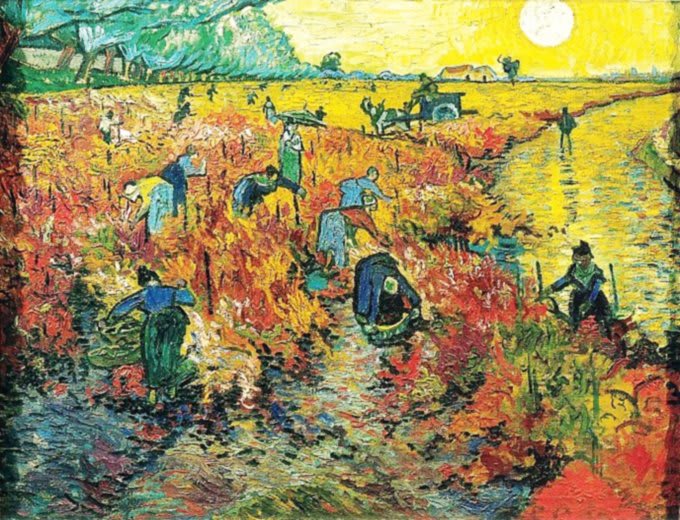
Throughout his life, the master painter sold only one painting: Vineyards or The Red Vineyard, in Arles.
He lived only 37 years and in that short period of life, he went hungry and cold, with his brother Théo as his only support, who always encouraged and financially helped him.
 Vincent van Gogh" class="wp-image-6289"/>
Van Gogh is classified as a post-impressionist painter.
He was a contemporary of the impressionists, had the same objectives, but with distinct characteristics and a unique style.
His painting was completely emotional, strong brushstrokes, and we have in Van Gogh the precursor of the expressionism.
Movement that took place especially in Germany, at the beginning of the 20th century, whose main characteristic is to express human feeling.
 Vincent van Gogh: The Starry Night" class="wp-image-6262"/>
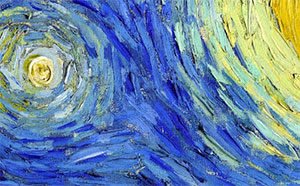
Expressionism was a kind of projection of subjectivity, based on an emotional reaction.
The artist's anguished feelings are expressed in his painting in strong brushstrokes and dominant colors.
In one of his last letters to Theo, his brother who supported him so much, he said:
"I don't need to leave routine to express sadness and the extreme of loneliness."
 Vincent van Gogh" class="wp-image-16224"/>
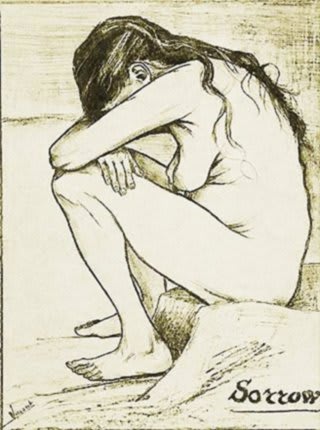
Sorrow is a lithograph that was also used as a base for Sorrowing Woman, a drawing made with pencil by the painter in Paris, around January and June 1887.
The nude depicted belongs to Clasina Maria Hoornik, better known as Sien.
This drawing is part of a series made by Van Gogh using Sien as a model, which he mentions in several letters and describes as "the best figure I've ever drawn."
Van Gogh would have found Sien wandering the streets, pregnant and with her five-year-old daughter in January 1882.
She was an alcoholic and a smoker, and worked as a prostitute.
Van Gogh took her in and took care of her for a year.
While the painter provided her with shelter, Sien was his model to practice his drawing skills.
In July 1882, Sien gave birth to a boy, Willem, at the maternity hospital in Leiden.
Van Gogh believed that he would have a happy life with her.
However, in mid-1883, Sien returned to drinking and resumed prostitution.
The relationship between them deteriorated until Vincent could no longer bear the woman and her children, who left the artist's apartment in 1883.
It is said that Sien died drowned in 1904 after the painter's death, possibly by suicide.
To understand the rest of this journey, continue to our next article: Vincent van Gogh: The Great Works and the Artistic Legacy in Post-Impressionism.


