
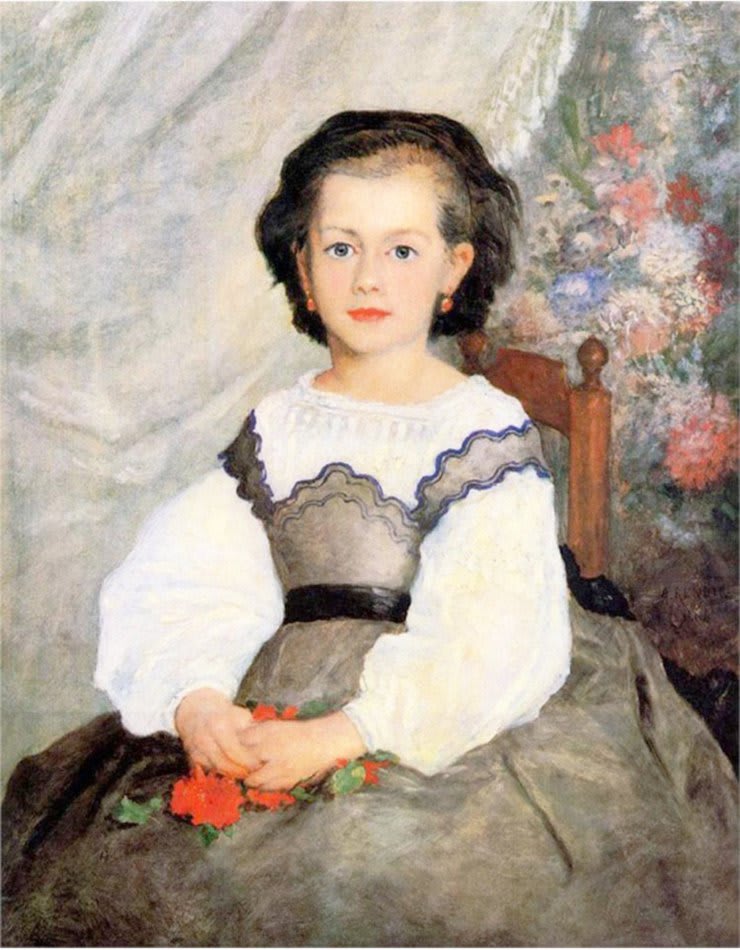
Auguste Renoir Biography and Major Works: The Impressionist Journey Begins
Auguste Renoir Biography and Major Works: The Impressionist Journey Begins
Auguste Renoir was an important painter and one of the main members of the impressionist movement, alongside Claude Monet and Edgar Degas, among others, he stood out for his beautiful paintings, whose eye for beauty made him one of the most popular practitioners of this movement.
Pierre Auguste Renoir was born in the city of Limoges, France on February 25, 1841. His father was a tailor and his mother a seamstress, a middle-class family.
The Renoir family moved to Paris in 1844, in search of a better life. From an early age, the young Renoir showed aptitude for painting. He attended a regular school until the age of 13, then began working at a porcelain factory owned by the Irmãos Levy, where he painted bouquets and flowers. He worked at this factory until the age of 17 and then worked for M. Gilbert, painting religious themes sold to missionaries. He also painted fans and fabrics that allowed him a better remuneration.
From 1861 on, he began to frequent the studio of the Swiss painter Charles Gleyre, in addition to visiting the Museu do Louvre as a copyist. The following year, he enrolled in the Escola de Belas Artes.
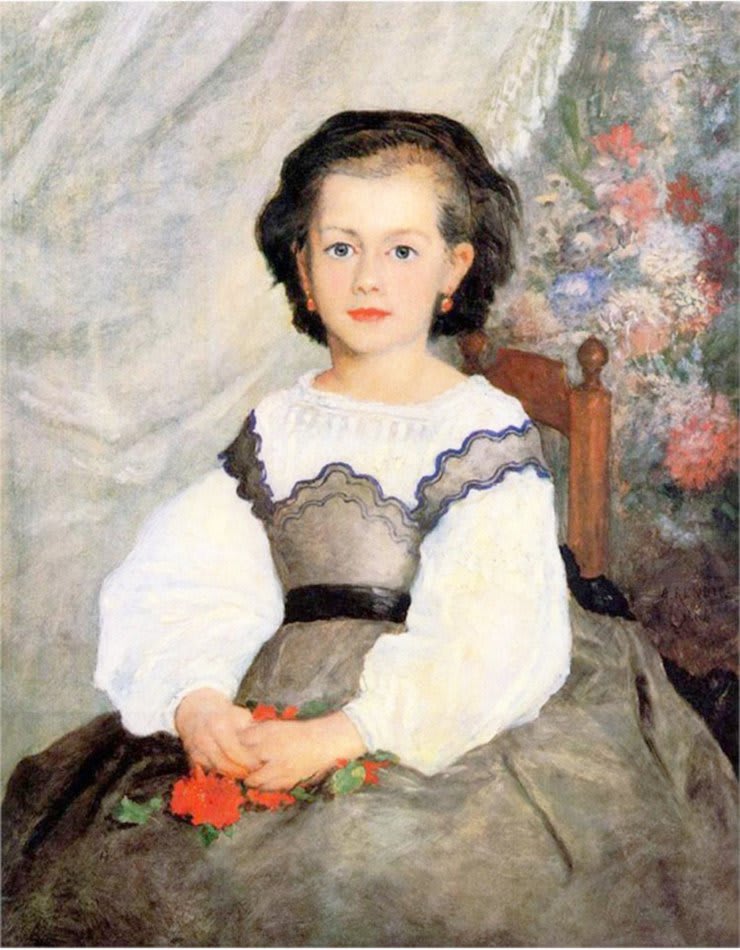
This painting is an introduction to a modest ceramics artist, who wants a portrait of his daughter. In the painting, simplified forms can be observed in the dress and a great delicacy in the tones, in addition to a constant mark in his portraits: the luminosity of the eyes.
In 1862, he began his studies at the Academia de Belas Artes. It was during this period that he met Claude Monet and Alfred Sisley, who became his friends and partners in the impressionist movement.
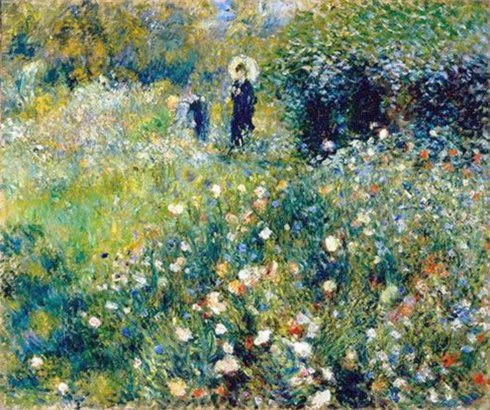
Lise posed for this painting in Fontainebleau. The work was inspired by the painting of Coubert. Despite the relative success of the work at the time, Renoir was going through financial difficulties and the young woman lived with Renoir in the house of her parents. 'Lise with the parasol' was his first major work of importance.
In 1869, Auguste Renoir and Claude Monet dedicated themselves to the same theme, the Balneário de Grenouillère. They painted together, observing the same landscape outdoors, side by side, studying the effects of movement and light on the water.
Parallel to the paintings and experiments made outdoors, Renoir continued to produce more traditional works, destined for the official Salon. “Banhista com Cão Grifon” was accepted at the Salon of 1870, along with the work “Mulher de Argel”. Although his style was not rigorously traditional, it brought elements already partially assimilated by the jury, such as the bidimensionalism seen in works by Édouard Manet.
In 1870, Renoir was called up for the Guerra Franco-Prussiana. Upon his return to the French capital in 1871, he found himself in the midst of the Comuna de Paris conflicts.
Despite his great identification with the impressionist painters, Renoir did not define himself as a revolutionary. Unlike Monet, he gradually incorporated other themes into his work, in addition to landscapes, such as artistic nudes, everyday moments, and portraits.
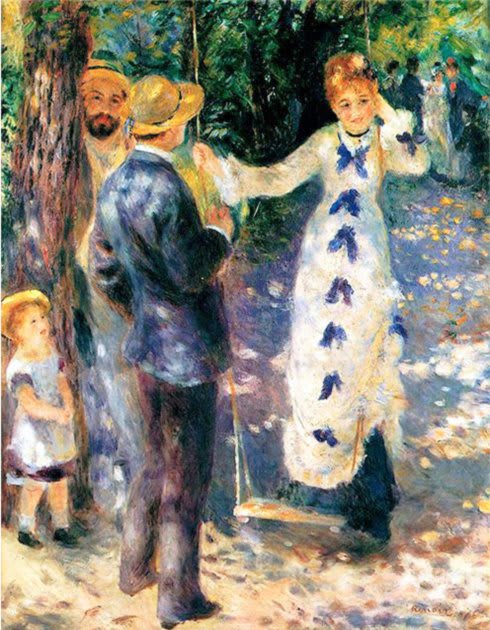
In the spring of 1876, Renoir sketched several large canvases in the dependencies of the Moulin de La Galette, O Balanço being one of them.
Renoir believed that the nude was the most indispensable form of art, saying: "it is impossible to imagine something more beautiful." This painting emphasizes the elegance of the silhouette, while at the same time attenuating the contours and the colors blend together forming a charming harmony.
In conversation with his friends, Degas commented: "The nudes that had never appeared in public seem to be discovered secretly, seen with a furtive glance. It is possible. I saw some images. They certainly do not have the naturalness and freshness of the bodies and women of Renoir." (Edgar Degas)
To understand the rest of this journey, continue to our next article: Biografia de Auguste Renoir e suas principais obras: Amadurecimento e Desafios.


