Biography of Francis Bacon
Discover the life and works of Francis Bacon, one of the most influential artists of the 20th century.
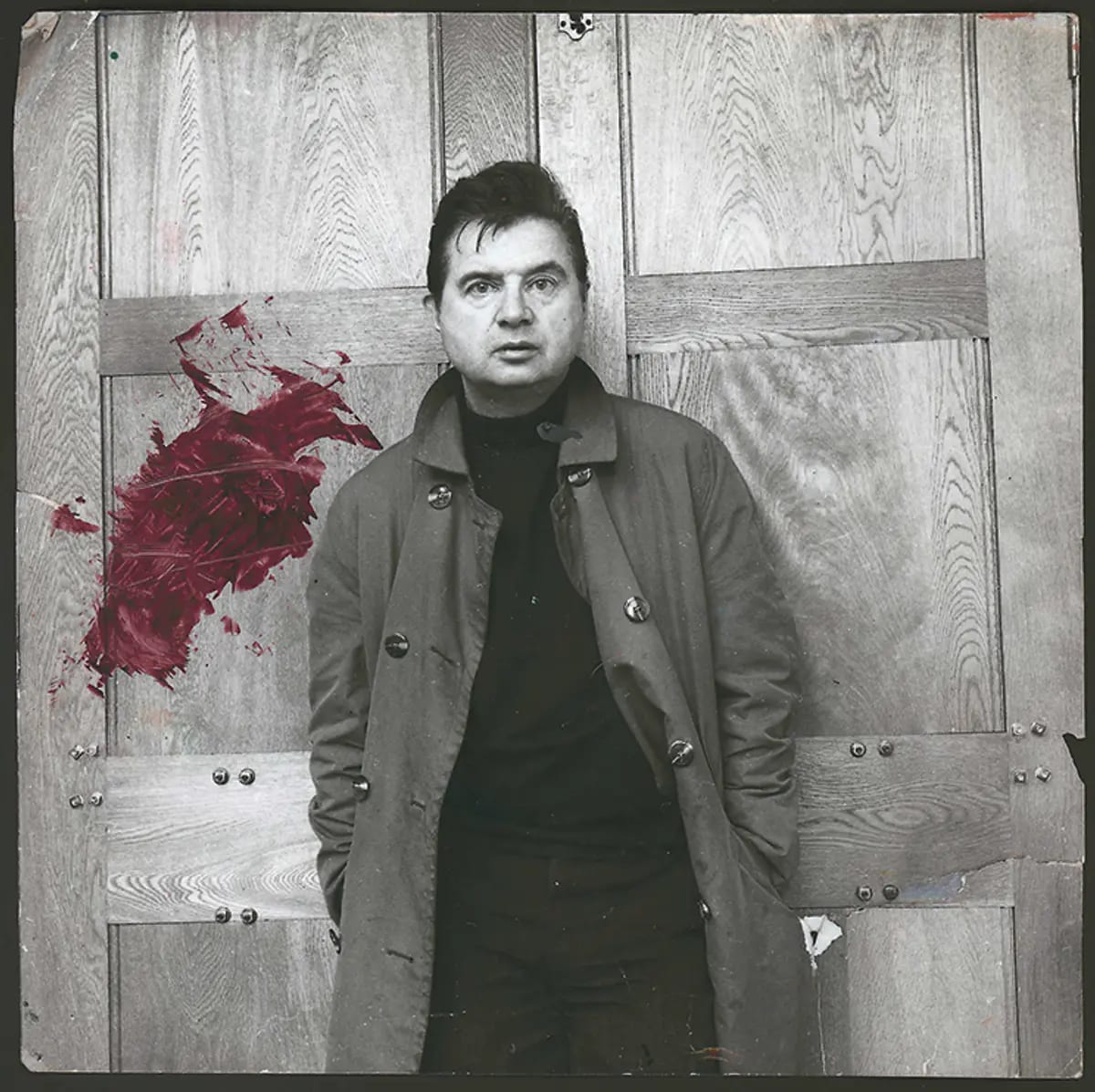
Francis Bacon was a renowned Irish-British painter, known for his intense and often disturbing works that explore the human condition and the darker aspects of existence.
His style, marked by distortions and grotesque figures, made him one of the most singular figures of the expressionist movement.
Francis Bacon produced some of the most iconic images of humanity wounded and traumatized in post-war art.
Inspired by surrealism, cinema, photography, and old masters, he created a distinct style that made him one of the most widely recognized figures of figurative art in the 1940s and 1950s.
The artist focused his energies, often depicting Soho club and bar regulars in London.
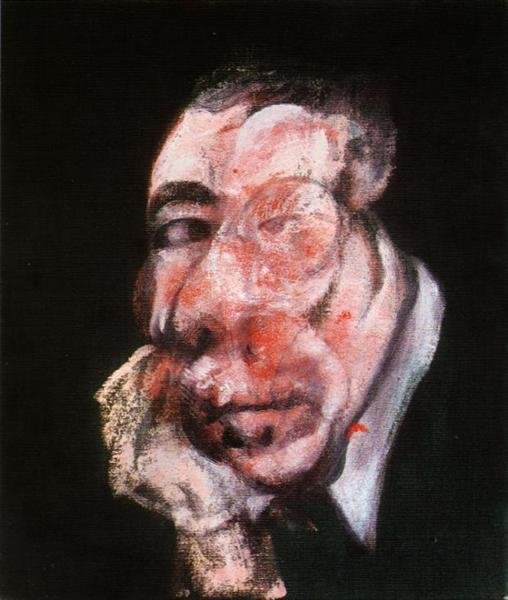
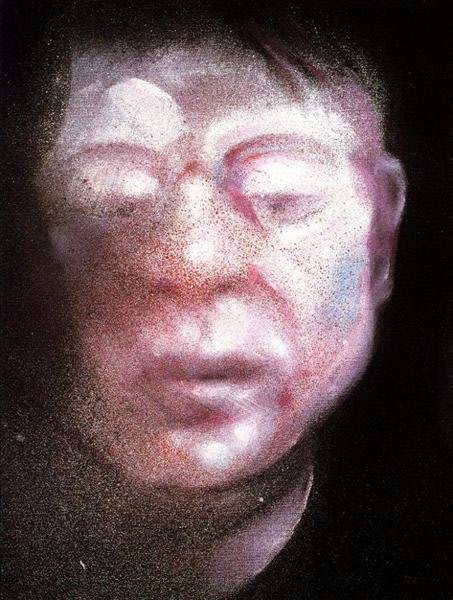
His subjects were always depicted as violently distorted, almost raw meat, that are isolated, imprisoned, and tormented by existential dilemmas.
One of the most successful British painters of the 20th century, Bacon's reputation was further elevated during the general return of the 'art world' to painting in the 1980s, and after his death, he was considered by some to be one of the most important painters in the world.
BIOGRAPHY
Francis Bacon was born on October 28, 1909, in Dublin, Ireland.
He was named after his famous ancestor, the English philosopher and scientist.
His father, Edward, served in the army and later got a job at the Ministry of War during World War I.
In an interview with critic David Sylvester, Bacon attributed the connotations of violence in his paintings to the turbulent circumstances of his childhood.
A British regiment was stationed near his childhood home, and he remembered hearing soldiers practicing maneuvers constantly.
Naturally, his father's position at the Ministry of War alerted him to the threat of violence at an early age.
Returning to Dublin after the war, he reached adulthood amidst the first campaigns of the Irish nationalist movement.
The young Francis had little formal education due to his severe asthma and the family's frequent trips to Edward's posting.
His mother, Christina, lived a life of a socialite, and with his father away at work, Francis was often left with his nanny.
Although he had four brothers, Bacon had a close relationship with her, who later, even elderly, lived with him in London for many years.
The family relationships became more abusive when Bacon dealt with his early homosexuality.
He had a difficult relationship with his parents, especially his father, who disapproved of his son's sexuality and independent behavior.
The young artist was severely disciplined by his father, being whipped for it.
In 1926, he was expelled from home by his father, when he caught him experimenting with his mother's clothes.
Surviving on a small allowance, Bacon lived the life of a vagabond, traveling through London, Berlin, and Paris.
Despite his father's hopes, the change of scenery only freed him to explore his identity even more; his time in Berlin proved particularly important in this regard and was later remembered by him as an emotional awakening.
In the late 1920s, Bacon moved to a flat in London and became involved in interior design and furniture.
One of his patrons, the artist Roy de Maistre, became his mentor and encouraged him to focus on oil painting.
Bacon modeled his initial work on Pablo Picasso and surrealism, whose work he had seen on a trip to Paris.
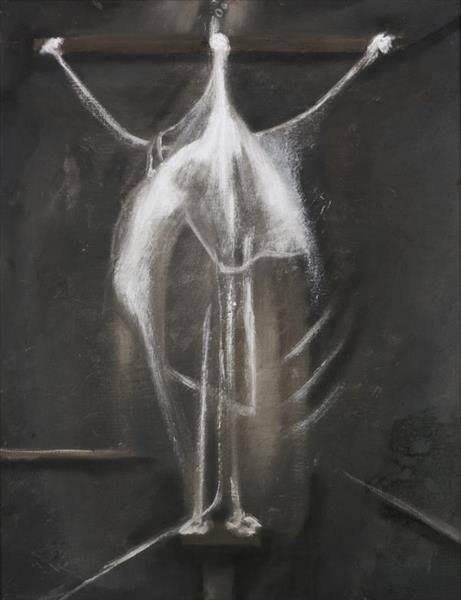
In 1933, Bacon exhibited his work Crucifixion, a skeletal composition in black and white that already radiated the tones of pain and fear that would become typical of his later work.
Encouraged, he organized his own art exhibition the following year, but received little attention.
His paintings were also researched for inclusion in the International Surrealist Exhibition, but were rejected as not surreal enough.
Disheartened, he returned to his vagabond lifestyle.
He destroyed most of his earlier works before 1943, and only fifteen pieces from that initial period survived.
Due to his asthma, Bacon was unable to join the armed forces during World War II.
He was accepted as a member of the Air Raid Precautions sector, which involved non-military search and rescue, only to be discharged when he fell ill due to dust and debris.
'If I hadn't been asthmatic, I might never have started painting.'
In 1949, he held his first solo exhibition, where he presented the series titled Heads, significant for being the first to introduce two important motifs:
the first was the scream, derived from an image of a film in which a wounded teacher is shown screaming.
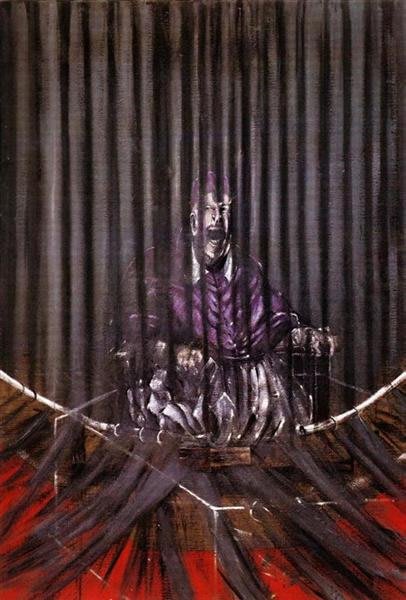
The second is the Portrait of Innocent X by Diego Velázquez, a painting that Bacon only knew through reproductions.
The Heads series also made greater use of closure devices that suggest a general sense of claustrophobia and anxiety, in this case, a shallow outline in the shape of a cage that he also employed in Three Studies of 1944.
In 1952, Bacon began one of his most powerful relationships, with former World War II fighter pilot Peter Lacy.
Lacy was attractive, well-educated, and highly self-destructive.
On one occasion, Lacy was drunk, and threw Bacon out the window, and the artist suffered a large number of injuries, but minor.
Through various escapes and clandestine meetings, with both men enjoying a variety of sexual partners between the time they spent together, the relationship was deteriorating.
Bacon's tendency to derive inspiration from personal experiences also drew him to portraiture.
He often painted close friends like Lucian Freud, Isabel Rawsthorne, and Michel Leiris.
The results convey an impressive intensity of emotional and psychological impact.
One of Bacon's most famous portraits was of his friend and lover George Dyer, whom he met in 1964.
During their relationship, Bacon executed several portraits of him that juxtaposed strong muscle with a sense of vulnerability.
In 1971, Dyer, who suffered from alcoholism and episodes of depression, ultimately committed suicide the night before Bacon's first retrospective in France.
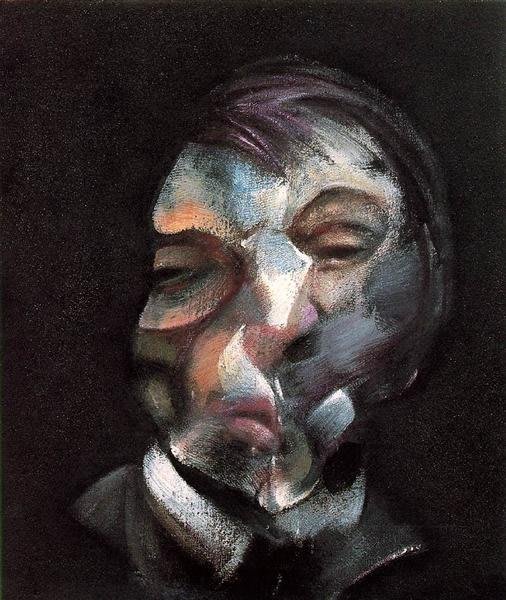
After the Paris exhibition, Bacon began to create more self-portraits, claiming:
'people around me are dying like flies and there's nothing left to paint but myself.'
Continuing to work steadily, he also completed a series of paintings in memory of Dyer.
Many of them took the form of large-format triptychs, including the well-known Black Triptych series, which detailed the circumstances of Dyer's death.
In 1973, Bacon became the first contemporary British artist to have a major exhibition at the Metropolitan Museum of Art in New York.
His work was exhibited internationally in the last years of his life, including retrospectives at the Hirshhorn and the Tate Gallery.
In the mid-1970s, Bacon met John Edwards, who replaced Dyer and Deakin as his constant companion and official photographer.
In his final years, he distanced himself from his previously turbulent social life, focusing on his work and the platonic relationship with Edwards.
He died of a heart attack in Madrid at the age of 81 on April 28, 1992.
COMMENTED ART
Crucifixion was exhibited at a time when the horrors of World War I were still remembered.
It adds a touch of the fantastical to an unsettling composition, introducing Bacon's obsession with pain and fear.
The painting spoke of how brutality had changed the world forever.
Study after Velázquez - A painting based on a 1650 portrait of Pope Innocent X by Diego Velázquez, Bacon avoided seeing the original painting, preferring to work from reproductions.
Again, he implants a frame in the shape of a cage that surrounds the pope, but also introduces vertical brushstrokes on the surface of the painting, an element he described as a curtain, relating the figure to a precious object that requires a protected space.
However, the linear traits are destructive to the image and seem more like the bars of a prison cell.
The lines almost seem to vibrate, and complementary tones of purple and yellow increase the tension of the composition.
ART GALLERY