
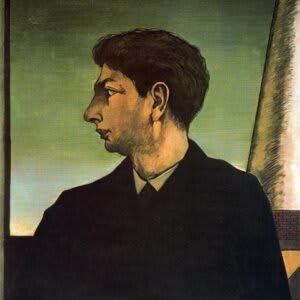
Biography of Giorgio de Chirico and Metaphysical Painting: The Origins of the Enigma
Biography of Giorgio de Chirico and Metaphysical Painting: The Origins of the Enigma
Giorgio de Chirico was an Italian artist of Greek origin who created distinctive urban landscapes that helped establish the groundwork for the development of surrealist art in the 20th century.
He drew inspiration throughout his life from mythology and architecture to create works that drew the observer into a world that was both familiar and unsettlingly disturbing.
The key to his work lies in the love he expressed for the classical past.
He arrived at this through his appreciation for German Romanticism and it was this that revealed new ways to see the classics and ways to treat themes of tragedy, enigma, and melancholy.
For de Chirico, the themes and motifs of classical Greeks and Romans remained valid even in the modern world.
It was a work in this style that encouraged him to form the ephemeral Metaphysical Art movement with painter Carlo Carrà.
BIOGRAPHY
Giorgio de Chirico was born in Greece to Italian parents on July 10, 1888, in Vólos, a port city near Athens.
His father was an engineer working on the Greek railway system and his mother was a noblewoman of Genoese origin.
His parents encouraged his artistic development, and from a young age, he was deeply interested in Greek mythology.
His birthplace was the port used by Jason and the Argonauts when they set sail to find the Golden Fleece.
From 1903 to 1905, de Chirico studied at the Academy of Fine Arts in Athens.
Aside from his father's death in 1905, the family visited Florence before moving to Germany the following year.
De Chirico enrolled in the Academy of Fine Arts in Munich and developed a strong interest in symbolist artists like the German Max Klinger and particularly the Swiss Arnold Böcklin.
In March 1910, he left Munich before graduating to join his family in Milan.
Soon after, he moved to Florence and, through the Italian writer Giovanni Papini, began studying some German philosophers such as Friedrich Nietzsche, Arthur Schopenhauer and Otto Weininger.
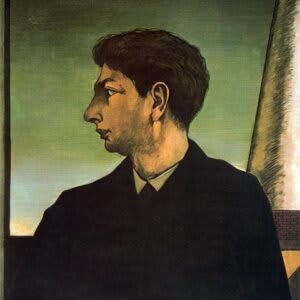
During this period, there are recurring references to memory, loss, mystery, the passage of time, and architecture - particularly arches and towers - in deserted and melancholic urban landscapes and city squares.
They appear to be images of deserted Mediterranean cities, in a time beyond history - where everyday life is imbued with mythology.
Over the next ten years, the artist developed his metaphysical painting style.
He attempted to infuse his interpretations of everyday reality with the impact of mythology and states of mind such as nostalgia and a sense of waiting.
The result were haunting and even disturbing paintings.
In July 1911, he moved with his mother to Paris to join his brother Andrea, having a stopover in Turin on the way.
He had become interested in the city, as it was the place where Nietzsche first showed signs of madness in 1889.
The architecture of the city squares and arches had a significant impact on him, and locations in the city can be seen in his paintings from this period.
In May 1915, along with his brother, he enlisted in the Italian army to fight in the First World War. The artist was stationed in Ferrara, continued to paint with the city's arcades and shopfronts appearing in his works.
He began to use mannequins in his paintings, and these became more frequent in his work.
In 1917, a state of nervousness obliged him to intern himself in an Italian hospital, where he continued to work, producing images mainly with disordered interiors in the metaphysical style.
In the hospital, he met Carlo Carrà, and through their exchanges, the Metaphysical Art movement was born, or Metaphysical Painting.
At the beginning of 1919, de Chirico held his first solo exhibition at the Bragaglia Gallery in Rome, it was during this period that he had a revelation while contemplating a painting by the Italian painter Titian at the Borghese Gallery in Rome.
Aside from the start of the First World War, he enlisted in the Italian army and instead of serving on the battlefield, accepted a mission at a hospital in Ferrara, where he continued to paint.
However, his reputation as an artist continued to grow, and de Chirico's first solo show took place in Rome in 1919.
Between 1919 and 1924, while in Rome, he produced figurative paintings that revealed a poorly developed knowledge of anatomy, where he worked on his technique and was inspired by the Old Masters.
During this period, the artist also became interested in other art forms.
In 1924, he worked on projects for a ballet in Paris based on a story by the Italian playwright Luigi Pirandello.
In 1929, he created lithographs for a reproduction of the poet Guillaume Apollinaire's book of poems.
In the same year, he wrote his only novel, Hebdomeros.
Despite his change in artistic style, the book's oniric collection of impressions and situations functions as a literary companion to his metaphysical paintings.
At this time, de Chirico had distanced himself from the surrealists, but his book is still considered one of the best examples of surrealist literature.
To understand the rest of this journey, continue to our next article: Biography of Giorgio de Chirico and Metaphysical Painting: Legacy, Impact, and Early Works


