
Biography of Odilon Redon: Life, Symbolism and Early Career
Biography of Odilon Redon: Life, Symbolism and Early Career
Odilon Redon, was a French painter and engraver often described as a symbolist painter. His career and painting are widely associated with this movement of the 19th century. Redon considered himself an independent artist, and never truly associated with the Symbolism.
His visionary works relate to the world of dreams, fantasy, and imagination. He became famous for the first time with his series noirs, monochromatic compositions that explore the expressive and suggestive powers of black color. His lithographs, which often reworked previous drawings, became a means of expanding his audience.
Bertrand-Jean Redon, better known as Odilon Redon was born on April 20, 1840, in Bordeaux, France. He was affectionately called Odilon by his mother, who gave him this nickname, derived from his name, Odile.
Redon began drawing as a child and, at 10 years old, won an art prize at school. At 15, he began formal drawing studies, but at his father's insistence, he switched to architecture. His failure in the entrance exam at the Paris School of Fine Arts put an end to all plans for a career as an architect, although he later studied there with Jean-Leon Gerome.
Back at his home in Bordeaux, he became interested in learning the craft of sculpture and other visual arts, such as engraving. However, his artistic career was interrupted in 1870, when he joined the army to serve in the Franco-Prussian War. At the end of the war, he moved to Paris, working almost exclusively with charcoal and lithography.
In 1872, he met Henri Fantin-Latour, with whom he learned the method of lithography transfer. When his father died very poor in 1874, Redon began to produce engravings as a means of making a living, as his lithographs could be produced and sold in relatively large quantities, allowing him to commercialize his works for a wider audience.
In 1876, the artist met the poet and art critic Stéphane Mallarmé and participated in regular meetings at his home, where he met many writers and artists from his symbolist circle.
In 1878, he produced his first lithographic series, In the Dream. Soon after, he gained great recognition with the work Guardian Spirit of the Waters (Espírito Guardião das Águas), and he published his first album of lithographs, titled Dans le Reve, in 1879.
In 1880, he married Camille Falte, commenting: "I believe that the yes I pronounced on the day of our union was the expression of the most complete and absolute certainty that I have ever experienced. A certainty even more complete than my vocation". However, the happiness of his marriage was overshadowed by the loss of his firstborn son, who died at six months old. This tragedy plunged Redon into a deep depression that he poetically described as "melancholic fainting".
During this period, Redon worked mainly with lithographs, creating several portfolios conceived as accompaniments to literary works. At Mallarmé's Salons, Redon met the critic, novelist, and art collector, Joris-Karl Huysmans, who became a great admirer of the artist. Among his collection are several works by Redon, including charcoal drawings. This friendship helped make Redon famous. At the same time, he met Paul Gauguin, who clearly understood his friend's visionary art: "I don't see why Odilon Redon paints monsters. They are imaginary beings. He is a dreamer, an imaginative spirit".
Odilon Redon exhibited with theimpressionists in his last collective exhibition in 1886. His works signaled the change in the tides of modern art, from impressionism to symbolism, and from a focus on the observation of the fleeting effects of nature to a concern with the emphasis on subjectivity and interior vision.
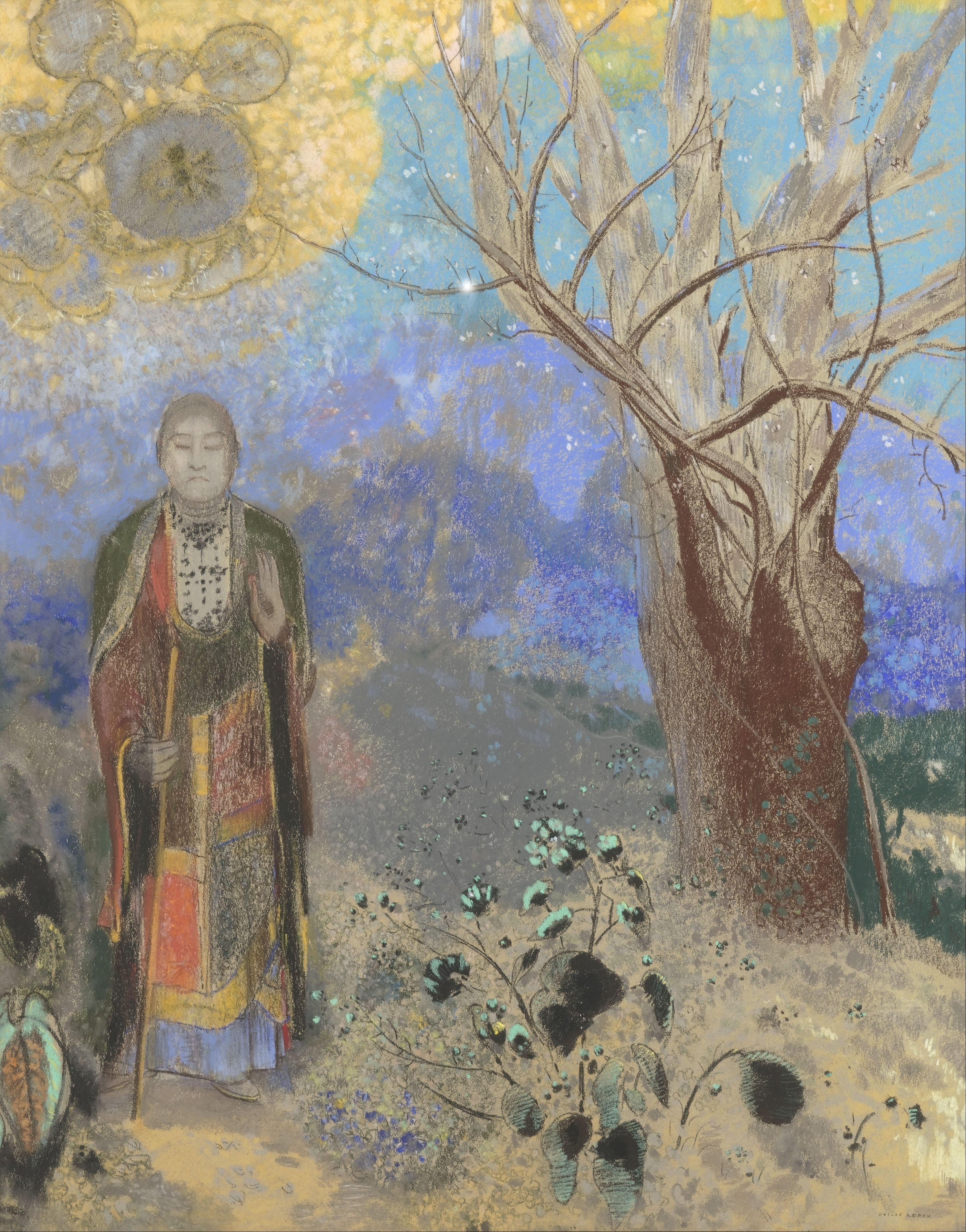
From the 1890s, Redon's work underwent a radical change, as he began to work predominantly in pastel tones, finally using colors after years of only black. Some scholars attributed the change to a religious awakening, as evidenced by the artist's growing interest in issues from Buddhism or Christianity, but many of his black-and-white lithographs were also dedicated to religious themes. Regardless of the medium, Redon's main concern was with the subjective experience of spirituality, rather than illustrating liturgical texts. Color simply became another means for him to explore realms beyond the visible, using it for expressive purposes rather than mimetic ones.
From the 1890s, Redon's continued friendship with Gauguin led to his meeting with the young artists of the Nabis (group of artists influenced by Paul Gauguin and post-impressionism). Maurice Denis saw in Redon an example of an established artist who, like him, used the formal tools of his art to express personal feelings, or what he called "the state of the artist's soul". Redon also learned from the younger painters and began to adopt Japonism, the expressive use of color, and the emphasis on decoration. Many of the Nabis, including Édouard Vuillard and Pierre Bonnard, created large-scale decorative projects, such as screens and murals, and Redon would do the same at the end of his career.
From 1900, Redon devoted himself to portraits, many of them commissioned, as well as mythological and literary themes, still lifes, and the aforementioned decorative work. Everything he produced was completely flooded with bright colors that exhibited what the artist surrealist of the 20th century, Andre Masson, would call "lyric chromaticism".
Redon's fame grew at the end of his life. In 1903, the French government awarded him the Legion of Honor. In 1913, the art critic Andre Mellerio published a catalog of his engravings; in the same year, he was included in the famous Armory Show in New York, exhibiting more works than any other artist in the exhibition.
Odilon Redon died on July 6, 1916, perhaps a death accelerated by his anxiety and fear for his son, who was serving as a soldier on the front line in the First World War.
LEGACY
The impact of Redon's noirs on modern art was perhaps even deeper, as we find his greatest originality and inventiveness there. The surrealists were particularly impressed by the dreamlike quality of those charcoals and lithographs, and André Breton, his de facto leader, was a particularly great admirer. A fundamental part of Redon's influence was the suggestiveness of his art - instead of describing things for us, the viewer participates actively in the interpretation of the work. The inventor of the ready-made, Marcel Duchamp, observed: "If I must tell how my own departure was, I must say that it was the art of Odilon Redon".
For the rest of this journey, continue to our next article: Biography of Odilon Redon: The Evolution of Color, Works and Visionary Legacy.


