
Frida Kahlo's Self-Portraits: Life, Pain, and the Genesis of an Artist (Part 1)
Frida Kahlo's Self-Portraits: Life, Pain, and the Genesis of an Artist (Part 1)
I invite you to explore Frida Kahlo's self-portraits, a series of works that reveal the artist's intense life and deep emotions.
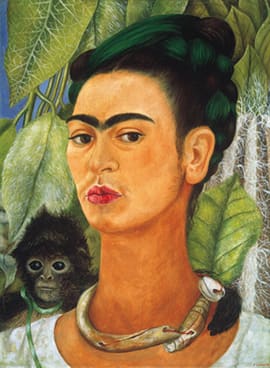
Kahlo painted around 55 self-portraits throughout her life, using art as a means to express her physical and emotional pain, political struggles, and cultural identity.
Her paintings are characterized by vibrant colors, powerful symbolism, and a direct and piercing gaze.
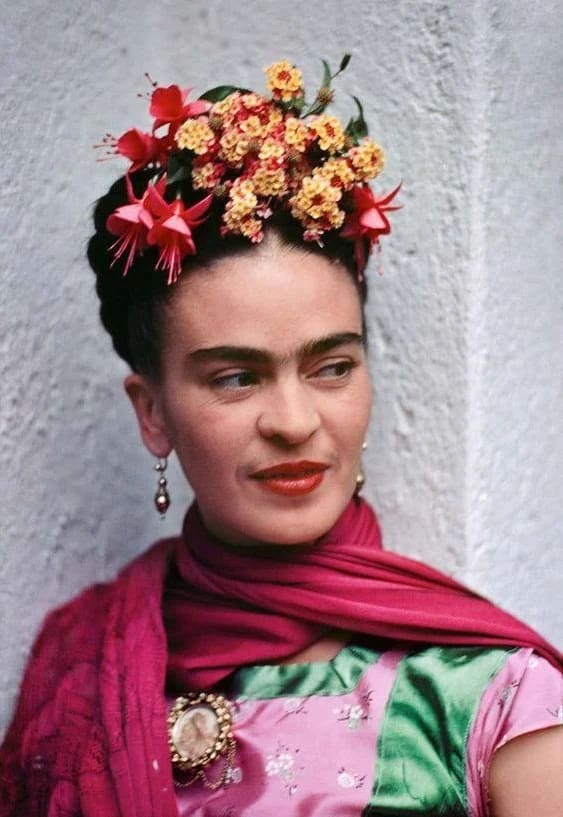
Magdalena Carmen Frieda Kahlo y Calderón, or simply Frida Kahlo, a reference to Mexican culture, her indigenous maternal heritage, and feminism are themes extensively explored in her work.
Like many artists who left their mark on the history of art through their work in various artistic modalities, Frida went beyond.
Her work and story are reflected in the numerous self-portraits she painted, expressing her struggle to stay alive and succeeding.... her work is eternal.
Frida had pain as her material.
The passion for life in a whirlwind of emotions expressed in her numerous self-portraits.
Her work, although melancholic, radiates warmth and life.
But what's most captivating and intriguing is that despite so much suffering, she never wore mourning clothes, Frida was colorful, preferring to wear flowers.
After contracting polio at six years old, unfortunately, she was left with a sequela in her right foot, which made her wear pants for a period of her life, but it was the long, printed skirts that made Frida her personal trademark, turning her into a reference in the world of fashion.
This is one of her first self-portraits in which Frida was wearing a red wine velvet dress and is considered one of her most beautiful.
She sent it to Alejandro, her boyfriend at the time, and hoped he would keep her in his mind.
Alejandro traveled to Europe in March 1927 because his parents did not want him to stay with Frida.
She wrote many letters after they separated.
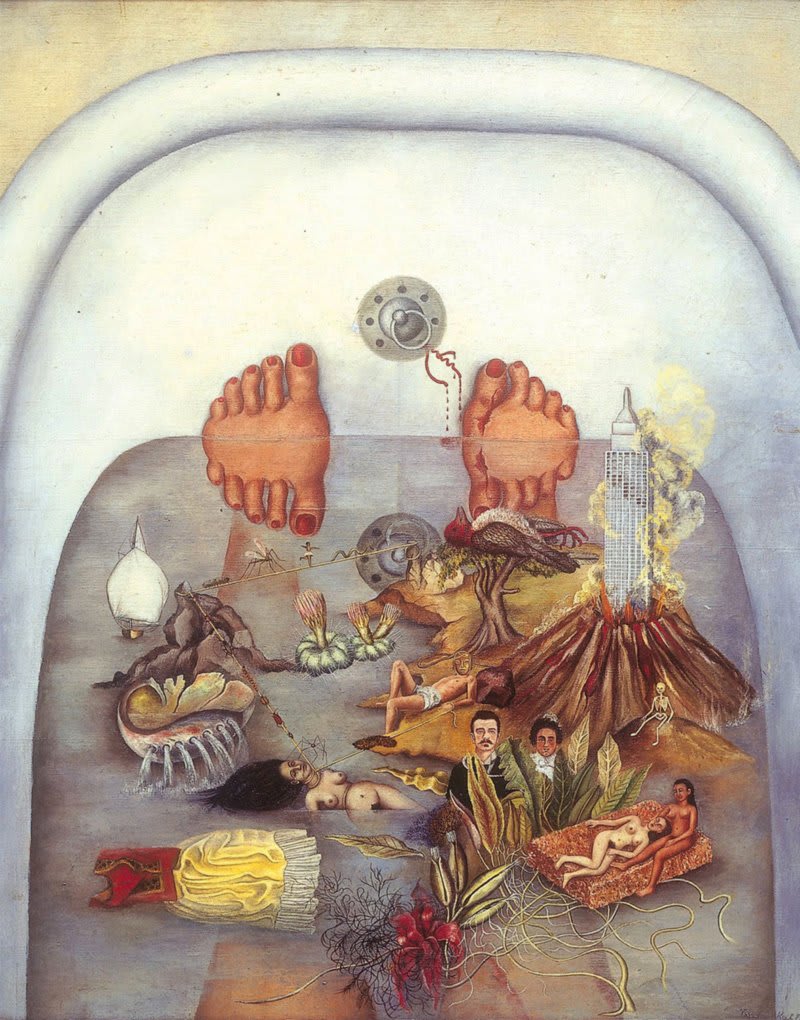
This painting is considered by many scholars of the artist's work to be the most surrealistic of all, as well as the most complex, giving us the possibility of different forms of interpretation.
Frida had a unique and peculiar face, different from the common woman.
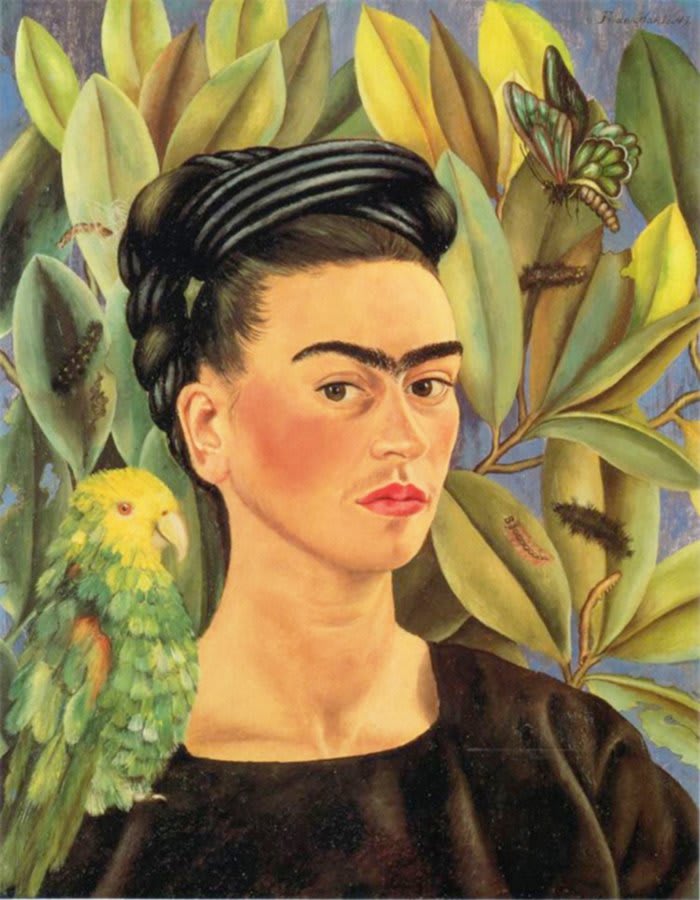
Her thick and united black eyebrows, never left to be demonstrated in her self-portraits, as well as the mustache she also did not hide and always accompanied her.
Surrealistic? When her work was classified as belonging to this movement, the artist denied it, saying she did not paint dreams.
But it's common to find symbols and the magic of dreams in her painting, giving us numerous possibilities of interpretation.
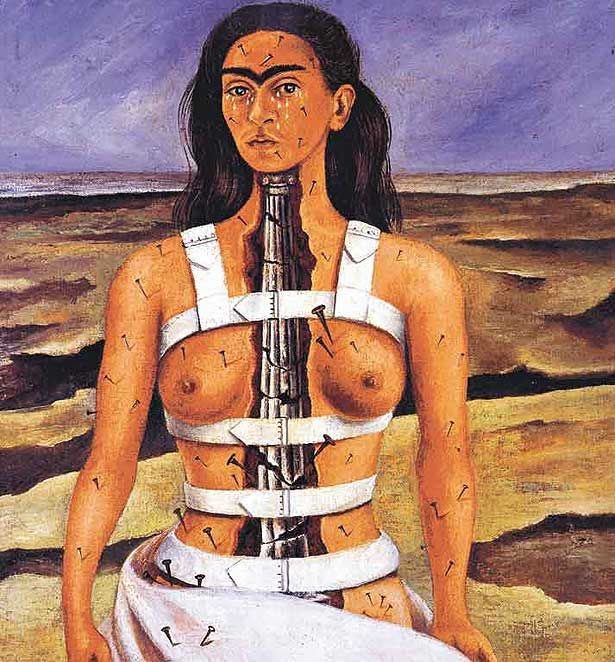
In this painting, Frida is wearing a masculine outfit, renouncing all her femininity as she presents herself.
In the background, there is the earth with dark ravines.
At first, she paints herself naked, but then covers the lower part with something that looks like a hospital sheet.
A broken column is placed in place of her spine.
The column seems to be on the verge of collapsing into rubble.
Piercing from the waist to the chin, the column seems phallic, and the sexual connotation is even more obvious due to Frida's beauty and torso.
Although her entire body is supported by the corset, she transmits a message of spiritual triumph.
She has tears in her face, but looks straight ahead and is challenging herself and the public to face her situation.
Pain and suffering are constant themes in Frida's painting.
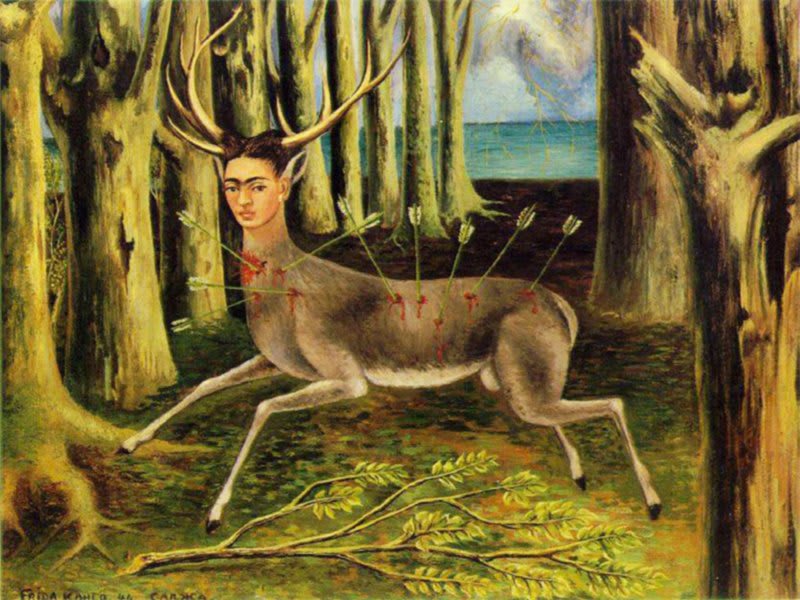
In The Wounded Deer, Frida represents herself in the body of a male deer.
With her body pierced by arrows that identify her physical and emotional wounds, expressing deep pain in her face.
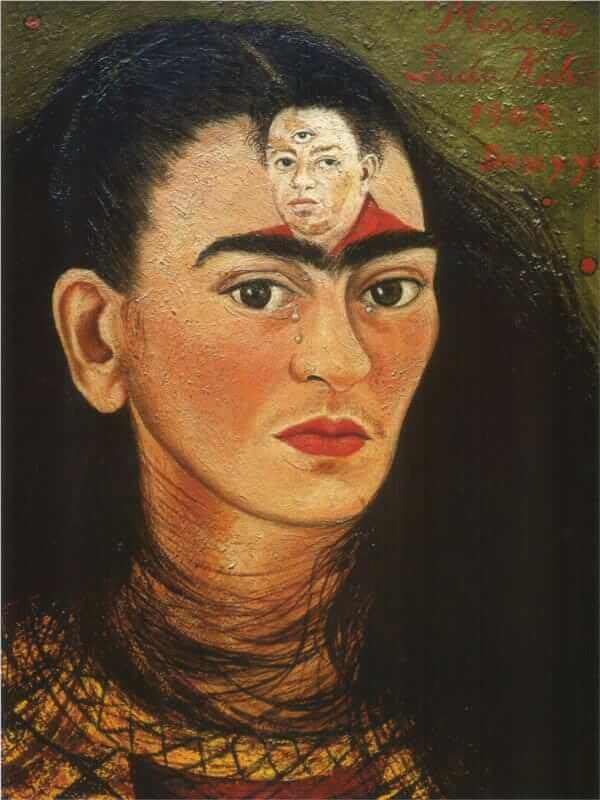
In the painting Diego and I, Frida has loose hair around her neck, indicating strangulation.
She lost her mask of reserve.
It's obvious that the cause of her anguish is her husband Diego, for whom her eyebrows serve as a platform.
A third eye, alluding to Rivera's predominant mental and visual acuity, opens on Frida's forehead.
Of the five-eyed pyramid placed in this painting, only Frida's eyes are found.
The fact that Rivera is always in Frida's thoughts is also revealed in her diary, a large part of which is a love poem to him: Diego, I am alone.
Then, a few pages later: My Diego. I am no longer alone. You accompany me. You put me to sleep and revive me.
Again, she drew two faces that look like vases.
Don't cry with me, one of them says.
The other responds: Yes. I will cry with you.
In a more romantic moment, she wrote: Diego: nothing compares to your hands and nothing equals the green-gold of your eyes.
My body is filled with you day after day.
You are the mirror of the night.
The violent light of the lightning.
The moisture of the earth.
Your armpit is my refuge.
My fingers touch your blood.
All my joy is feeling your life sprouting from your flower-source that my guardian fills to fill all the paths of my nerves that belong to you.
To understand the rest of this journey, continue to our next article: Frida Kahlo's Self-Portraits: Passions, Politics, and the Legacy of an Icon (Part 2).


