
Leonardo da Vinci: Biography and Work: A Life of Genius and Endless Curiosity
Discover the fascinating biography of Leonardo da Vinci, from his humble birth, learning with Verrocchio, to his early years as an artist and scientist in the Renaissance.
Leonardo da Vinci is a legendary figure whose life and work continue to intrigue and inspire people all over the world.
His genius was not limited to art, but also to science, engineering, and anatomy, among many other fields.
In this text, we will explore the fascinating life of this Renaissance master, his contributions to various areas of knowledge, and his lasting influence on the history of humanity.
Leonardo da Vinci, the universal man of the Italian Renaissance, is considered by many to be the Hamlet of the History of Art.
The truth is that for centuries, his figure has caused obsession due to his character of sphinx, his depth and subtlety, his refinement.
Painter and draftsman par excellence, engineer well-versed in Physics, Mechanics, and Chemistry, strategist, architect, urban planner, sculptor, anatomist, inventor, man of spirit and method, he managed to combine science and art, analysis and emotion, nature and idealism, foresight and spontaneity, consciousness and unconsciousness, gravity and play.
Despite leaving behind countless masterpieces, we suspect that none surpass the creation of himself. "It is free who is the cause of himself," wrote Thomas Aquinas in a phrase that honors him.
Da Vinci was born at 10 pm on April 15, 1452.
It was the year in which, pushed by Turkish hands, the Eastern Roman Empire was falling.
The place was Anchiano, near Vinci, neighbor of Florence.
His father, Ser Piero, was a notary.
His mother, Caterina, who soon abandoned him to marry a peasant, worked in the fields.
Ser Piero, on the other hand, married Donna Albieri, with whom he lived in Vila Adriano.
They did not have children until Leonardo began his apprenticeship.
From his childhood, we are left with the same nature, which he soaked up to ecstasy, and a memory:
"I was in my cradle and, suddenly, it seemed to me that a strange villain was rushing towards me.
With his feathers, he opened my mouth and moved them from side to side in my lips.
It seems to be my destiny."
At 13, he moved to Florence, on the Street of the Gondi.
Three years later, he entered the workshop of Verrocchio, a link that would unite him to the current of Ghiberti, Brunelleschi, and Donatello.
The apprenticeship with Verrocchio lasted six years.
With Verrocchio, he crowned the dome of Brunelleschi in Santa Maria del Fiore with the golden copper sphere that supports the cross.
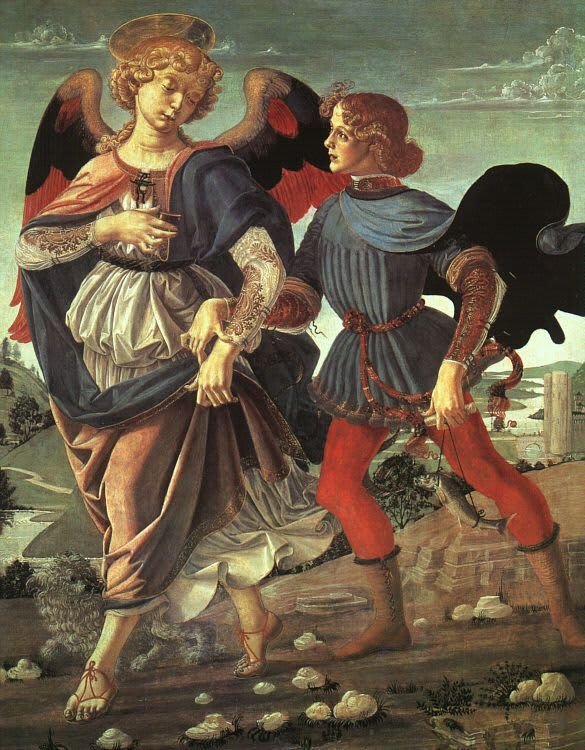
A curious detail: it is likely that Leonardo da Vinci was the model for Verrocchio in two of his works, as he was also a young man with beautiful features and great physical beauty.
An example of this can be seen in the painting where he was represented by his master as the archangel in Tobias and the Angel.
In 1475, Leonardo received the commission for an Annunciation and a Portrait of Ginevra Benci, and later for painting a Adoration of the Shepherds.
In the latter, he approached the theme with singular and heterodox ambition.
It is said that there are no less than 66 different figures, 41 of which are animals.
Only Goya in his black paintings could achieve a similar treatment of human mass.
As an adult, Leonardo was two meters tall, he was a vegetarian, homosexual, and pacifist; very unusual for that time.
He developed a method of writing from right to left, and it is believed that he deliberately committed errors and omissions in his notes and sketches to protect his ideas and conceptions from his own inventions.
Leonardo was around 30 years old when he wrote a letter to Ludovico "il Moro," then ruler of Milan, detailing his skills and projects to help in battles as well as offer his services in other different skills he possessed.
It was then that the noble artist went to Milan, around 1482.
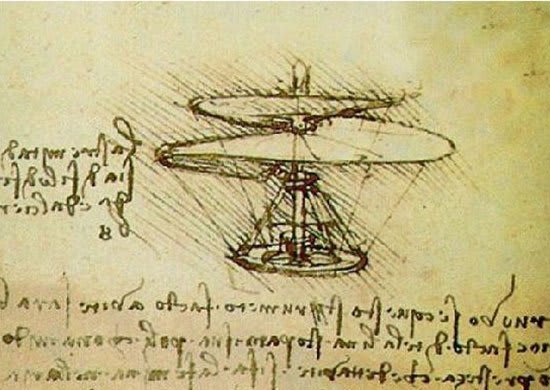
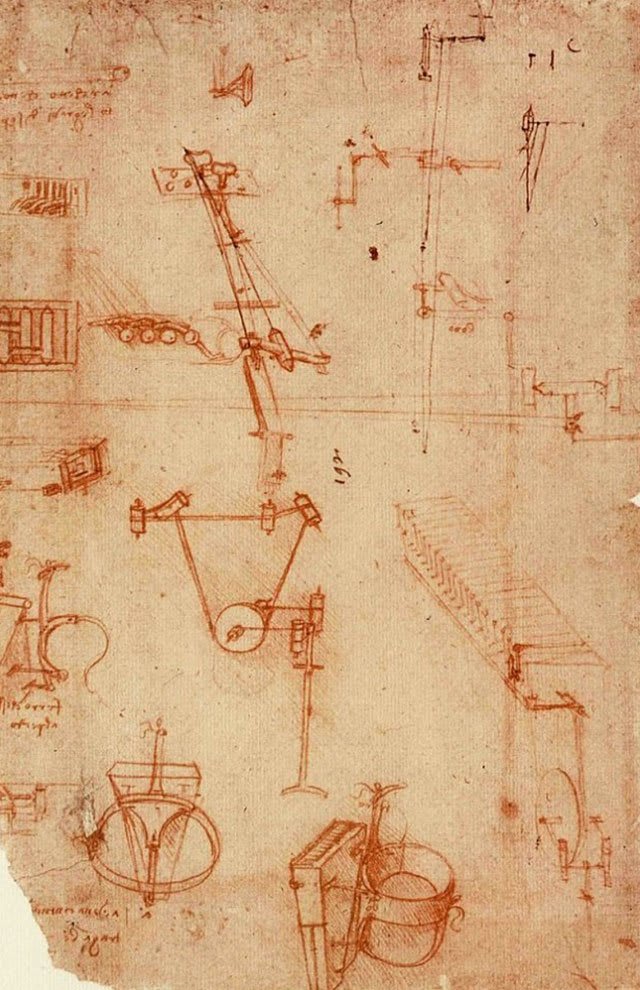
Most of what we know about Leonardo's scientific ideas come from his codices.
It is believed that he wrote at least 24,000 pages, but only 6,000 are known.
He wrote about geometry, fauna and flora, mathematics, physics, philosophy; made incredibly detailed anatomical sketches (at significant risk of heretical behavior of dissecting corpses in the early 1500s) and designed innovative designs for construction and mechanical inventions.
Leonardo was very well-known for his ability to play musical instruments such as the lyre.
Based on what we know from his biographers and the presentation letter he sent to Ludovico "il Moro," the change of Da Vinci to Milan was influenced by his skills as a musician and inventor of musical instruments, as well as his activities as a military engineer and strategist.
Leonardo had a very original project to build the main instruments of the Renaissance period.
He designed and built many instruments, such as the lyre, the portable piano, the drum, and the mechanical flute, among others.
It is also known that Leonardo worked at the court of the Sforza in Milan, not as a painter, but as a director of festivals and shows.
Da Vinci believed that art was the most noble of all human skills.
He created some of the most important works in the history of art.
In 1503, in Florence, he began working on the most famous of his paintings, the Mona Lisa.
Another of his very important paintings is the fresco of The Last Supper, located in Milan. Naturally, The Vitruvian Man is also synonymous with Leonardo and while he did not "invent" the concept of divine proportion, he prolonged the creation of Vitruvius and sketched the famous figure.
Most of Leonardo's studies and experiments related to the Vitruvian Man helped his investigations into the perfect art.
His paintings are all considered masterpieces, but it was his sketches and research in anatomy and science that showed a level of genius hundreds of years ahead of his time.
He also became an expert in human anatomy, where his representations of muscles and tendons remain comparable to some of the most recent imaging technologies.
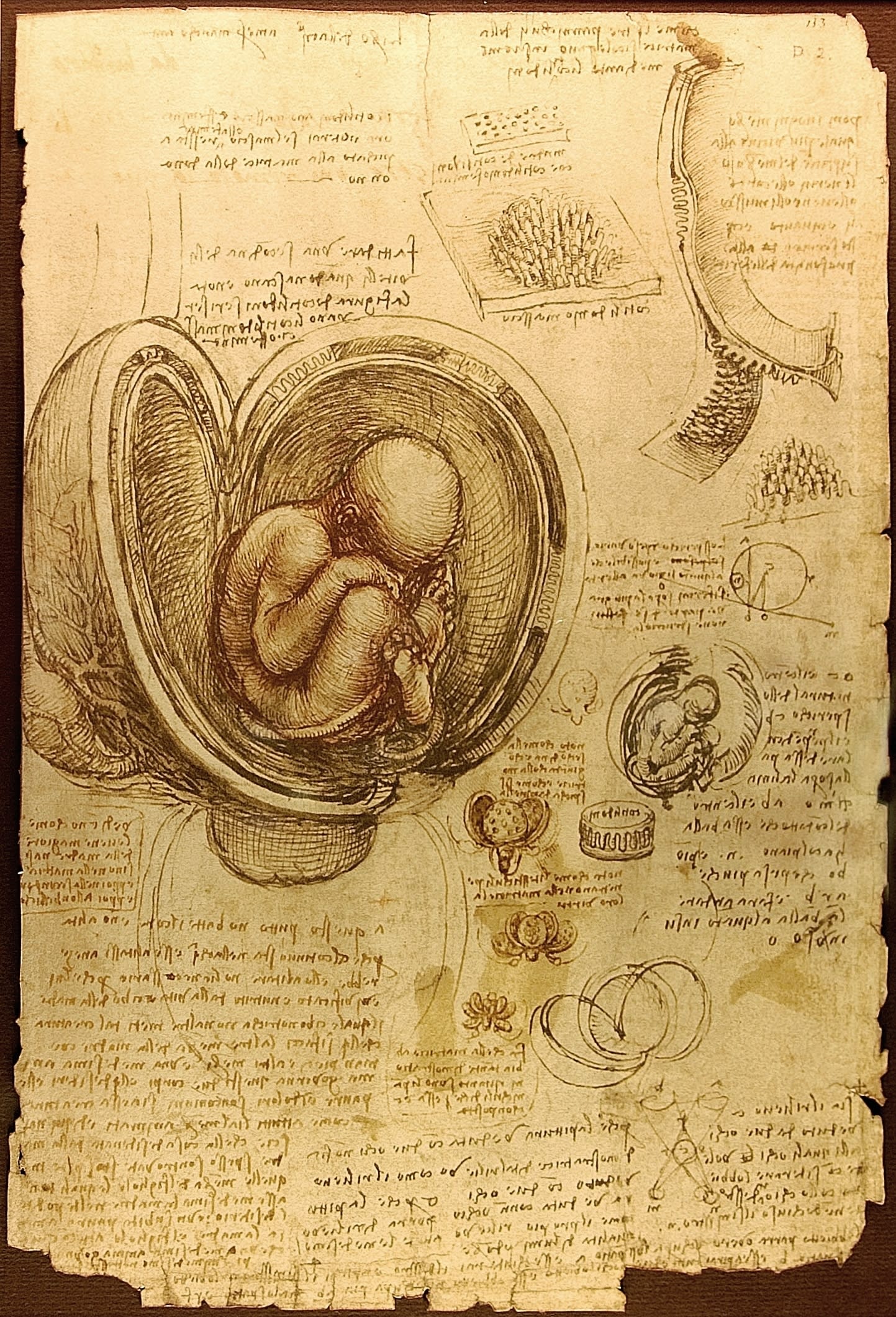
But perhaps no work of Leonardo is more profound or beautiful than the drawing of a fetus in the womb.
Shown curled up with the umbilical cord wrapped around one of his ankles, the baby in the womb appears to be in a state of suspended animation, probably at term, waiting in the pelvic position for the right moment to enter the world.
Although some of the descriptions of the baby made by Leonardo were imperfect, his discoveries were, in many ways, revolutionary.
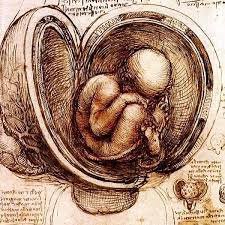
He correctly discovered that the umbilical cord is what nourishes and removes waste from the baby, and that the womb is composed of a single chamber, not two.
The pre-natal baby was also so large that he was curious to know how the child fit in such a small space.
The experience seemed to evoke a sense of admiration.
Da Vinci knew that what was inside the womb was not like any of the other anatomical studies he had done.
Instead, it was something incredibly special, almost spiritual.
He revisited the sketch a few years later and wrote his belief that mother and child share a soul until birth.
He wrote: "One and the same soul governs these two bodies... and one and the same soul nourishes both."
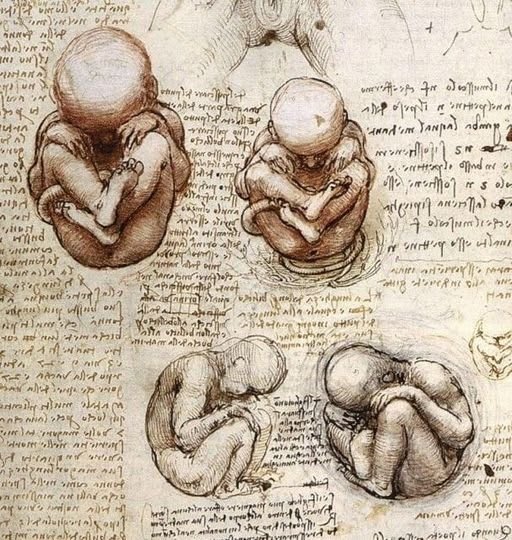
Although many people may disagree with his conclusion, the world's most famous artist was on the right track.
A fetus is not just a collection of cells or an anomalous creature, but a developing human being.
It took centuries for the invention of ultrasound and magnetic resonance machines to bring a clearer image of the active and lively life inside the womb.
He concluded in his studies that life begins at conception, the moment when the sequence of DNA and all hereditary characteristics are determined.
Everything, from a person's eye color to the shape of their nose, is determined in that instant.
Of all Leonardo's creations, there is nothing more real and inspiring than the image of this baby, where we can see ourselves embodied in the wonder of creation: innocent, miraculous, and mysterious.
It is the miracle of life!
Leonardo was also a great student of light and shadow, and the effects created by multiple light sources on faces and objects.
From a very young age, he demonstrated an uncommon artistic ability.
He was drawn to all types of artistic modalities, motivated by an unparalleled curiosity and an unparalleled ability to complement these areas with his scientific knowledge.
During his life, Leonardo was entrusted with the Army of Milan as an engineer and strategist.
It is believed that he did this purely to earn money to train, as well as to follow other interests.
He was, above all, an insatiable observer who occupied his mind with the solution of a vast range of problems, creating plans and schemes for inventions that, however, would take centuries to be produced.
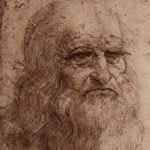
On the day of the Ascension of 1517, he is in Amboise and lives in the Castle of Cloux.
He has his right arm paralyzed.
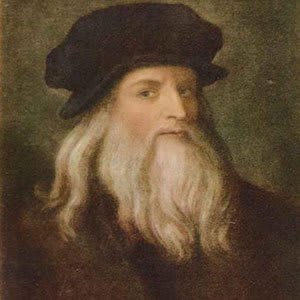
He makes his self-portrait with a long beard and tired eyes.
He leaves his manuscripts, thousands of pages, to his disciple Melzi.
He leaves the world a universe of transparencies, sweetness, and harmonies
Leonardo died on May 2, 1519, alone and discontent.
He died in Amboise, France, and was buried in the Saint Florentine Church, but his remains are lost during the religious wars.
Among his last writings, there is:
"I offended God and Humanity because my work did not reach the quality it should have."
Meanwhile, his Gioconda continued to smile, unchanged.
TIMELINE
To understand the rest of this journey, continue to our next article: Leonardo da Vinci: Biography and Work: Timeline and Marks of a Multifaceted Career.


