
Lygia Clark's Biography: Origins, Neoconcretism, and Early Disruptions
Lygia Clark's Biography: Origins, Neoconcretism, and Early Disruptions
Article Index
Lygia Clark was an important Brazilian artist considered one of the most significant figures of the global avant-garde, transcending the boundaries of sculpture, performance, and educational art.
She fostered an engaged relationship that integrated the art object with its audience.
Her early abstract canvases were supplanted by constructions that sought to break the pictorial frame, challenging the separation between the artwork and its surrounding environment, announcing a shift from the two-dimensional to the three-dimensional plane.
These were followed by increasingly organic or corporeal sculptural forms designed to be physically activated and interactive, which were eventually incorporated into the therapeutic practice she established at the end of her professional career.
BIOGRAPHY
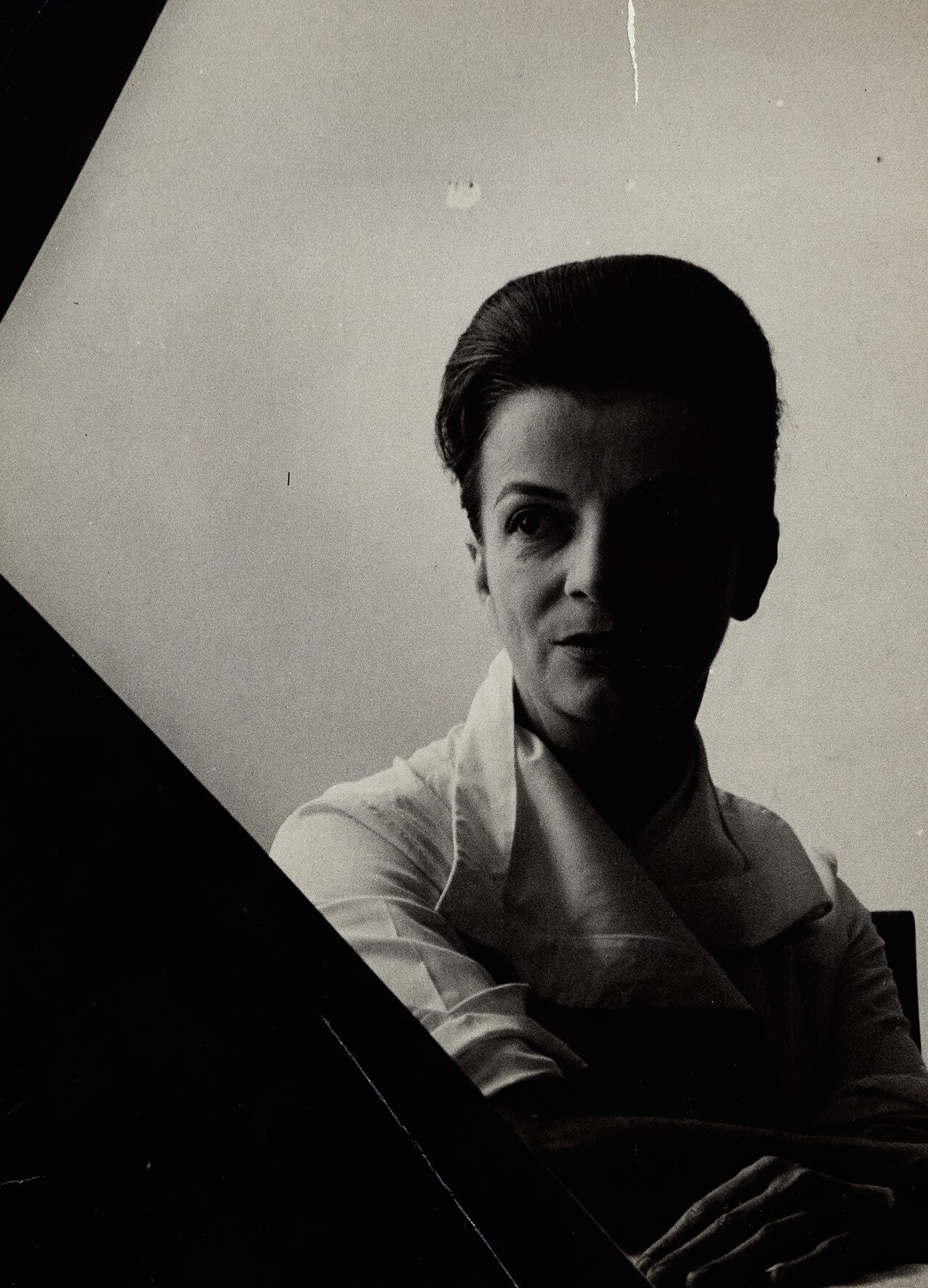
Lygia Pimentel Lins was born on October 23, 1920, in the city of Belo Horizonte, Minas Gerais, Brazil.
She came from an upper-class family, educated by nuns at a Catholic school where she showed an early interest in drawing.
Her childhood was a privileged life in a small town mixed with bourgeois repression: her father was often violent and abusive, and Lygia felt suffocated by the limitations dictated by her traditional upbringing.
As an adult, psychoanalysis would trigger many painful childhood memories, often centered on a feeling of not belonging that became more pronounced with the onset of adolescence; as she recalled: "I grew up feeling outside the family, trying every night to tear out my small clitoris, which I experienced as a sign of marginality."
At eighteen, she married Aluízio Clark Ribeiro, a civil engineer, and they moved to Rio de Janeiro.
From this union, they had three children: Elizabeth, Álvaro, and Eduardo, born between 1941 and 1945.
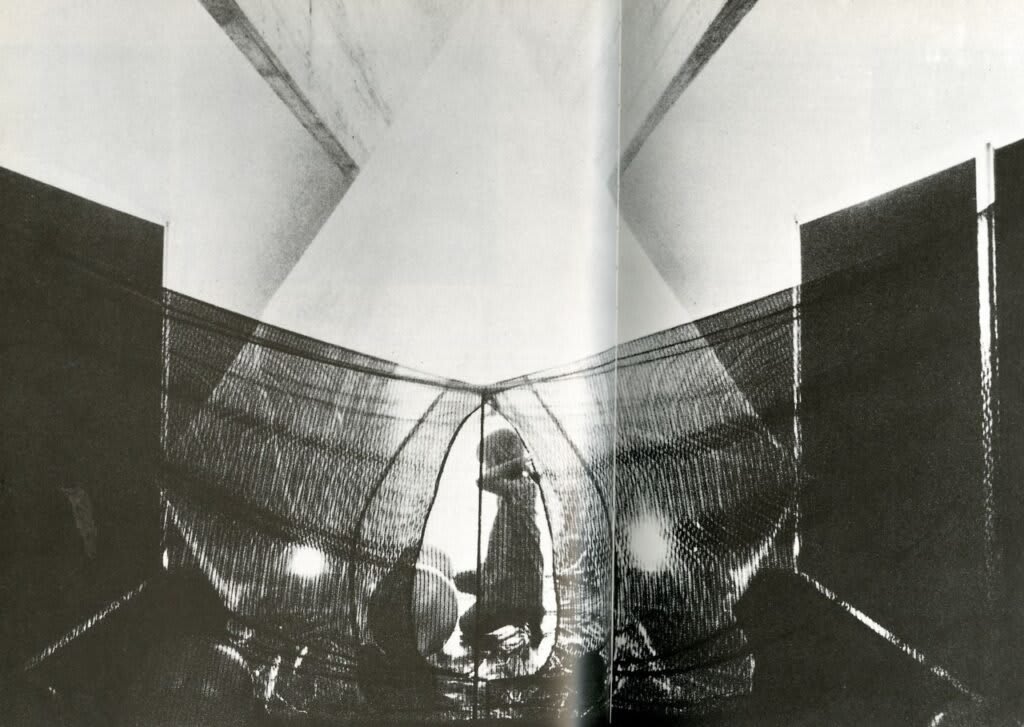
Her experience with motherhood would later help her produce important works such as The House is the Body, from 1968, a participatory installation exhibited to critical acclaim at the Brazilian Pavilion of the Venice Biennale in 1968.
Between 1947 and 1949, she studied with the painter and landscape architect Roberto Burle Marx, an important figure of Brazilian modernism, and with the painter and sculptor Zélia Salgado in Rio de Janeiro.
Between 1950 and 1951, she traveled to Paris to engage with the European avant-gardes, which allowed her to continue her education with Árpad Szenes, Isaac Dobrinsky, and Fernand Léger.
Upon her return to Brazil, she held her first solo exhibition and received a prestigious award for best new artist of the year.
In 1953, personal difficulties arose when her marriage fell apart, leading to divorce.
The separation would ultimately allow her to pursue her chosen career: as her son Eduardo observed: "My mother was born rich, married a rich man, and after their separation, she received 86 apartments, which she sold one by one to support her work."
The 1950s in Brazil were marked by intense optimism, stemming from the economic prosperity and political stability experienced under the presidency of Juscelino Kubitschek, who was president of Brazil at the time.
Rio de Janeiro was a stimulating place to be: the rhythms of Bossa Nova filled the air, bold experiments in modernist architecture were underway, and visual artists were adapting Constructivism to create something inexorably Brazilian – the Concrete and Neoconcrete movements.
Clark's early abstract compositions are definitive examples of visual art produced during this era.
In 1954, she joined the Grupo Frente (Front Group), a group of artists led by Ivan Serpa and including Lygia Pape and Hélio Oiticica.
The group initially embraced the ideals of Concrete art, which aimed to emphasize geometric abstraction.
In 1959, Lygia Clark and Hélio Oiticica collaborated to create the Neoconcrete Manifesto, which criticized the overly dogmatic approach of some Concrete artists, advocating for an art with greater sensuality, color, and feeling.
During this period, Lygia began to adopt a bodily and sensorial approach to her work, which started to break with the orthodox modernist canon as her paintings evolved from two-dimensional abstractions into three-dimensional structures and participatory objects like the famous "Bichos" series (Creatures).

By the mid-1960s, her work was fully corporeal, participatory, and performative, without any trace of earlier geometric abstraction.
She was now an internationally celebrated artist, with a series of critically acclaimed exhibitions, including a major solo show in London in 1965, and the opportunity to represent Brazil at the Venice Biennale in 1968, where she presented her participatory installation simulating the experience of gestation and birth, "The House is the Body," as previously mentioned.
This profoundly Freudian work exemplifies her desire to achieve a spatial and psychological understanding of the body and to facilitate this process of exploration for her participating audience.
In 1964, a coup in Brazil established a repressive military regime that would last until 1984.
Following the approval of a decree that suspended many constitutional rights, the artist, like many other writers and intellectuals, moved to Europe, arriving in Paris in 1968 to find a city deeply affected by the student protests of that year.
Her highly corporeal and participatory work from this period reflects a response to the tense political situation in Brazil, as well as the recent unrest in Paris.
Her interest in participatory environments resonated with the emergence of early forms of performance art, such as Happenings.
But history holds a bizarre detail: Lygia Clark's experience with corporeal and participatory art was among the first to be recognized as a form of therapy.
To understand the rest of this journey, continue with our next article: Lygia Clark's Biography: Corporeal Art, Therapeutic Legacy, and Notable Works.


