Nicolas Poussin
Nicolas Poussin was a French painter who lived in the 17th century.
Article Index
Nicolas Poussin was a French painter who lived in the 17th century.
He is considered one of the principal representatives of the classical style in European painting.
Poussin became known for his historical, mythological, and biblical paintings, which combined a careful composition, balance, and rich details.
Aside from his talent as a painter, he was also known as an art theorist.
He wrote a series of letters and essays in which he discussed the principles of painting and composition.
His ideas had a lasting influence on art theory and helped establish the foundations of classicism in painting.
BIOGRAPHY
Nicolas Poussin was born on June 15, 1594, near the town of Les Andelys, in Normandy.
He was the son of a noble family that was going through difficult times.
He was educated in many subjects, including Latin and letters, but showed a talent for drawing.
The Baroque French painter Quentin Varin encountered his work while passing through the town where Poussin lived and encouraged him to pursue painting professionally.
However, his parents did not agree, which led the young Poussin to flee to Paris in 1612 at the age of 18.
Upon arriving in Paris, he studied various topics, including anatomy and visual perspective, while working with more established painters, Georges Lalleman and Ferdinand Elle.
The art trade was flourishing at the time, and figures such as the queen of France during this period provided many commissions to decorate her palace, while wealthy landowners sought original religious works to adorn their homes.
It was in Paris that he was first introduced to Italian Renaissance art, a style that would determine his own artistic destiny.
In 1622, he received his first commission for the Jesuits, and the following year was invited to produce a painting to decorate the Notre-Dame Cathedral.
The paintings for the Jesuits drew attention in art circles, and through them, he was commissioned by the court poet Giambattista Marino to create a series of drawings.
In 1624, Poussin traveled to Italy, where he remained in the city of Rome.
His friend and patron Marino died shortly after his arrival, leaving him in financial difficulties.
He also suffered from syphilis, from which he would never fully recover.
Despite these initial setbacks, Poussin studied at the Italian artist Domenichino's academy, learning to paint nudes and visiting cathedrals and convents to study the work of Italian masters.
During this period, he met Cassiano dal Pozzo, who would become one of his most influential patrons and a close personal friend.
Dal Pozzo helped him secure other commissions and consolidate his position as a prominent painter.
Dal Pozzo also introduced him to literature, philosophy, and art history.
Poussin also met another French artist who had lived in Italy for a long time, Claude Lorrain. They were neighboring artists, and both were patronized by the Cardinal Camillo Massimo.
Poussin and Claude embarked on joint drawing expeditions into the Campagna, where they sketched the heroic Roman landscape together. Poussin also met the Baroque poet Giovanni Battista Marino, the engraver and draftsman Pietro Testa, with whom he shared his interest in ancient history, and Matteo Zaccolini, considered a specialist in perspective.
In 1630, Poussin married Anne-Marie Dughet.
Fortunately, he earned enough to buy a small house for them in the Via Paolina.
During this period, he ventured into landscape painting, a genre that did not have the same heritage or seriousness as the biblical and mythological narratives on which he built his reputation.
In fact, his interest in landscapes would be fundamental to the development of the genre.
His inspiration came from trips to the Roman countryside, although he still treated it as a backdrop for established literary stories.
In 1639, he received an invitation to live in Paris and work for King Louis XIII, although he was reluctant to leave Rome.
It was only at the king's order that he exchanged Italy for France, arriving in December 1640.
Appointed the king's first painter, his main tasks were to decorate the royal residence, execute projects for the long gallery of the Louvre, and paint altarpieces for the king and members of his court.
Working with a large team of assistants, Poussin became frustrated with his lack of autonomy and the peculiar mix of demands from the king.
In 1642, he finally managed to return to Italy.
Upon arriving in Rome, he discovered that many of his former clients had died, although he was financially supported by a growing number of French patrons.
As he grew older, he became more reclusive and was known to be quite cantankerous and intolerant of other painters.
However, the artist defended the work of the French painter Charles Le Brun, a painter with whom he worked for three years.
In fact, Le Brun had a significant influence on his worldview, although the developing art theory of men proved somewhat controversial.
Le Brun, speaking on behalf of his friend, entered into a dispute with the critic Roger de Piles over Poussin's new approach to color: what Le Brun called the 'Poussinist' approach.
In this approach, color would become more subordinate - or secondary to the subject itself - being preceded by the work of those painters who followed the themes of antiquity.
De Piles defended the work of the Flemish painter Peter Paul Rubens, who had learned from the more expressive composition and color rules of Titian and Correggio.
In 1650, his health began to deteriorate.
It is estimated that he still painted four canvases a year, but he began to feel tremors in his hands.
In the years leading up to his death, the artist restricted his production to landscapes, using figures from the Old Testament on each canvas to represent individual seasons.
Especially in these works, he used his extensive reading and search for complex representations to produce richly meaningful and emotionally charged works, while also showing the inherent harmony of nature.
After his wife's death in 1664, his health rapidly deteriorated, leading to his death the following year.
Poussin died on November 19, 1665, at the age of 71, in Rome.
Nicolas Poussin left a significant legacy in the history of art, being considered one of the great masters of the Baroque classical French style.
His works continue to be appreciated for their beauty, technical skill, and conceptual depth.
GALLERY - COMMENTED ART
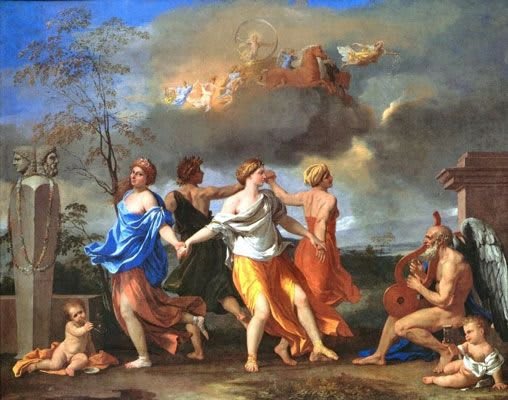
Poussin's work was deeply influenced by classical antiquity, especially Roman frescoes and Greek sculptures.
He valued harmony, proportion, and clarity in the representation of his themes.
His paintings often featured idealized figures in serene and timeless landscapes.
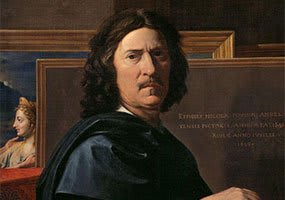
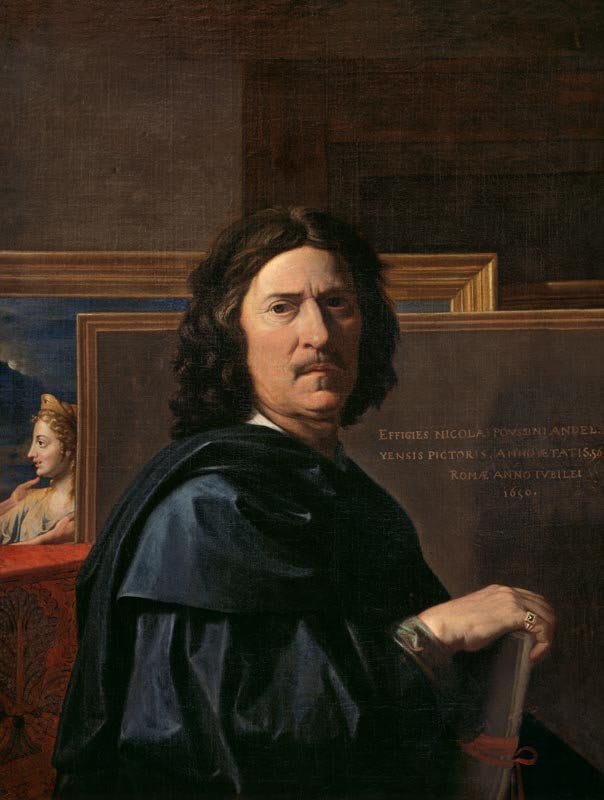
Self-Portrait - Poussin presents himself with a stole thrown over his shoulders.
His posture is firm, and his head is turned towards the viewer.
His expression is intense, and the background is his own studio.
On the canvas, there is an inscription that reads: 'Portrait of Nicolas Poussin of Les Andalys, made in Rome during the year of the Jubilee of 1650, with 56 years'.
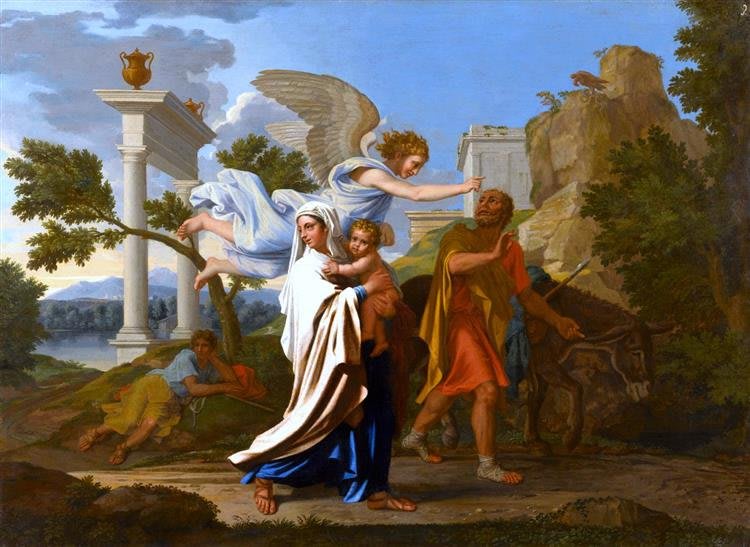
The Flight into Egypt - Poussin painted this work in 1657.
The work is considered one of the most important of his career.
The painting depicts the flight of the Israelites from Egypt and is characterized by its careful composition and balance.