
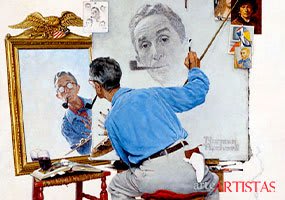
Norman Rockwell
Norman Rockwell
Rockwell presented to the world the definitive image of what it meant to be "all-American." He was an important artist who worked as an illustrator and painter, belonging to American Realism.
Norman Percevel Rockwell was born on February 3, 1894, in New York, United States. He is primarily remembered for his 47-year association with the The Saturday Evening Post which was published weekly, for whom he produced more than 320 cover images, and his long-standing connection with the Boy Scouts of America, for whom he provided works for their annual calendar for most of his working years. His concern with the minutiae of everyday life of the American nuclear family, not to mention his vital contribution to the propaganda effort of World War II, led him to achieve the status of an American icon.
Many define him as an illustrator, yet the artist always preferred to be considered a genre painter. He is perhaps best known for a particular type of painting rather than specific works and, not unlike Edward Hopper, his vision of small-town America permeated the nation's collective consciousness. While his visible patriotism and pictorial style made him an easy target for avant-gardists and left-wing intellectuals, his later works revealed the influence of Social Realism and several of his pieces, especially those he produced for Look Magazine, took on a more socio-political edge. History has, rightfully, tended to greatly appreciate his contribution to the pictorial arts in America, and his nostalgic images continue to adorn calendars, postcards, posters, and other artistic ephemera.
A religious and traditional thinker, Rockwell was above all a patriot. His vision was sympathetic and optimistic, and he, more than any other artist in his history, captured the daily customs and rituals of the graceful forms of traditional American family life.
The artist executed his scenes with humor and respect for his subjects, and with an attention to detail that, in his words, would make the viewer want to sigh and smile simultaneously. Painting at a time when abstract art was gaining prominence, Rockwell remained convinced that his positive and unambiguous images surpassed abstract experimentation.
DEATH & LEGACY
Norman Rockwell passed away at 84 years old due to pulmonary emphysema, on November 8, 1978, in Stockbridge, Massachusetts.
Rockwell had a lasting and profound effect on his country's self-image. He is arguably considered the American public's favorite painter of all time. His images, still widely reproduced today, are seen almost as hymns to a lost era of suburban America in the 20s, 30s, 40s, and 50s, providing reference material for Hollywood directors, including George Lucas and Steven Spielberg.
FEATURED ARTWORK
This painting was originally created for a magazine to exemplify the goodwill of a Red Cross man, seen here in the form of a scout attending to a small dog that had suffered an injury. Rockwell, always a keen observer of his world and its issues, captured the realities of individual lives, as well as the customs cherished by society. In many of his paintings, he promotes personal responsibility, patriotism, heroism, gender equity, and/or racial integration, which he saw as the foundations of the American way.
The composition, meticulously and rigorously planned, was staged in real life at a café near Times Square in Manhattan. In fact, Rockwell first brought the café's furniture to his studio and took photographs to use as later reference. He used the photographic technique of deep focus for the staging. A middle-aged woman and a boy, seated at a crowded table in a noisy diner, take a moment to pray before eating. The two young people seated at the table stare at them, while other customers also turn to observe them. This was the artist's message: we share a world where many different people exist, and we can live in harmony if we respect each other's beliefs. Rockwell clearly felt that the American people had a collective source of strength and a heartfelt prayer of gratitude for the gift of love.
Considered his most famous work, Happy Birthday, Miss Jones was created for one of the numerous covers in which he illustrated for the magazine The Saturday Evening Post. In it, the artist captures the affection that exists between teachers and their students.
In this painting, we have the portrait of Ruby Nell Bridges, a six-year-old African-American girl, in a scene being escorted to her school in New Orleans on her first day by four United States marshals. The William Franz Elementary School in question was one of two all-white public schools where desegregation was implemented in 1960. As a consequence, school personnel experienced racial unrest and death threats against the Black children. It took more than ten years for New Orleans public schools to fully integrate, and even longer for local Catholic schools to follow suit. People of all kinds across the country were paying attention; despite entrenched prejudices against his "conservative" perspective, Norman Rockwell demonstrated that he could indeed generate strong emotions through the dissemination of this work, and he succeeded.
GALLERY OF SELECTED WORKS
Boy and Girl Gazing at the Moon. Norman Rockwell. 1926
The Veterinarian. Norman Rockwell. 1952
Self-Portrait. 1960


