
Wassily Kandinsky: The Journey from Abstraction to Bauhaus
Follow the artistic evolution of Kandinsky, from the founding of the Blue Rider group and his development towards pure abstraction, through the influence of World War I and his teaching period at the iconic Bauhaus school.
Article Index
The First World War brought Kandinsky back to Russia, where his artistic vision was influenced by the constructivist movement, based on hard lines, dots, and geometry.
While Kandinsky explored geometry in Russia, other artists were redefining the avant-garde through the lens of Dadaism. Max Ernst: Early Years and the Dadaist Revolution
While there, Kandinsky, then 50 years old, met the young Nina von Andreewsky, daughter of a Russian army general, and married her.
They had a son, but the boy lived for only three years, and the theme of children became a taboo.
The couple remained in Russia after the revolution, with Kandinsky applying his restless and far-reaching energies to the administration of government-sponsored art education programs.
He helped create the Moscow Institute of Artistic Culture and the Museum of Pictorial Culture.
Back in Germany after theoretically clashing with other artists, he began teaching at the Bauhaus school in Berlin and wrote plays and poems.
During this period, he wrote his second major book, a continuation of his first: Point and Line on a Plane.
Meanwhile, his teaching and work gained significant visibility and acceptance.
Several exhibitions of his paintings were organized, including those in Paris in 1929 and 1930.
In 1933, when the Nazis took power, the stormtroopers closed the Bauhaus school.
Although Kandinsky had gained German citizenship, with the Second World War it became impossible for him to remain in Germany.
Even so, with the innovative method already widely disseminated, his teaching model was implemented in the world's major art centers.
Today, institutions based on the Bauhaus model exist, such as the Harvard University in the United States.
During its existence (1919-1933), the Bauhaus dedicated itself to testing new artistic conceptions in various areas – architecture, plastic arts, sculpture, and design –, becoming a major center of modernism and functionalism studies.
The functional idea that 'form follows function' solidified the current that would mark the image of 20th-century design.
Kandinsky’s focus on the emotional power of color shares deep roots with earlier 20th-century movements that prioritized expression over reality. Fauvism
In July 1937, he and other artists participated in the 'Exhibition of Degenerate Art' in Munich.
Of the works exhibited, 57 of his works were confiscated by the Nazis.
Kandinsky and Nina moved to the Paris suburb at the end of the 1930s, when Marcel Duchamp found a small apartment for them.
When the Germans invaded France in 1940, Kandinsky fled to the Pyrenees, but then returned to Neuilly, where he lived a rather isolated life, depressed by his paintings not selling.
Although still considered controversial by many, he gained prominent defenders like Solomon Guggenheim and continued to exhibit until his death.
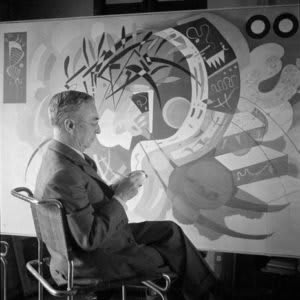
Wassily Kandinsky died of a cerebral hemorrhage in Neuilly-sur-Seine, a residential district of Paris, France.
He died on December 13, 1944.
Little of Kandinsky's work from his time in Russia survived, although many of the paintings he created in Germany still exist.
Fifteen years after his death, his name would be the key and password for abstract art and the fundamental platform for the artistic movement for two consecutive decades.
In 1955, thanks to the dedication of Max Bill, a disseminator of the great artist's work, his posthumous collection of essays was published under the title 'Ueber Kunst und Künstler' (On Art and the Artist).
In 1981, his widow, Nina, who had already donated part of the works, completed the legacy of works to the Musée National d'Art Moderne de Paris.
In November 1984, the Centre Pompidou in Paris exhibited the largest exhibition of Kandinsky's works: fifty-nine paintings, plus the library and instruments used by the great artist, one of the keys to the turbulent 20th century.
Wassily Kandinsky: Life and Work
Wassily Kandinsky is considered by some to be the first non-representational painter to achieve complex compositions solely with almost unrecognizable objects.
Much of his study was self-directed.
He began with conventional themes, but throughout his time he was forming theories derived from dedicated and informed spiritual study and an intense relationship between music and color.
These theories merged in the first decade of the 20th century, leading him to his final status as the father of Abstract Art.
Kandinsky perceived the emotional power of music in the 1890s, when he attended a performance of Lohengrin, an opera by Richard Wagner.
Years later, he became friends with Arnold Schönberg, whose twelve-tone composition method represented a decisive change in 20th-century music.
His works were associated with the expressionist movements, allowing sounds to remain dissonant and unresolved, respecting conventional structures to give meaning to the composition.
In the same way, Kandinsky replaced representation with abstraction.
Kandinsky believed that each period of time leaves its indelible mark on artistic expression.
His vivid interpretations of color through musical and spiritual sensitivity certainly altered the artistic landscape at the beginning of the 20th century, precipitating the modern era.
Kandinsky, along with Piet Mondrian and Kasimir Malevich, forms the so-called 'holy trinity of abstraction', with him being the most famous.
Aside from being a painter, he also left brilliant, abstract poems that referred to colors and lines, such as those that appeared in the artist's perception and genius.
The journey from representational origins to pure abstract language is a path shared by many influential artists of the century. Tomie Ohtake - Biography and Art: A Journey from Immigration to Abstraction
Leaving a Legacy
To understand the rest of this journey, continue to our next article: Wassily Kandinsky: The Legacy and Pioneering Works of Abstract Art.


