Oskar Kokoschka
Oskar Kokoschka was an Austrian painter and writer, considered one of the most important exponents of German Expressionism and one of the most important artists of the 20th century.
Oskar Kokoschka was an Austrian painter and writer, considered one of the most important exponents of German Expressionism and one of the most important artists of the 20th century.
He is known for his vibrant and expressive works, which often feature themes such as love, sex, death, and violence.
He also wrote poetry, plays, and essays on art.
BIOGRAPHY
Oskar Kokoschka was born on March 1, 1880, in Pöchlarn, a small town on the Danube, near Vienna, Austria.
Asked about his childhood, he said he was a very happy child and that his father gave him books that formed him as a man and an artist.
Among those books was a shortened version of The Painted World of Sensual, a 1658 children's textbook written by the Czech educator John Amos Comenius.
From them, he began to appreciate classical literature and the arts.
In Vienna, he attended the Realschule, an institution where science and language were emphasized.
However, his interests were strongly focused on the arts and classical literature.
At 18, he entered the Kunstgewerbeschule, the Vienna University of Applied Arts.
Most of the school's professors belonged to the Vienna Secession, which in its early years adopted the styles of Art Nouveau.
During this period, he developed his own style, and his first oil paintings date back to 1905 and 1906.
In 1907, he became a member of a pioneering alliance of artists and designers in modern design.
That same year, he participated as a graphic designer of postcards, exhibits, and children's drawings, in which he often included the human figure as a decorative motif.
In 1908, Gustav Klimt, the main secessionist, included Kokoschka in his exhibition at the Kunstchau, and was admired for the talent of this young artist.
During this period, he met the architect Adolf Loos, who became his patron and lawyer.
In 1909, Kokoschka was expelled from the university after the presentation of his sinister and violent play - Assassin, the Hope of Women - caused a commotion.
Thanks to Loos' support, the following year the artist traveled to Switzerland, where he painted landscapes and portraits of aristocrats suffering from tuberculosis in the Leysin sanatorium, a community in Switzerland.
In 1912, he met Alma Malher, the widow of the famous composer Gustav Mahler, and they had a torrid affair that would become a great source of inspiration and torment in his life.
He asked her to marry him several times, but Mahler always refused, eventually leaving him for the famous architect of the Bauhaus, Walter Gropius.
The three years he lived with Alma were a single and intense battle of love.
He declared: "I never experienced so much tension, so much hell, so much paradise."
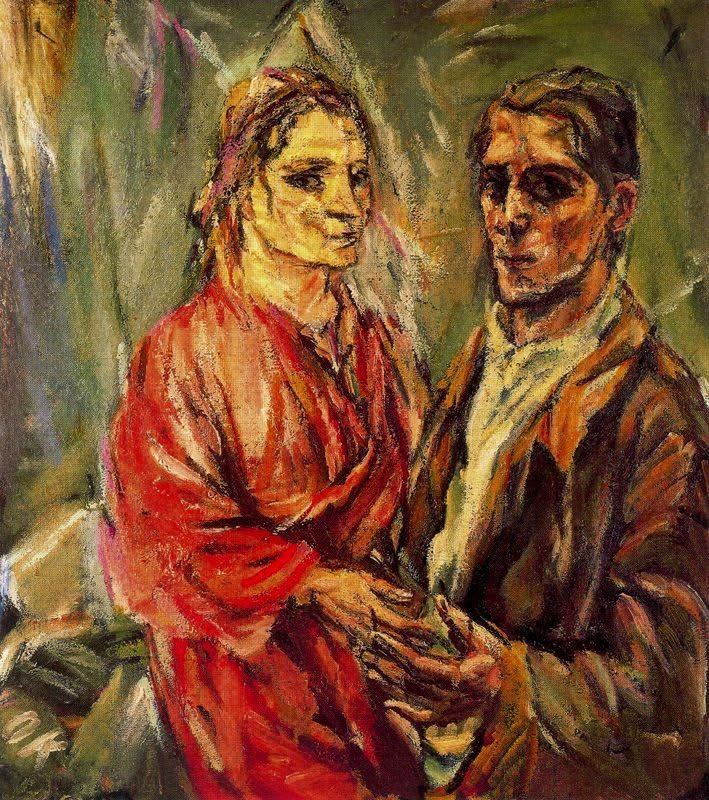
During the time they spent together, the artist painted many portraits of the couple, including Double Portrait of Oskar Kokoschka and Alma Mahler.
In 1915, after Mahler had an abortion, the artist was very sad and decided to join the army to fight in World War I.
During this period, he was called up for military service and was eventually wounded in combat, which affected his physical and mental health.
Kokoschka was wounded twice during the war: in Ukraine, when a bullet passed through his head, and again in Russia, when he was stabbed in the chest with a bayonet.
He miraculously survived both injuries, but suffered from headaches and hallucinations for many years after.
He said: "The war was terrible, I didn't know if I would ever come out alive, but if I came out, I would climb to the highest peak to see what motivates people to sacrifice their lives without reason."
During his convalescence in Vienna and later in Dresden, he wrote several plays, including Orpheus and Eurydice, in 1918, about his war experiences.
During the 1920s, Kokoschka was a professor at the Dresden Academy and traveled extensively throughout Europe, North Africa, and the Middle East, painting mainly landscapes.
In 1934, in the midst of the growing Nazi power, Kokoschka traveled to Prague, where he met his future wife, Olda.
There, he was commissioned to paint a portrait of the philosopher Tomáš G. Masaryk, president of Czechoslovakia.
The two men became friends and often discussed the 17th-century philosopher Comenius.
In 1935, Kokoschka acquired Czech citizenship.
In 1937, the Nazis declared Kokoschka a degenerate artist, in the infamous Exhibition of Degenerate Art, which were seen alongside works by Wassily Kandinsky, Paul Klee, and Egon Schiele.
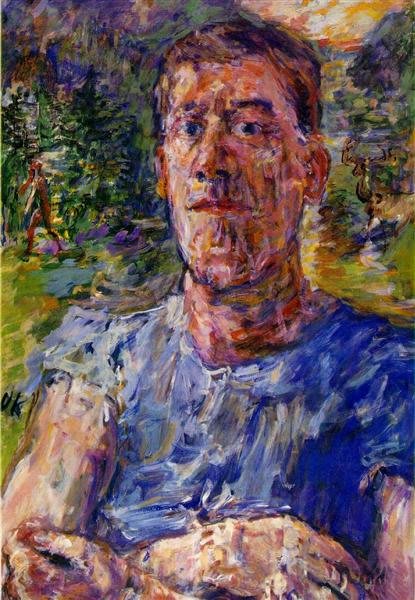
As a response, he painted the challenging Portrait of a Degenerate Artist during one of his stays at Olda's parents' house in the outskirts of Prague.
Persecuted by the Germans, after the Munich Agreement, he and Olda escaped the impending invasion of Czechoslovakia and fled to London.
There, he participated in the exhibition German Art of the 20th Century with twenty-two works.
From London, the couple moved to Cornwall, where he painted a series of landscapes, which often contain allegorical political questions questioning the immobility of England and other European countries in the face of Nazi advancement and the terrible situation of refugees.
In the early 1940s, Oskar and Olda moved again, this time to Scotland and northern Wales, where he continued to make landscapes, often using wax crayons.
In 1943, they returned to London and, at the end of World War II, obtained British citizenship.
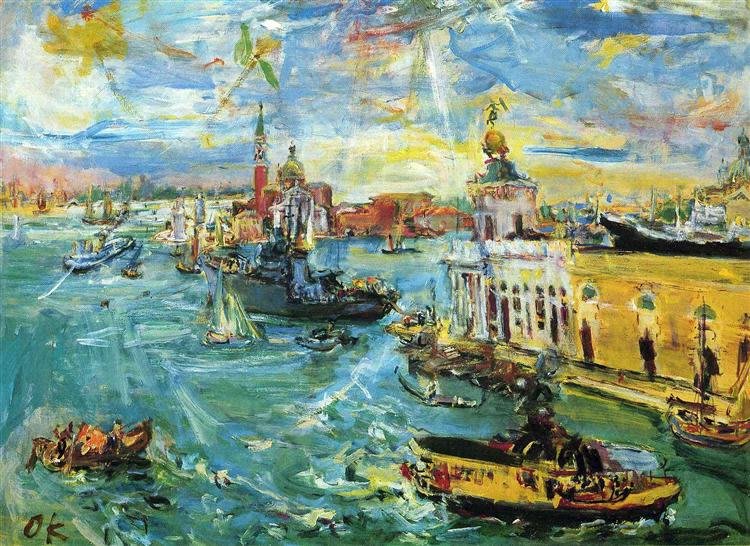
At the end of the decade, he participated in the Venice Biennale, representing Austria with sixteen paintings.
In 1954, he painted a second mythological triptych, Thermopylae, for the University of Hamburg, and during the 1950s and 1960s worked increasingly with lithography, tapestries, stage designs, and costumes for theater.
In 1960, the University of Oxford awarded him an honorary doctorate, and in 1962, the Tate Gallery held his first British retrospective.
In 1974, he wrote an autobiography titled My Life. Despite his poor eyesight, he continued to paint until he was 90 years old.
He died in a clinic at the age of 93 on February 22, 1980.
GALLERY - COMMENTED ART
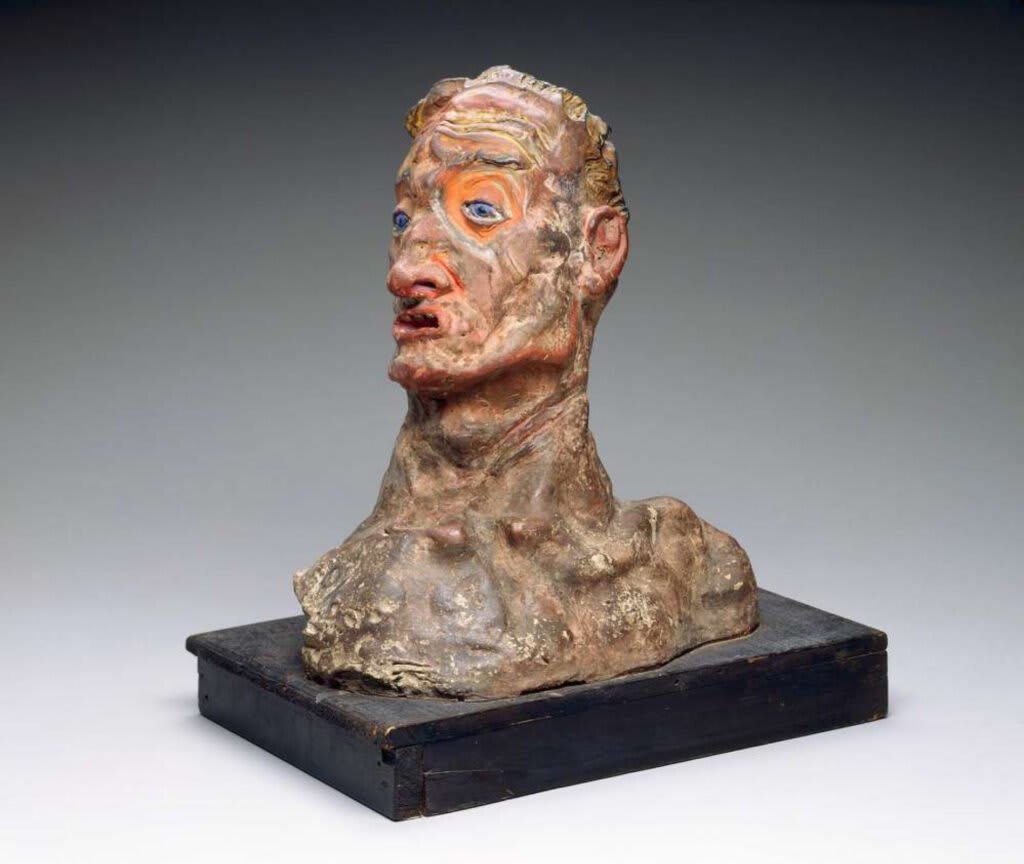
Self-Portrait as a Warrior - The fact that Kokoshka imagined himself as a warrior, along with his aggressive attacks on academic norms, intrigued the Viennese architect Alfred Loos, who immediately bought the sculpture when he saw it.
In it, the artist affirms his commitment to an expressionist art. It's as if he pulled his own skin to reveal nerves and flesh in living flesh.
The densely modeled clay, with incised lines, would find its counterpart in his portraits of the same period.
Kokoschka commented: "When I saw a Polynesian mask with its incised tattoo, I immediately understood, because I could feel my own facial nerves reacting to the cold and hunger in the same way."
Kokoschka's sculpture and painting did everything in their power to cause discomfort and alarm.